



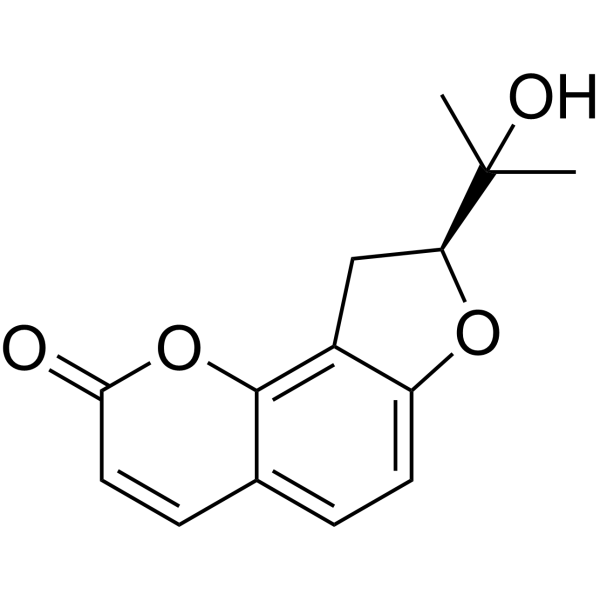
(+)-Columbianetin
Based on 2 publication(s) in Google Scholar
(+)-Columbianetin ((S)-Columbianetin) acts as an inhibitor of JNK/ERK. (+)-Columbianetin inhibits UVA-induced phosphorylation of JNK and ERK, reduces the production of MMP-1, reverses UVA-induced Collagen (HY-NP003) degradation, and alleviates UVA-mediated inhibition of Smad2/3 phosphorylation and translocation. (+)-Columbianetin regulates the AP-1 and ASK1-MAPK signaling pathways, inhibits the production of ROS and blocks sub-G1 cell cycle arrest. (+)-Columbianetin is applicable to research related to skin aging.
For research use only. We do not sell to patients.
- Purity : 99.30%
- CAS No.: 3804-70-4
- Formula: C14H14O4
- Molecular Weight:246.26
-
Storage:
4°C, protect from light
* In solvent : -80°C, 6 months; -20°C, 1 month (protect from light)

To place orders, for customer services and technical support, please contact: MedChemExpress USA
Tel: 609-228-6898 E-mail: [email protected] [email protected]


-
 Biological Activity
-
Chemical Information
-
Solvent & Solubility
- Protocols
- Purity & Documentation
- References
-
 Help & FAQs



Publications Citing Use of MedChemExpress (MCE) (+)-Columbianetin
More

Biological Activity
Description
In Vitro
(+)-Columbianetin (1-25 μM; 48 h) exhibits dose-dependent cytotoxicity in human dermal fibroblasts with an IC50 of 93.89 μM, and maintains >90% cell viability at concentrations up to 10 μM after 48 h incubation[1].
(+)-Columbianetin (1-10 μM) dose-dependently suppresses UVA (10 J/cm2)-induced reactive nitrogen species generation in human dermal fibroblasts[1].
(+)-Columbianetin (1-10 μM; 24 h) dose-dependently reverses UVA (10 J/cm2)-induced changes in human dermal fibroblasts, reducing MMP-1 release to 19,094 pg/mL and increasing type Iα1 pro-collagen release to 1,955 pg/mL at 10 μM after 24 h incubation[1].
(+)-Columbianetin (1-10 μM; 24 h) dose-dependently reverses UVA (10 J/cm2)-induced changes in human dermal fibroblasts, suppressing MMP-1 gene expression and increasing type I pro-collagen gene expression after 24 h incubation[1].
(+)-Columbianetin (1-10 μM; 48 h) dose-dependently reverses UVA (10 J/cm2)-induced changes in human dermal fibroblasts, suppressing MMP-1 protein expression and increasing type I pro-collagen and collagen protein expression after 48 h incubation[1].
(+)-Columbianetin (10 μM; 24 h) suppresses UVA (10 J/cm2)-induced phosphorylation of JNK and ERK, but not p38, in human dermal fibroblasts after 24 h incubation[1].
(+)-Columbianetin (10 μM; 24 h) reverses UVA (10 J/cm2)-induced changes in the TGFβ pathway in human dermal fibroblasts, increasing p-Smad2/3 and Smad4 protein levels and decreasing Smad7 protein levels after 24 h incubation[1].
(+)-Columbianetin (10 μM; 24 h) increases nuclear levels of p-Smad2/3 and Smad4, reversing UVA (10 J/cm2)-induced reductions in human dermal fibroblasts after 24 h incubation[1].
(+)-Columbianetin (1-20 μM; 24 h) dose-dependently increases the viability of UVB-exposed HaCaT cells, with near-full viability restoration at 20 μM after 24 h of treatment[2].
(+)-Columbianetin (1-20 μM; 24 h) dose-dependently reduces UVB-induced cell injury in HaCaT cells, with LDH release suppressed to ~20% of positive control levels at 20 μM after 24 h of treatment[2].
(+)-Columbianetin (1-20 μM; 2 h) dose-dependently scavenges H2O2-induced intracellular ROS in HaCaT cells, with ROS generation reduced to ~72% of H2O2-only levels at 20 μM after 2 h of treatment[2].
(+)-Columbianetin (1-20 μM; 24 h) dose-dependently scavenges UVB-induced intracellular ROS in HaCaT cells, with ROS generation reduced to ~72% of UVB-only levels at 20 μM after 24 h of treatment[2].
(+)-Columbianetin (1-20 μM; 24 h) dose-dependently reduces UVB-induced sub-G1 phase cell cycle arrest in HaCaT cells, with sub-G1 phase cell percentage lowered to 10.62% at 20 μM after 24 h of treatment[2].
(+)-Columbianetin (1-20 μM; 24 h) dose-dependently regulates UVB-altered gene expression of MMP-2, MMP-9, TIMP-1, and TIMP-2 in HaCaT cells after 24 h of treatment[2].
(+)-Columbianetin (1-20 μM; 24 h) dose-dependently regulates UVB-altered protein expression of MMP-2, MMP-9, TIMP-1, and TIMP-2 in HaCaT cells after 24 h of treatment[2].
(+)-Columbianetin (1-20 μM; 24 h) dose-dependently inhibits UVB-induced phosphorylation of p38, JNK, and ERK MAPKs in HaCaT cells, with the greatest inhibition observed at 20 μM after 24 h of treatment[2].
(+)-Columbianetin (1-20 μM; 24 h) dose-dependently inhibits UVB-induced phosphorylation of ASK1 in HaCaT cells, with p-ASK1 levels reduced to ~80% of UVB-only levels at 20 μM after 24 h of treatment[2].
(+)-Columbianetin (1-20 μM; 24 h) dose-dependently inhibits UVB-induced activation of the AP-1 component c-fos in HaCaT cells, with c-fos levels reduced to ~80% of UVB-only levels at 20 μM after 24 h of treatment[2].
(+)-Columbianetin (1-20 μM; 24 h) dose-dependently inhibits UVB-induced phosphorylation of p53 and upregulation of Bax in HaCaT cells, with the greatest inhibition observed at 20 μM after 24 h of treatment[2].
MedChemExpress (MCE) has not independently confirmed the accuracy of these methods. They are for reference only.
-
Cell Line:UVA-irradiated human dermal fibroblasts (HDFs)
-
Concentration:1 μM; 5 μM; 10 μM
-
Incubation Time:24 h
-
Result:Reduced UVA-increased MMP-1 levels from 20,849 pg/mL to 19,094 pg/mL at 10 μM.
Increased UVA-decreased type Iα1 pro-collagen levels from 1,753 pg/mL to 1,955 pg/mL at 10 μM.
-
Cell Line:UVA-irradiated human dermal fibroblasts (HDFs)
-
Concentration:1 μM; 5 μM; 10 μM
-
Incubation Time:24 h
-
Result:Dose-dependently suppressed UVA-increased MMP-1 mRNA expression.
Dose-dependently increased UVA-decreased type I pro-collagen mRNA expression.
-
Cell Line:UVA-irradiated human dermal fibroblasts (HDFs)
-
Concentration:1 μM; 5 μM; 10 μM
-
Incubation Time:48 h
-
Result:Dose-dependently suppressed UVA-increased MMP-1 protein expression.
Dose-dependently increased UVA-decreased type I pro-collagen and collagen protein expression.
-
Cell Line:UVA-irradiated human dermal fibroblasts (HDFs)
-
Concentration:10 μM
-
Incubation Time:24 h
-
Result:Suppressed UVA-induced phosphorylation of JNK and ERK.
Did not significantly affect UVA-induced phosphorylation of p38.\nIncreased UVA-decreased p-Smad2/3 and Smad4 protein levels.
Decreased UVA-increased Smad7 protein levels.\nIncreased nuclear levels of p-Smad2/3 and Smad4, reversing UVA-induced reductions.
-
Cell Line:UVB-exposed human keratinocyte (HaCaT) cells
-
Concentration:1 μM; 5 μM; 20 μM
-
Incubation Time:24 h
-
Result:Reduced UVB-induced upregulation of MMP-2 and MMP-9 gene expression in a dose-dependent manner.
Inhibited UVB-induced downregulation of TIMP-1 and TIMP-2 gene expression in a dose-dependent manner.
- Kinase activity and phosphorylation assays
- Western Blot
- Mitochondrial membrane-potential fluorescent assay
- Flow cytometric DNA-content cell-cycle staining
- ROS/oxidative-stress fluorescent staining
- BrdU Incorporation Assay
- Mitochondrial membrane-potential and mitochondrial mass staining
- Protocol for Cell Cycle
- Protocol for Kinase activity and phosphorylation assays


Chemical Information
-
CAS No. 3804-70-4
-
Appearance Solid
-
Molecular Weight 246.26
-
Formula C14H14O4
-
Color Off-white to light yellow
-
SMILES
O=C1C=CC2=CC=C(O[C@H](C(C)(O)C)C3)C3=C2O1
-
Synonyms
(S)-Columbianetin
-
Structure Classification
-
Shipping
Room temperature in continental US; may vary elsewhere.
-
Storage
4°C, protect from light
* In solvent : -80°C, 6 months; -20°C, 1 month (protect from light)


Publications (2)
-
Journal Impact Factor
-
Most Recent


Solvent & Solubility
In Vitro:
DMSO : 100 mg/mL (406.07 mM; Need ultrasonic; Hygroscopic DMSO has a significant impact on the solubility of product, please use newly opened DMSO)
Please refer to the solubility information to select the appropriate solvent. Once prepared, please aliquot and store the solution to prevent product inactivation from repeated freeze-thaw cycles.
Storage method and period of stock solution: -80°C, 6 months; -20°C, 1 month (protect from light). When stored at -80°C, please use it within 6 months. When stored at -20°C, please use it within 1 month.
Please refer to the solubility information to select the appropriate solvent. Once prepared, please aliquot and store the solution to prevent product inactivation from repeated freeze-thaw cycles.
Storage method and period of stock solution: -80°C, 6 months; -20°C, 1 month (protect from light). When stored at -80°C, please use it within 6 months. When stored at -20°C, please use it within 1 month.
Concentration (start) × Volume (start) = Concentration (final) × Volume (final)
In Vivo:
Select the appropriate dissolution method based on your experimental animal and administration route.
- For the following dissolution methods, please ensure to first prepare a clear stock solution using an In Vitro approach and then sequentially add co-solvents:
- To ensure reliable experimental results, the clarified stock solution can be appropriately stored based on storage conditions. As for the working solution for In Vivo experiments, it is recommended to prepare freshly and use it on the same day.
- The percentages shown for the solvents indicate their volumetric ratio in the final prepared solution. If precipitation or phase separation occurs during preparation, heat and/or sonication can be used to aid dissolution.
Add each solvent one by one: 10% DMSO 40% PEG300 5% Tween-80 45% Saline
Solubility: ≥ 2.5 mg/mL (10.15 mM); Clear solution
This protocol yields a clear solution of ≥ 2.5 mg/mL (saturation unknown).
Taking 1 mL working solution as an example, add 100 μL DMSO stock solution (25.0 mg/mL) to 400 μL PEG300, and mix evenly; then add 50 μL Tween-80 and mix evenly; then add 450 μL Saline to adjust the volume to 1 mL.
Preparation of Saline: Dissolve 0.9 g sodium chloride in ddH₂O and dilute to 100 mL to obtain a clear Saline solution.
Add each solvent one by one: 10% DMSO 90% (20% SBE-β-CD in Saline)
Solubility: ≥ 2.5 mg/mL (10.15 mM); Clear solution
This protocol yields a clear solution of ≥ 2.5 mg/mL (saturation unknown).
Taking 1 mL working solution as an example, add 100 μL DMSO stock solution (25.0 mg/mL) to 900 μL 20% SBE-β-CD in Saline, and mix evenly.
Preparation of 20% SBE-β-CD in Saline (4°C, storage for one week): 2 g SBE-β-CD powder is dissolved in 10 mL Saline, completely dissolve until clear.
In Vivo Dissolution Calculator
Please enter the basic information of animal experiments:
-
-
-
-
Recommended: Prepare an additional quantity of animals to account for potential losses during experiments.
Please enter your animal formula composition:
-
%DMSO +
Recommended: Keep the proportion of DMSO in working solution below 2% if your animal is weak.
-
%+
-
+%Tween-80 + +
-
%Saline +
The co-solvents required include: DMSO, . All of co-solvents are available by MedChemExpress (MCE). , Tween 80. All of co-solvents are available by MedChemExpress (MCE).
Working solution concentration: 0.22 mg/mL
Method for preparing stock solution: mg drug dissolved in μL DMSO. Stock solution concentration: mg/mL. * In solvent : -80°C, 6 months; -20°C, 1 month (protect from light)
1. Take μL DMSO stock solution;
2. Add μL .
μL , mix evenly;
3. Then add μL Tween 80, mix evenly;
4. Then add μL
Please ensure that the stock solution in the first step is dissolved to a clear state, and add co-solvents in sequence. You can use ultrasonic heating (ultrasonic cleaner, recommended frequency 20-40 kHz), vortexing, etc. to assist dissolution.


Purity & Documentation
-
Data Sheet (287 KB)
-
SDS (393 KB)
- English - EN (393 KB)
- Français - FR (393 KB)
- Deutsch - DE (393 KB)
- Norwegian - NO (393 KB)
- Español - ES (393 KB)
- Swedish - SV (393 KB)
- Italian - IT (393 KB)
- Korean - KR (393 KB)
- Portuguese - PT (393 KB)
-
Handling Instructions (2659 KB)
References


Complete Stock Solution Preparation Table
Please refer to the solubility information to select the appropriate solvent. Once prepared, please aliquot and store the solution to prevent product inactivation from repeated freeze-thaw cycles.
Storage method and period of stock solution: -80°C, 6 months; -20°C, 1 month (protect from light). When stored at -80°C, please use it within 6 months. When stored at -20°C, please use it within 1 month.
| Optional Solvent | Concentration Solvent Mass | 1 mg | 5 mg | 10 mg | 25 mg |
|---|---|---|---|---|---|
| DMSO | 1 mM | 4.0607 mL | 20.3037 mL | 40.6075 mL | 101.5187 mL |
| 5 mM | 0.8121 mL | 4.0607 mL | 8.1215 mL | 20.3037 mL | |
| 10 mM | 0.4061 mL | 2.0304 mL | 4.0607 mL | 10.1519 mL | |
| 15 mM | 0.2707 mL | 1.3536 mL | 2.7072 mL | 6.7679 mL | |
| 20 mM | 0.2030 mL | 1.0152 mL | 2.0304 mL | 5.0759 mL | |
| 25 mM | 0.1624 mL | 0.8121 mL | 1.6243 mL | 4.0607 mL | |
| 30 mM | 0.1354 mL | 0.6768 mL | 1.3536 mL | 3.3840 mL | |
| 40 mM | 0.1015 mL | 0.5076 mL | 1.0152 mL | 2.5380 mL | |
| 50 mM | 0.0812 mL | 0.4061 mL | 0.8121 mL | 2.0304 mL | |
| 60 mM | 0.0677 mL | 0.3384 mL | 0.6768 mL | 1.6920 mL | |
| 80 mM | 0.0508 mL | 0.2538 mL | 0.5076 mL | 1.2690 mL | |
| 100 mM | 0.0406 mL | 0.2030 mL | 0.4061 mL | 1.0152 mL |


(+)-Columbianetin Related Classifications
HY-N0363 Related Classifications
 Powered by Bioz