



DSG3 Protein, Human (sf9, His)
Based on 1 Customer Validation
DSG3 is a component of intercellular desmosome junctions and plays a key role in promoting intercellular adhesion by participating in important interactions with plaque proteins and intermediate filaments. Carefully orchestrated interactions between DSG3 and these structural elements are critical for maintaining the integrity and strength of cell-to-cell connections. DSG3 Protein, Human (sf9, His) is the recombinant human-derived DSG3 protein, expressed by sf9 insect cells , with C-6*His labeled tag.
- Species: Human
- Source: Sf9 insect cells
-
Storage:Stored at -20°C for 2 years from date of receipt. After reconstitution, it is stable at 4°C for 1 week or -20°C for longer (with carrier protein). It is recommended to freeze aliquots at -20°C or -80°C for extended storage.


To place orders, for customer services and technical support, please contact: MedChemExpress USA
Tel: 609-228-6898 E-mail: [email protected] [email protected]


-
 Biological Activity
-
Technical Parameters
-
Product Properties
- Documentation
- Help & FAQs




Biological Activity
Description
DSG3 is a component of intercellular desmosome junctions and plays a key role in promoting intercellular adhesion by participating in important interactions with plaque proteins and intermediate filaments. Carefully orchestrated interactions between DSG3 and these structural elements are critical for maintaining the integrity and strength of cell-to-cell connections. DSG3 Protein, Human (sf9, His) is the recombinant human-derived DSG3 protein, expressed by sf9 insect cells , with C-6*His labeled tag.
Background
Desmoglein-3 (DSG3) is an integral component of intercellular desmosome junctions, playing a crucial role in mediating cell-cell adhesion. Functioning within these junctions, DSG3 is involved in the interaction between plaque proteins and intermediate filaments, contributing to the structural integrity and stability of tissues. Notably, DSG3 interacts with Plakophilin-2 (PKP2), emphasizing its role in coordinating the assembly and maintenance of desmosomal complexes. This interaction further highlights the intricate molecular network involved in cell-cell adhesion and reinforces the importance of DSG3 in ensuring the proper function and structural cohesion of tissues through its engagement in desmosomal signaling pathways. (
Verified Bioactivity
Measured by its binding ability in a functional ELISA. Immobilized Human DSG3 at 2 μg/mL can bind Anti-DSG3 recombinant antibody, the EC50 is <5.720 ng/mL.
MCE Validation Data
-
Purity - SDS-PAGE
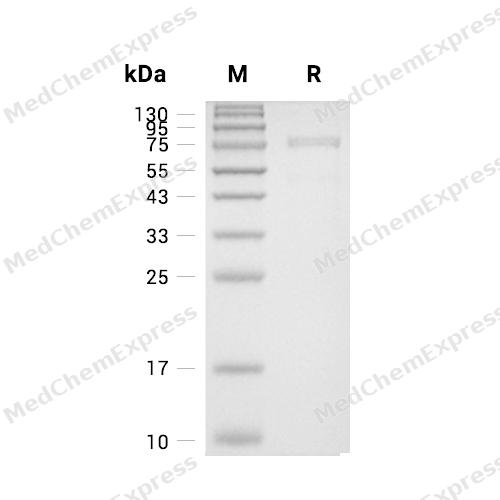
Purity - SDS-PAGE
-
Bioactivity - ELISA
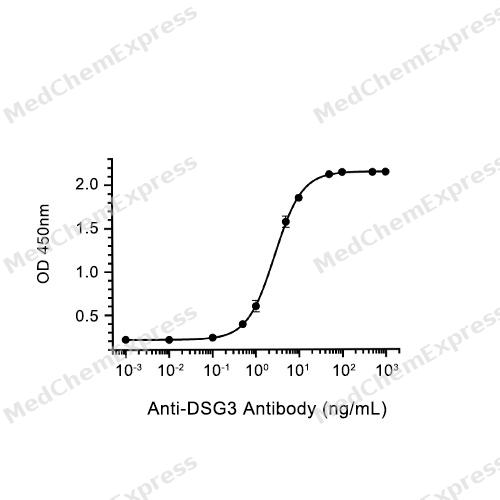
Bioactivity - ELISA


Technical Parameters
-
Species Human
-
Source Sf9 insect cells
-
Tag C-6*His
-
Accession
P32926 (E50-R615)
-
Molecular Construction
-
N-term
-
DSG3 (E50-R615)
Accession # P32926 -
6*His
-
C-term
-
-
Protein Length
Extracellular Domain
-
Synonyms
DSG3; Desmoglein-3; Desmoglein 3; PVA; CDHF6; Desmoglein 3 (Pemphigus Vulgaris Antigen); 130 KDa Pemphigus Vulgaris Antigen; Pemphigus Vulgaris Antigen; Cadherin Family Member 6; ABOLM
-
AA Sequence
EWVKFAKPCREGEDNSKRNPIAKITSDYQATQKITYRISGVGIDQPPFGIFVVDKNTGDINITAIVDREETPSFLITCRALNAQGLDVEKPLILTVKILDINDNPPVFSQQIFMGEIEENSASNSLVMILNATDADEPNHLNSKIAFKIVSQEPAGTPMFLLSRNTGEVRTLTNSLDREQASSYRLVVSGADKDGEGLSTQCECNIKVKDVNDNFPMFRDSQYSARIEENILSSELLRFQVTDLDEEYTDNWLAVYFFTSGNEGNWFEIQTDPRTNEGILKVVKALDYEQLQSVKLSIAVKNKAEFHQSVISRYRVQSTPVTIQVINVREGIAFRPASKTFTVQKGISSKKLVDYILGTYQAIDEDTNKAASNVKYVMGRNDGGYLMIDSKTAEIKFVKNMNRDSTFIVNKTITAEVLAIDEYTGKTSTGTVYVRVPDFNDNCPTAVLEKDAVCSSSPSVVVSARTLNNRYTGPYTFALEDQPVKLPAVWSITTLNATSALLRAQEQIPPGVYHISLVLTDSQNNRCEMPRSLTLEVCQCDNRGICGTSYPTTSPGTRYGRPHSGR
-
Molecular Weight
Approximately 74 kDa, based on SDS-PAGE under reducing conditions, due to the glycosylation.
-
Glycosylation
Yes
-
Purity
≥ 95%, as determined by reducing SDS-PAGE.


Product Properties
Lyophilized powder
1.Lyophilized from a 0.22 μm filtered solution of 20 mM Tris-HCl, 0.5 M NaCl, 6% trehalose, pH 8.0.
2.Lyophilized from a 0.22 μm filtered solution of PBS, pH 7.4, 8% trehalose.
Please refer to the lot-specific COA for specific buffer information.
Note: For SPR assay, please replace the buffer. Primary amine components (e.g., Tris, imidazole) can affect protein-coupled chips.
<1 EU/μg, determined by LAL method.
It is not recommended to reconstitute to a concentration less than 100 μg/mL in ddH2O.
Stored at -20°C for 2 years from date of receipt. After reconstitution, it is stable at 4°C for 1 week or -20°C for longer (with carrier protein). It is recommended to freeze aliquots at -20°C or -80°C for extended storage.
Room temperature in continental US; may vary elsewhere.


Documentation
-
Data Sheet (239 KB)
-
SDS (252 KB)
- English - EN (252 KB)
- Français - FR (252 KB)
- Deutsch - DE (252 KB)
- Norwegian - NO (252 KB)
- Español - ES (252 KB)
- Swedish - SV (252 KB)
- Italian - IT (252 KB)
- Korean - KR (252 KB)
- Portuguese - PT (252 KB)
-
Handling Instructions (2659 KB)

Calculators
Concentration (start) × Volume (start) = Concentration (final) × Volume (final)


 Powered by Bioz

