



Glutamine synthetase/GLUL Protein, Human (His)

Based on 1 Customer Validation
GLUL proteins catalyze the conversion of glutamate and ammonia to glutamine. Glutamine synthetase/GLUL Protein, Human (His) is the recombinant human-derived Glutamine synthetase/GLUL protein, expressed by E. coli , with C-6*His labeled tag.
- Species: Human
- Source: E. coli
-
Storage:Stored at -80°C for 1 year from date of receipt. It is stable at -20°C for 3 months after opening. It is recommended to freeze aliquots at -80°C for extended storage. Avoid repeated freeze-thaw cycles.


To place orders, for customer services and technical support, please contact: MedChemExpress USA
Tel: 609-228-6898 E-mail: [email protected] [email protected]


-
 Biological Activity
-
Technical Parameters
-
Product Properties
- Documentation
- Help & FAQs




Biological Activity
Description
GLUL proteins catalyze the conversion of glutamate and ammonia to glutamine. Glutamine synthetase/GLUL Protein, Human (His) is the recombinant human-derived Glutamine synthetase/GLUL protein, expressed by E. coli , with C-6*His labeled tag.
Background
Glutamine synthetase/GLUL Protein serves as a crucial enzyme catalyzing the ATP-dependent conversion of glutamate and ammonia to glutamine. Its functional significance varies with tissue localization; in the brain, it plays a pivotal role in regulating levels of toxic ammonia and converting neurotoxic glutamate to harmless glutamine. Conversely, in the liver, GLUL is integral to the enzymatic machinery responsible for ammonia removal. Beyond its classical role in glutamine synthesis, GLUL exhibits diverse functions. It is essential for the proliferation of fetal skin fibroblasts and independently contributes to endothelial cell migration during vascular development by regulating membrane localization and activation of the GTPase RHOJ, potentially through promoting RHOJ palmitoylation. Furthermore, GLUL may act as a palmitoyltransferase for RHOJ, demonstrating autopalmitoylation capability and subsequent transfer of the palmitoyl group to RHOJ. Additionally, GLUL plays a role in ribosomal 40S subunit biogenesis. The multifaceted activities of GLUL underscore its importance in various cellular processes, highlighting its versatility in both metabolic and regulatory contexts.
Verified Bioactivity
The enzyme activity of this recombinant protein is testing in progress, we cannot offer a guarantee yet.
MCE Validation Data
-
Purity - SDS-PAGE
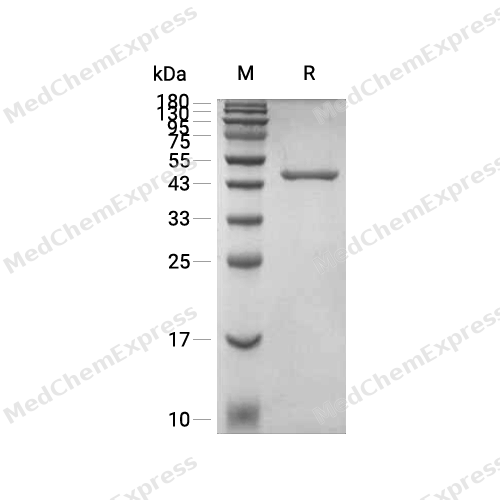
Purity - SDS-PAGE


Technical Parameters
-
Species Human
-
Source E. coli
-
Tag C-6*His
-
Accession
P15104 (T2-N373)
-
Molecular Construction
-
N-term
-
GLUL (T2-N373)
Accession # P15104 -
6*His
-
C-term
-
-
Protein Length
Full Length
-
Synonyms
GLUL; Proliferation-Inducing Protein 43; Prev. GLNS; Glutamate Decarboxylase; Glutamine Synthetase; Glutamine Synthase; Palmitoyltransferase GLUL; DEE116; GS; PIG43; Glutamate-Ammonia Ligase (Glutamine Synthase); PIG59; Cell Proliferation-Inducing Protein
-
AA Sequence
TTSASSHLNKGIKQVYMSLPQGEKVQAMYIWIDGTGEGLRCKTRTLDSEPKCVEELPEWNFDGSSTLQSEGSNSDMYLVPAAMFRDPFRKDPNKLVLCEVFKYNRRPAETNLRHTCKRIMDMVSNQHPWFGMEQEYTLMGTDGHPFGWPSNGFPGPQGPYYCGVGADRAYGRDIVEAHYRACLYAGVKIAGTNAEVMPAQWEFQIGPCEGISMGDHLWVARFILHRVCEDFGVIATFDPKPIPGNWNGAGCHTNFSTKAMREENGLKYIEEAIEKLSKRHQYHIRAYDPKGGLDNARRLTGFHETSNINDFSAGVANRSASIRIPRTVGQEKKGYFEDRRPSANCDPFSVTEALIRTCLLNETGDEPFQYKN
-
Predicted Molecular Mass
43.1 kDa
-
Molecular Weight
Approximately 40-50 kDa, based on SDS-PAGE under reducing conditions.
-
Purity
≥ 95%, as determined by reducing SDS-PAGE.


Product Properties
Solution
Supplied as a 0.22 μm filtered solution of 20 mM Tris-HCl, 200 mM NaCl, 50 mM Imidazole, pH 8.0 or 20mM Citrate,100mM NaCl,8%Trehalose,10%Glycerol,0.03%Tween80,pH5.0.
Note: For SPR assay, please replace the buffer. Primary amine components (e.g., Tris, imidazole) can affect protein-coupled chips.
<1 EU/μg, determined by LAL method.
Stored at -80°C for 1 year from date of receipt. It is stable at -20°C for 3 months after opening. It is recommended to freeze aliquots at -80°C for extended storage. Avoid repeated freeze-thaw cycles.
Shipping with dry ice.


Documentation
-
Data Sheet (238 KB)
-
SDS (252 KB)
- English - EN (252 KB)
- Français - FR (252 KB)
- Deutsch - DE (252 KB)
- Norwegian - NO (252 KB)
- Español - ES (252 KB)
- Swedish - SV (252 KB)
- Italian - IT (252 KB)
- Korean - KR (252 KB)
- Portuguese - PT (252 KB)
-
Handling Instructions (2659 KB)

Calculators
Concentration (start) × Volume (start) = Concentration (final) × Volume (final)


 Powered by Bioz

