



MCP-4/CCL13 Protein, Human
Based on 1 publication(s) in Google Scholar
MCP-4/CCL13 Protein, Human is a CC family chemokine with chemotactic effects on basophils, monocytes, macrophages, immature dendritic cells and T cells. CCL13 binds to CCR1, CCR2, CCR3, CCR5, and CCR11 chemokine receptors and is able to induce key immunomodulatory responses through its effects on regulatory muscle, epithelial, and endothelial cells. MCP-4/CCL13 Protein, Human is a recombinant human MCP-4/CCL13 (Q24-T98) protein expressed by E.coli.
- Species: Human
- Source: E. coli
-
Storage:Stored at -20°C for 2 years from date of receipt. After reconstitution, it is stable at 4°C for 1 week or -20°C for longer (with carrier protein). It is recommended to freeze aliquots at -20°C or -80°C for extended storage.


To place orders, for customer services and technical support, please contact: MedChemExpress USA
Tel: 609-228-6898 E-mail: [email protected] [email protected]


-
 Biological Activity
-
Technical Parameters
-
Product Properties
- Documentation
- References
- Help & FAQs




Biological Activity
Description
MCP-4/CCL13 Protein, Human is a CC family chemokine with chemotactic effects on basophils, monocytes, macrophages, immature dendritic cells and T cells. CCL13 binds to CCR1, CCR2, CCR3, CCR5, and CCR11 chemokine receptors and is able to induce key immunomodulatory responses through its effects on regulatory muscle, epithelial, and endothelial cells. MCP-4/CCL13 Protein, Human is a recombinant human MCP-4/CCL13 (Q24-T98) protein expressed by E.coli[1][2].
Background
CCL13, also known as monocyte chemotactic protein MCP-4, is a small cell factor belonging to the CC chemokine family and is located on human chromosome 17. At the amino acid level, human CCL13 shares 65% identity with human CCL2. CCL13 can act as a chemoattractant for monocytes, macrophages, T lymphocytes, immature DCs, eosinophils, and basophils by binding to cell surface G protein-linked chemokine receptors such as CCR1, CCR2, CCR3, CCR5, and CCR11. CCL13 also induces histamine release from basophils and eosinophil degranulation, and causes expression of adhesion molecules and production of pro-inflammatory cytokines in endothelial cells, epithelial cells and muscle cells[1]. CCL13 plays a role in leukocyte accumulation on both sides of allergic and non-allergic inflammation. Studies have shown that CCL13 is upregulated in asthma and allergic rhinitis and is associated with the number of monocytes/macrophages and eosinophils recruited in the airways of patients. It may be involved in the recruitment of monocytes to the arterial wall during atherosclerotic disease and plays a role in the attraction of monocytes in tissues chronically exposed to exogenous pathogens. ccl13 may also contribute to the development of drug resistance in tumor cells by promoting apoptosis and drug resistance[2].
Verified Bioactivity
1. Fully biologically active when compared to standard. The biological activity determined by a chemotaxis bioassay using human peripheral blood eosinophils is in a concentration range of 10-100 ng/mL.
2. Measured by its ability to chemoattract THP-1 cells. The ED50 this effect is 18.2 ng/mL, corresponding to a specific activity is 5.49×10⁴ units/mg.
MCE Validation Data
-
Purity - SDS-PAGE
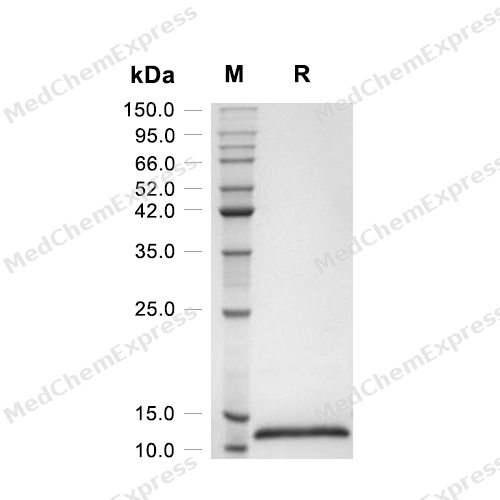
Purity - SDS-PAGE
-
Bioactivity - Cell-Based Assay
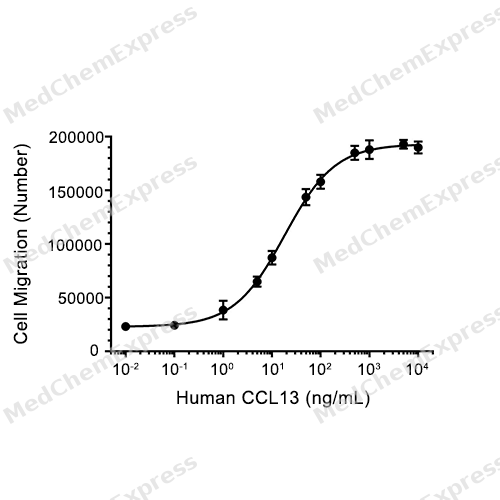
Bioactivity - Cell-Based Assay


Publications (1)
-
Journal Impact Factor
-
Most Recent
-
Nat Methods
Genetically encoded biosensor for monitoring spatiotemporal dynamics of CCR2 ligands in culture and in vivo. [Abstract]2025 Aug;22(8):1731-1741. PMID: 40665002


Technical Parameters
-
Species Human
-
Source E. coli
-
Tag Tag Free
-
Accession
Q99616 (Q24-T98)
-
Molecular Construction
-
N-term
-
CCL13 (Q24-T98)
Accession # Q99616 -
C-term
-
-
Protein Length
Full Length of C-C motif chemokine 13, short Chain
-
Synonyms
CCL13; Monocyte Chemotactic Protein 4; Prev. SCYA13; C-C Motif Chemokine 13; MCP-4; CK-Beta-10; NCC-1; MGC17134; SCYL1; NCC1; CKb10; Chemokine (C-C Motif) Ligand 13, Isoform CRA_a; Small Inducible Cytokine Subfamily A (Cys-Cys), Member 13; New CC Chemokin
-
AA Sequence
QPDALNVPSTCCFTFSSKKISLQRLKSYVITTSRCPQKAVIFRTKLGKEICADPKEKWVQNYMKHLGRKAHTLKT
-
Predicted Molecular Mass
8.6 kDa
-
Molecular Weight
Approximately 13 kDa, based on SDS-PAGE under reducing conditions.
-
Purity
≥ 95%, as determined by reducing SDS-PAGE.


Product Properties
Lyophilized powder.
Lyophilized from a 0.22 μm filtered solution of 20 mM PB, 150 mM NaCl, pH 7.4.
<1 EU/μg, determined by LAL method.
It is not recommended to reconstitute to a concentration less than 100 μg/mL in ddH2O. For long term storage it is recommended to add a carrier protein (0.1% BSA, 5% HSA, 10% FBS or 5% Trehalose).
Stored at -20°C for 2 years from date of receipt. After reconstitution, it is stable at 4°C for 1 week or -20°C for longer (with carrier protein). It is recommended to freeze aliquots at -20°C or -80°C for extended storage.
Room temperature in continental US; may vary elsewhere.


Documentation
-
Data Sheet (262 KB)
-
SDS (252 KB)
- English - EN (252 KB)
- Français - FR (252 KB)
- Deutsch - DE (252 KB)
- Norwegian - NO (252 KB)
- Español - ES (252 KB)
- Swedish - SV (252 KB)
- Italian - IT (252 KB)
- Korean - KR (252 KB)
- Portuguese - PT (252 KB)
-
Handling Instructions (2659 KB)


References
[1]. Mendez-Enriquez E, et al. The multiple faces of CCL13 in immunity and inflammation. Inflammopharmacology. 2013 Dec;21(6):397-406. [Content Brief]
[2]. Shaoping She, et al. Functional Roles of Chemokine Receptor CCR2 and Its Ligands in Liver Disease. Front Immunol. 2022 Feb 25;13:812431. [Content Brief]

Calculators
Concentration (start) × Volume (start) = Concentration (final) × Volume (final)


 Powered by Bioz

