



Lymphotactin/XCL1 Protein, Human

Based on 1 Customer Validation
XCL1, a C class chemokine also known as Lymphotactin, is mainly produced by activated CD8+ T cells and natural killer cells. XCL1 signals by binding to the XCR1 receptor. XCL1 is involved in infectious, inflammatory and immunological diseases. Lymphotactin/XCL1 Protein, Human (HEK293, Fc-His) is produced in E. coli, and consists of 92 amino acids (G23-G114).
- Species: Human
- Source: E. coli
-
Storage:Stored at -20°C for 2 years from date of receipt. After reconstitution, it is stable at 4°C for 1 week or -20°C for longer (with carrier protein). It is recommended to freeze aliquots at -20°C or -80°C for extended storage.


To place orders, for customer services and technical support, please contact: MedChemExpress USA
Tel: 609-228-6898 E-mail: [email protected] [email protected]


-
 Biological Activity
-
Technical Parameters
-
Product Properties
- Documentation
- References
- Help & FAQs




Biological Activity
Description
XCL1, a C class chemokine also known as Lymphotactin, is mainly produced by activated CD8+ T cells and natural killer cells. XCL1 signals by binding to the XCR1 receptor. XCL1 is involved in infectious, inflammatory and immunological diseases[1]. Lymphotactin/XCL1 Protein, Human (HEK293, Fc-His) is produced in E. coli, and consists of 92 amino acids (G23-G114).
Background
XCL1, also known as lymphotactin, single C motif-1 (SCM-1), and activation-induced T-cell-derived and chemokine-related molecule (ATAC). XCL1 is expressed by various immune cells, including activated CD8+ T cells, CD4+ T cells, NK cells, NKT cells, γδ T cells, and thymic medullary epithelial cells. XCL1 elicits its chemotactic function by binding to the receptor called XCR1. XCR1 is expressed by a dendritic cell (DC) subpopulation[1].
There are two highly homologous C class chemokine genes in human, XCL1 and XCL2 (also known as SCYC1 and SCYC2, respectively). The XCL1 and XCL2 genes in human are localized closely on chromosome 1 and encode highly homologous proteins (also known as SCM-1K and SCM-1L, respectively) with only two amino acid differences from each other. Unlike CXC, CC, and CX3C class chemokines that carry two disulfide bonds with four cysteine residues at the amino termini, XCL1 has only one disulfide bond with two cysteine residues at the amino terminus. Human and mouse XCL1s share 60% amino acid identity. XCL1 transcripts are detected in spleen, thymus, intestine, and peripheral blood leukocytes. XCL1 expression is also detectable in lung, colon, prostate gland, testis, and ovary. In leukocytes, XCL1 is highly expressed in CD8+ and CD4-CD8- TCRαβ+ T cells in blood and thymus, particularly when the cells are activated. TCRαβ+ T cells in epidermis and intestinal epithelium also express XCL1[1].
XCL1 exerts chemotactic and immunomodulatory activity on T cells, natural killer (NK) cells, and macrophages. The interaction between XCL1 and XCR1 plays an important role in DC-mediated immune response and thymic development of regulatory T cells. It has been also shown that XCL1 and XCR1 are constitutively expressed in the thymus and regulate the thymic establishment of self-tolerance and the generation of regulatory T cells. The elevated expression of XCL1 in various infectious and autoimmune diseases suggests the role of the XCL1-XCR1 axis in protective and pathological immune responses. In addition, XCL1 plays a role in the development of arthritis and progressive bone degradation in rheumatoid arthritis[1][2].
In Vitro
Recombinant human XCL1 (10, 50, or 100 ng/mL; 48 hours) promotes osteoclastogenesis and the osteoclast-bone resorbing activity in human monocytes. Moreover, recombinant XCL1 promotes the expression of inflammatory and osteoclastogenic factors, including IL-6, IL-8, and RANKL in human differentiated osteoblasts[2].
In Vivo
Lei Y, et al. XCL1 and XCR1 in the immune system. Microbes Infect. 2012 Mar;14(3):262-7.
Verified Bioactivity
1.Full biological activity determined by a chemotaxis bioassay using human T-lymphocytes is in a concentration of 10-100 ng/ml.
2.Measured by its ability to chemoattract NK92 cells. The ED50 for this effect is 0.0734 μg/mL, corresponding to a specific activity is 1.362×10⁴ U/mg.
MCE Validation Data
-
Purity - SDS-PAGE
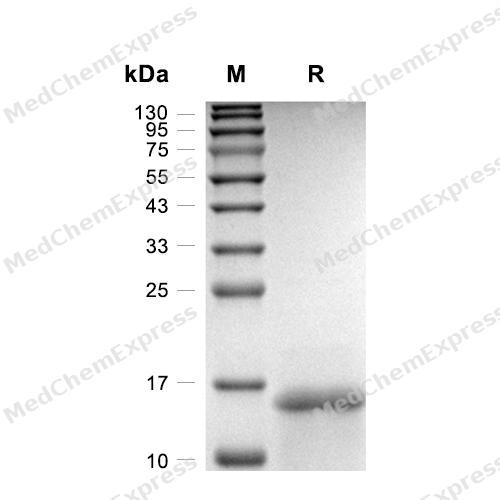
Purity - SDS-PAGE
-
Bioactivity - Cell-Based Assay
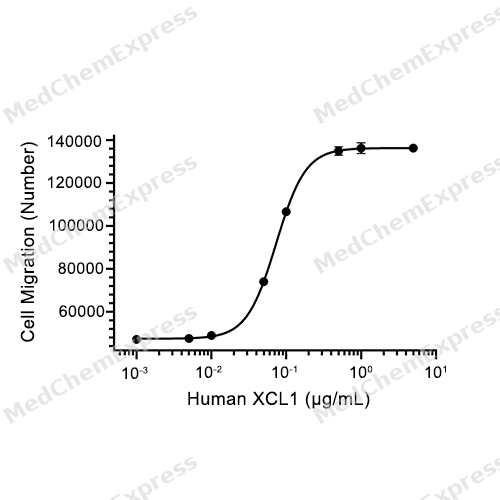
Bioactivity - Cell-Based Assay


Technical Parameters
-
Species Human
-
Source E. coli
-
Tag Tag Free
-
Accession
P47992 (G23-G114)
-
Molecular Construction
-
N-term
-
XCL1 (G23-G114)
Accession # P47992 -
C-term
-
-
Protein Length
Full Length of Mature Protein
-
Synonyms
XCL1; X-C Motif Chemokine Ligand 1; SCYC1; LTN; ATAC; Lymphotactin; SCM-1a; SCM-1; LPTN; Small Inducible Cytokine Subfamily C, Member 1 (Lymphotactin); Chemokine (C Motif) Ligand 1; Small-Inducible Cytokine C1; XC Chemokine Ligand 1; C Motif Chemokine 1;
-
AA Sequence
GSEVSDKRTCVSLTTQRLPVSRIKTYTITEGSLRAVIFITKRGLKVCADPQATWVRDVVRSMDRKSNTRNNMIQTKPTGTQQSTNTAVTLTG
-
Predicted Molecular Mass
10.2 kDa
-
Molecular Weight
Approximately 15 kDa, based on SDS-PAGE under reducing conditions.
-
Purity
≥ 95%, as determined by reducing SDS-PAGE.


Product Properties
Lyophilized powder.
Lyophilized after extensive dialysis against 20 mM PB, pH 7.4, 150 mM NaCl.
<1 EU/μg, determined by LAL method.
It is not recommended to reconstitute to a concentration less than 100 μg/mL in ddH2O. For long term storage it is recommended to add a carrier protein (0.1% BSA, 5% HSA, 10% FBS or 5% Trehalose).
Stored at -20°C for 2 years from date of receipt. After reconstitution, it is stable at 4°C for 1 week or -20°C for longer (with carrier protein). It is recommended to freeze aliquots at -20°C or -80°C for extended storage.
Room temperature in continental US; may vary elsewhere.


Documentation
-
Data Sheet (263 KB)
-
SDS (251 KB)
- English - EN (251 KB)
- Français - FR (251 KB)
- Deutsch - DE (251 KB)
- Norwegian - NO (251 KB)
- Español - ES (251 KB)
- Swedish - SV (251 KB)
- Italian - IT (251 KB)
- Korean - KR (251 KB)
- Portuguese - PT (251 KB)
-
Handling Instructions (2659 KB)


References
[1]. Lei Y, et al. XCL1 and XCR1 in the immune system. Microbes Infect. 2012 Mar;14(3):262-7. [Content Brief]
[2]. Lei Y, et al. XCL1 and XCR1 in the immune system. Microbes Infect. 2012 Mar;14(3):262-7. [Content Brief]
[3]. Yuan Tian, et al. Blockade of XCL1/Lymphotactin Ameliorates Severity of Periprosthetic Osteolysis Triggered by Polyethylene-Particles. Front Immunol. 2020 Aug 4;11:1720. [Content Brief]

Calculators
Concentration (start) × Volume (start) = Concentration (final) × Volume (final)


 Powered by Bioz

