



Serpin B5/Maspin Protein, Human

Based on 1 Customer Validation
Serpin B5/Maspin Protein, Human could inhibit invasion and motility of mammary tumors. Maspin Protein, Human is also found to be a potent angiogenesis inhibitor.
- Species: Human
- Source: E. coli
-
Storage:Stored at -20°C for 2 years from date of receipt. After reconstitution, it is stable at 4°C for 1 week or -20°C for longer (with carrier protein). It is recommended to freeze aliquots at -20°C or -80°C for extended storage.


To place orders, for customer services and technical support, please contact: MedChemExpress USA
Tel: 609-228-6898 E-mail: [email protected] [email protected]


-
 Biological Activity
-
Technical Parameters
-
Product Properties
- Documentation
- References
- Help & FAQs




Biological Activity
Description
Serpin B5/Maspin Protein, Human could inhibit invasion and motility of mammary tumors. Maspin Protein, Human is also found to be a potent angiogenesis inhibitor.
Background
Maspin is a unique member of the serpin family that shares extensive homology with monocyte-neutrophil elastase inhibitor, PAI-2 and other serpins. Maspin has been shown to inhibit invasion and motility of mammary tumors. Tumor transfectants expressing maspin exhibit decreased growth and metastasis in nude mice. Maspin gene expression is not detected in most breast tumors and loss of its expression is correlated with tumor invasiveness. Maspin is also found to be a potent angiogenesis inhibitor. In human breast tissue, maspin seems to be present more in luminal than myoepithelial cells, and it has been suggested that those maspin-expressing myoepithelial cells form a defensive barrier for the progression from ductal carcinoma in situ to more invasive carcinomas. A dispute exists regarding whether maspin acts as a protease inhibitor among biochemists[1].
MCE Validation Data
-
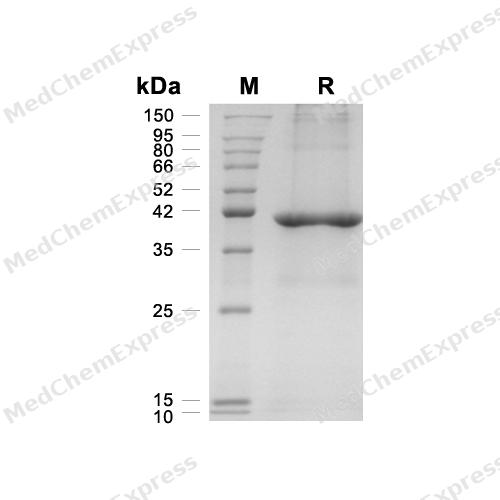
Purity - SDS-PAGE
Purity - SDS-PAGE


Technical Parameters
-
Species Human
-
Source E. coli
-
Tag Tag Free
-
Accession
P36952-1 (D2-P375)
-
Molecular Construction
-
N-term
-
Maspin (D2-P375)
Accession # P36952-1 -
C-term
-
-
Protein Length
Full Length of Isoform-1
-
Synonyms
SERPINB5; Serpin Peptidase Inhibitor, Clade B (Ovalbumin), Member 5; Prev. PI5; Peptidase Inhibitor 5; Maspin; Serpin B5; Serine (Or Cysteine) Proteinase Inhibitor, Clade B (Ovalbumin), Member 5; PI-5; Serpin Family B Member 5; Protease Inhibitor 5 (Maspi
-
AA Sequence
DALQLANSAFAVDLFKQLCEKEPLGNVLFSPICLSTSLSLAQVGAKGDTANEIGQVLHFENVKDVPFGFQTVTSDVNKLSSFYSLKLIKRLYVDKSLNLSTEFISSTKRPYAKELETVDFKDKLEETKGQINNSIKDLTDGHFENILADNSVNDQTKILVVNAAYFVGKWMKKFSESETKECPFRVNKTDTKPVQMMNMEATFCMGNIDSINCKIIELPFQNKHLSMFILLPKDVEDESTGLEKIEKQLNSESLSQWTNPSTMANAKVKLSIPKFKVEKMIDPKACLENLGLKHIFSEDTSDFSGMSETKGVALSNVIHKVCLEITEDGGDSIEVPGARILQHKDELNADHPFIYIIRHNKTRNIIFFGKFCSP
-
Molecular Weight
Approximately 38-47 kDa, based on SDS-PAGE under reducing conditions.
-
Purity
≥ 95%, as determined by reducing SDS-PAGE.


Product Properties
Lyophilized powder.
Lyophilized from a 0.22 μm filtered solution of 20 mM PB, 150 mM NaCl, pH 7.4.
<1 EU/μg, determined by LAL method.
It is not recommended to reconstitute to a concentration less than 100 μg/mL in ddH2O. For long term storage it is recommended to add a carrier protein (0.1% BSA, 5% HSA, 10% FBS or 5% Trehalose).
Stored at -20°C for 2 years from date of receipt. After reconstitution, it is stable at 4°C for 1 week or -20°C for longer (with carrier protein). It is recommended to freeze aliquots at -20°C or -80°C for extended storage.
Room temperature in continental US; may vary elsewhere.


Documentation
-
Data Sheet (262 KB)
-
SDS (251 KB)
- English - EN (251 KB)
- Français - FR (251 KB)
- Deutsch - DE (251 KB)
- Norwegian - NO (251 KB)
- Español - ES (251 KB)
- Swedish - SV (251 KB)
- Italian - IT (251 KB)
- Korean - KR (251 KB)
- Portuguese - PT (251 KB)
-
Handling Instructions (2659 KB)


References

Calculators
Concentration (start) × Volume (start) = Concentration (final) × Volume (final)


 Powered by Bioz

