



SFRP2 Protein, Human (HEK293, His, solution)
Based on 3 publication(s) in Google Scholar
SFRP2 Protein is a soluble crimson-associated protein that promotes tumor development by activating the Wnt/β-catenin signaling pathway. The methylation of SFRP2 Protein DNA is associated with tumor development. SFRP2 Protein, Human (HEK293, His, solution) is the recombinant human-derived SFRP2 protein, expressed by HEK293 , with C-His labeled tag.
- Species: Human
- Source: HEK293
-
Storage:Stored at -80°C for 1 year from date of receipt. It is stable at -20°C for 3 months after opening. It is recommended to freeze aliquots at -80°C for extended storage. Avoid repeated freeze-thaw cycles.


To place orders, for customer services and technical support, please contact: MedChemExpress USA
Tel: 609-228-6898 E-mail: [email protected] [email protected]


-
 Biological Activity
-
Technical Parameters
-
Product Properties
- Documentation
- Help & FAQs




Biological Activity
Description
SFRP2 Protein is a soluble crimson-associated protein that promotes tumor development by activating the Wnt/β-catenin signaling pathway. The methylation of SFRP2 Protein DNA is associated with tumor development. SFRP2 Protein, Human (HEK293, His, solution) is the recombinant human-derived SFRP2 protein, expressed by HEK293 , with C-His labeled tag.
Background
Secreted frizzled-related protein 2 (SFRP2) is a soluble frizzled-related protein that activates the Wnt/β-catenin signaling pathway through DNA demethylation regulation. SFRP2 contains a cysteine-rich domain that is a soluble regulator of Wnt signaling. SFRP2 can differentiate human induced pluripotent stem cells into mature cardiomyocytes. Overexpression of SFRP2 induces osteoblast-like phenotype in prostate cancer cells. SFRP2 promotes carcinogenesis and radiation resistance of glioma cells by activating the Wnt/β-catenin signaling pathway. SFRP2 promoter is hypermethylated in a variety of malignancies and overexpressed in a variety of tumor cells, which may be associated with tumorigenesis. SFRP2 can be used as a non-invasive biomarker for HBV-associated hepatocellular carcinoma[1][2][3][4][5].
MCE Validation Data
-
Purity - SDS-PAGE
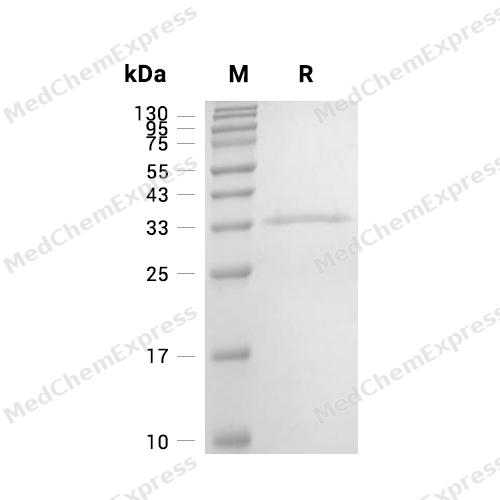
Purity - SDS-PAGE


Publications (3)
-
Journal Impact Factor
-
Most Recent
-
Nat Commun
Identifying fibroblast-derived sFRP2 as a therapeutic target and engineering siRNA therapy for uterine scarring. [Abstract]2025 Jul 25;16(1):6850. PMID: 40715133 -
J Mol Cell Biol
Canonical Wnt signaling affects calcium homeostasis in serum-treated AC16 cells through MLN-mediated SERCA2a regulation. [Abstract]2025 Dec 5:mjaf050. PMID: 41348974 -
J Mol Cell Biol
Wnt/β-catenin pathway induces cardiac dysfunction via AKAP6-mediated RyR2 phosphorylation and sarcoplasmic reticulum calcium leakage. [Abstract]2025 Jul 28;17(2):mjaf002. PMID: 40097291


Technical Parameters
-
Species Human
-
Source HEK293
-
Tag C-8*His
-
Accession
Q96HF1 (L25-C295)
-
Molecular Construction
-
N-term
-
SFRP2 (L25-C295)
Accession # Q96HF1 -
8*His
-
C-term
-
-
Protein Length
Full Length of Mature Protein
-
Synonyms
SFRP2; Secreted Apoptosis-Related Protein 1; Secreted Frizzled Related Protein 2; SARP-1; SARP1; SFRP-2; FRP-2; Secreted Apoptosis Related Protein 1; Secreted Frizzled-Related Protein 2; Testicular Tissue Protein Li 170; SDF-5; FRP2
-
AA Sequence
LFLFGQPDFSYKRSNCKPIPANLQLCHGIEYQNMRLPNLLGHETMKEVLEQAGAWIPLVMKQCHPDTKKFLCSLFAPVCLDDLDETIQPCHSLCVQVKDRCAPVMSAFGFPWPDMLECDRFPQDNDLCIPLASSDHLLPATEEAPKVCEACKNKNDDDNDIMETLCKNDFALKIKVKEITYINRDTKIILETKSKTIYKLNGVSERDLKKSVLWLKDSLQCTCEEMNDINAPYLVMGQKQGGELVITSVKRWQKGQREFKRISRSIRKLQC
-
Predicted Molecular Mass
32.4 kDa
-
Molecular Weight
Approximately 34-38 kDa, based on SDS-PAGE under reducing conditions, due to the glycosylation.
-
Purity
≥ 95%, as determined by Bis-Tris PAGE.


Product Properties
Solution
Supplied as a 0.22 μm filtered solution of 20 mM PBS, 100 mM Larginine, pH 7.4.
<1 EU/μg, determined by LAL method.
Stored at -80°C for 1 year from date of receipt. It is stable at -20°C for 3 months after opening. It is recommended to freeze aliquots at -80°C for extended storage. Avoid repeated freeze-thaw cycles.
Shipping with dry ice.


Documentation
-
Data Sheet (237 KB)
-
SDS (252 KB)
- English - EN (252 KB)
- Français - FR (252 KB)
- Deutsch - DE (252 KB)
- Norwegian - NO (252 KB)
- Español - ES (252 KB)
- Swedish - SV (252 KB)
- Italian - IT (252 KB)
- Korean - KR (252 KB)
- Portuguese - PT (252 KB)
-
Handling Instructions (2659 KB)

Calculators
Concentration (start) × Volume (start) = Concentration (final) × Volume (final)


 Powered by Bioz

