



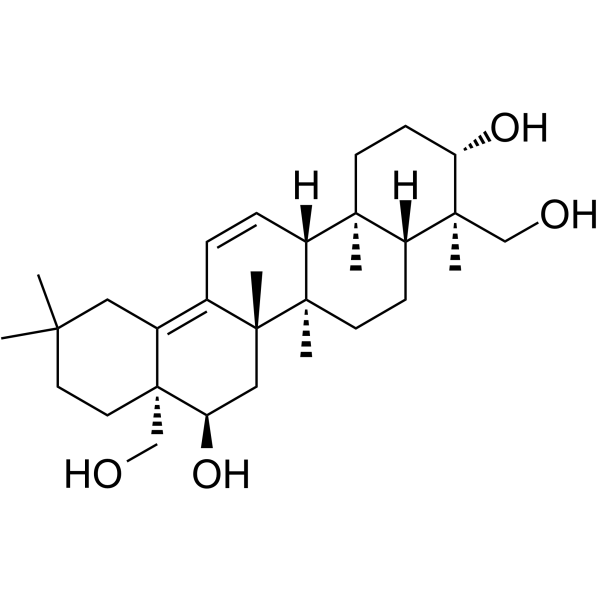
Saikogenin D
Based on 1 publication(s) in Google Scholar
Saikogenin D is isolated from?Bupleurum chinense, has anti-inflammatory effects. Saikogenin D activates epoxygenases that converts arachidonic acid to epoxyeicosanoids and dihydroxyeicosatrienoic acids, and the metabolites secondarily inhibit prostaglandin E2 (PGE2) production. Saikogenin D results in an elevation of [Ca2+]i due to Ca2+ release from intracellular stores.
For research use only. We do not sell to patients.
- Purity: 99.99%
- CAS No.: 5573-16-0
- Formula: C30H48O4
- Molecular Weight:472.70
-
Storage:
4°C, protect from light
* In solvent : -80°C, 6 months; -20°C, 1 month (protect from light)

To place orders, for customer services and technical support, please contact: MedChemExpress USA
Tel: 609-228-6898 E-mail: [email protected] [email protected]


-
 Biological Activity
-
Chemical Information
-
Solvent & Solubility
- Purity & Documentation
- References
-
 Help & FAQs



Publications Citing Use of MedChemExpress (MCE) Saikogenin D
More

Biological Activity
Description
IC50 & Target
|
EP |
Cellular Effect
|
Cell Line

|
Type | Value | Description | References |
|---|---|---|---|---|
| A549 | IC50 |
>80 μM
Compound: 6
|
Cytotoxicity against human A549 cells after 48 hrs by MTT assay
Cytotoxicity against human A549 cells after 48 hrs by MTT assay
|
[PMID: 26883148] |
| Bcap37 | IC50 |
>80 μM
Compound: 6
|
Cytotoxicity against human Bcap37 cells after 48 hrs by MTT assay
Cytotoxicity against human Bcap37 cells after 48 hrs by MTT assay
|
[PMID: 26883148] |
| Hep 3B2 | IC50 |
>80 μM
Compound: 6
|
Cytotoxicity against human Hep3B cells after 48 hrs by MTT assay
Cytotoxicity against human Hep3B cells after 48 hrs by MTT assay
|
[PMID: 26883148] |
| HepG2 | IC50 |
>80 μM
Compound: 6
|
Cytotoxicity against human HepG2 cells after 48 hrs by MTT assay
Cytotoxicity against human HepG2 cells after 48 hrs by MTT assay
|
[PMID: 26883148] |
| MCF7 | IC50 |
>80 μM
Compound: 6
|
Cytotoxicity against human MCF7 cells after 48 hrs by MTT assay
Cytotoxicity against human MCF7 cells after 48 hrs by MTT assay
|
[PMID: 26883148] |
In Vitro
Saikogenin D (1-20 μM) inhibits PGE2 production induced by the Ca2+ ionophore A23187 in a concentration-dependent manner with an IC50 value of 3 μM in C6 rat glioma cells[1]. Saikogenin D (10-100 μM) elevates [Ca2+]i in a concentration-dependent manner with a EC50 value of 35 μM in the presence or absence of extracellular Ca2+ in C6 rat glioma cells[1].
MedChemExpress (MCE) has not independently confirmed the accuracy of these methods. They are for reference only.


Chemical Information
-
CAS No. 5573-16-0
-
Appearance Solid
-
Molecular Weight 472.70
-
Formula C30H48O4
-
Color White to off-white
-
SMILES
C[C@]12[C@]3(C(C=C[C@]1([H])[C@@]4([C@@]([C@@](C)([C@@H](O)CC4)CO)([H])CC2)C)=C5[C@](CO)(CCC(C)(C)C5)[C@H](O)C3)C
-
Structure Classification
-
Shipping
Room temperature in continental US; may vary elsewhere.
-
Storage
4°C, protect from light
* In solvent : -80°C, 6 months; -20°C, 1 month (protect from light)


Publications (1)
-
Journal Impact Factor
-
Most Recent
-
J Ethnopharmacol
Systematic pharmacology and experimental validation revealed the mechanism of Bupleurum chinense DC -mediated autophagy in alleviating osteoarthritis. [Abstract]2025 Jul 24:351:120042. PMID: 40517915


Solvent & Solubility
In Vitro:
DMSO : ≥ 100 mg/mL (211.55 mM; Hygroscopic DMSO has a significant impact on the solubility of product, please use newly opened DMSO)
* "≥" means soluble, but saturation unknown.
Please refer to the solubility information to select the appropriate solvent. Once prepared, please aliquot and store the solution to prevent product inactivation from repeated freeze-thaw cycles.
Storage method and period of stock solution: -80°C, 6 months; -20°C, 1 month (protect from light). When stored at -80°C, please use it within 6 months. When stored at -20°C, please use it within 1 month.
Please refer to the solubility information to select the appropriate solvent. Once prepared, please aliquot and store the solution to prevent product inactivation from repeated freeze-thaw cycles.
Storage method and period of stock solution: -80°C, 6 months; -20°C, 1 month (protect from light). When stored at -80°C, please use it within 6 months. When stored at -20°C, please use it within 1 month.
Concentration (start) × Volume (start) = Concentration (final) × Volume (final)
In Vivo:
Select the appropriate dissolution method based on your experimental animal and administration route.
- For the following dissolution methods, please ensure to first prepare a clear stock solution using an In Vitro approach and then sequentially add co-solvents:
- To ensure reliable experimental results, the clarified stock solution can be appropriately stored based on storage conditions. As for the working solution for In Vivo experiments, it is recommended to prepare freshly and use it on the same day.
- The percentages shown for the solvents indicate their volumetric ratio in the final prepared solution. If precipitation or phase separation occurs during preparation, heat and/or sonication can be used to aid dissolution.
Add each solvent one by one: 10% DMSO 90% (20% SBE-β-CD in Saline)
Solubility: ≥ 2.5 mg/mL (5.29 mM); Clear solution
This protocol yields a clear solution of ≥ 2.5 mg/mL (saturation unknown).
Taking 1 mL working solution as an example, add 100 μL DMSO stock solution (25.0 mg/mL) to 900 μL 20% SBE-β-CD in Saline, and mix evenly.
Preparation of 20% SBE-β-CD in Saline (4°C, storage for one week): 2 g SBE-β-CD powder is dissolved in 10 mL Saline, completely dissolve until clear.
In Vivo Dissolution Calculator
Please enter the basic information of animal experiments:
-
-
-
-
Recommended: Prepare an additional quantity of animals to account for potential losses during experiments.
Please enter your animal formula composition:
-
%DMSO +
Recommended: Keep the proportion of DMSO in working solution below 2% if your animal is weak.
-
%+
-
+%Tween-80 + +
-
%Saline +
The co-solvents required include: DMSO, . All of co-solvents are available by MedChemExpress (MCE). , Tween 80. All of co-solvents are available by MedChemExpress (MCE).
Working solution concentration: 0.22 mg/mL
Method for preparing stock solution: mg drug dissolved in μL DMSO. Stock solution concentration: mg/mL. * In solvent : -80°C, 6 months; -20°C, 1 month (protect from light)
1. Take μL DMSO stock solution;
2. Add μL .
μL , mix evenly;
3. Then add μL Tween 80, mix evenly;
4. Then add μL
Please ensure that the stock solution in the first step is dissolved to a clear state, and add co-solvents in sequence. You can use ultrasonic heating (ultrasonic cleaner, recommended frequency 20-40 kHz), vortexing, etc. to assist dissolution.


Purity & Documentation
-
Data Sheet (275 KB)
-
SDS (392 KB)
- English - EN (392 KB)
- Français - FR (392 KB)
- Deutsch - DE (392 KB)
- Norwegian - NO (392 KB)
- Español - ES (392 KB)
- Swedish - SV (392 KB)
- Italian - IT (392 KB)
- Korean - KR (392 KB)
- Portuguese - PT (392 KB)
-
Handling Instructions (2659 KB)
References
[1]. Toriniwa Y, et al. Participation of epoxygenase activation in saikogenin D-induced inhibition of prostaglandin E(2) synthesis.J Pharm Pharmacol. 2006 Jun;58(6):859-66. [Content Brief]
[2]. Kodama Y, et al. Dual effect of saikogenin D: in vitro inhibition of prostaglandin E2 production and elevation of intracellular free Ca2+ concentration in C6 rat glioma cells.Planta Med. 2003 Aug;69(8):765-7. [Content Brief]


Complete Stock Solution Preparation Table
Please refer to the solubility information to select the appropriate solvent. Once prepared, please aliquot and store the solution to prevent product inactivation from repeated freeze-thaw cycles.
Storage method and period of stock solution: -80°C, 6 months; -20°C, 1 month (protect from light). When stored at -80°C, please use it within 6 months. When stored at -20°C, please use it within 1 month.
| Optional Solvent | Concentration Solvent Mass | 1 mg | 5 mg | 10 mg | 25 mg |
|---|---|---|---|---|---|
| DMSO | 1 mM | 2.1155 mL | 10.5775 mL | 21.1551 mL | 52.8877 mL |
| 5 mM | 0.4231 mL | 2.1155 mL | 4.2310 mL | 10.5775 mL | |
| 10 mM | 0.2116 mL | 1.0578 mL | 2.1155 mL | 5.2888 mL | |
| 15 mM | 0.1410 mL | 0.7052 mL | 1.4103 mL | 3.5258 mL | |
| 20 mM | 0.1058 mL | 0.5289 mL | 1.0578 mL | 2.6444 mL | |
| 25 mM | 0.0846 mL | 0.4231 mL | 0.8462 mL | 2.1155 mL | |
| 30 mM | 0.0705 mL | 0.3526 mL | 0.7052 mL | 1.7629 mL | |
| 40 mM | 0.0529 mL | 0.2644 mL | 0.5289 mL | 1.3222 mL | |
| 50 mM | 0.0423 mL | 0.2116 mL | 0.4231 mL | 1.0578 mL | |
| 60 mM | 0.0353 mL | 0.1763 mL | 0.3526 mL | 0.8815 mL | |
| 80 mM | 0.0264 mL | 0.1322 mL | 0.2644 mL | 0.6611 mL | |
| 100 mM | 0.0212 mL | 0.1058 mL | 0.2116 mL | 0.5289 mL |


Saikogenin D Related Classifications
HY-N4237 Related Classifications
 Powered by Bioz