



Endothelin-1 (1-31) (Human)
Based on 1 publication(s) in Google Scholar
Endothelin-1 (1-31) (Human) is a potent vasoconstrictor and hypertensive agent. Endothelin-1 (1-31) (Human) is derived from the selective hydrolysis of big ET-1 by chymase.
For research use only. We do not sell to patients.
- Purity : 99.73%
- CAS No.: 133972-52-8
- Formula: C162H236N38O47S5
- Molecular Weight:3628.16
-
Storage:
Sealed storage, away from moisture.
Powder -80°C, 2 years , -20°C, 1 year* In solvent : -80°C, 6 months; -20°C, 1 month (sealed storage, away from moisture)

To place orders, for customer services and technical support, please contact: MedChemExpress USA
Tel: 609-228-6898 E-mail: [email protected] [email protected]


-
 Biological Activity
-
Chemical Information
-
Solvent & Solubility
- Purity & Documentation
- References
-
 Help & FAQs


Publications Citing Use of MedChemExpress (MCE) Endothelin-1 (1-31) (Human)
More

Biological Activity
Description
In Vitro
Endothelin-1 (1-31) (Human) (100 pM-100 nM; 24 h) induces human mesangial cells proliferation[2].
Endothelin-1 (1-31) (Human) (100 nM; 0-10 min) induces ERK activation in human mesangial cells[2].
MedChemExpress (MCE) has not independently confirmed the accuracy of these methods. They are for reference only.
-
Cell Line:Human mesangial cells
-
Concentration:100 pM-100 nM
-
Incubation Time:24 h
-
Result:Caused an increase in [3H]-thymidine incorporation into the cells in a concentration-dependent manner.
-
Cell Line:Human mesangial cells
-
Concentration:100 nM
-
Incubation Time:0, 5, 10, 15 and 30 min
-
Result:ERK activities rapidly increased 2.45-fold at 5 min and peaked at 10 min. The activities of both ERKs rapidly declined, returning to the baseline control value 30 min after stimulation.
In Vivo
MedChemExpress (MCE) has not independently confirmed the accuracy of these methods. They are for reference only.
-
Animal Model:ICR mice, Streptozocin (HY-13753)-induced diabetic model[1]
-
Dosage:100 nM
-
Administration:In the organ bath, single dose
-
Result:In the 1-week control (but not diabetic) group, induced contraction and the contractile response was significantly greater in female mice than in male mice, and there was no significant difference in either male or female mice between the age-matched controls and the diabetic mice. In the 8-weeks group, the contraction was or tended to be increased compared with the corresponding 1-week group in all mice. Although in male mice this contraction was not different between control and diabetic groups, it was significantly greater in diabetic female mice than in the control female mice and in female diabetic mice than in male diabetic mice. The contraction was inhibited by ETA receptor inhibitor.


Chemical Information
-
CAS No. 133972-52-8
-
Appearance Solid
-
Molecular Weight 3628.16
-
Formula C162H236N38O47S5
-
Color White to off-white
-
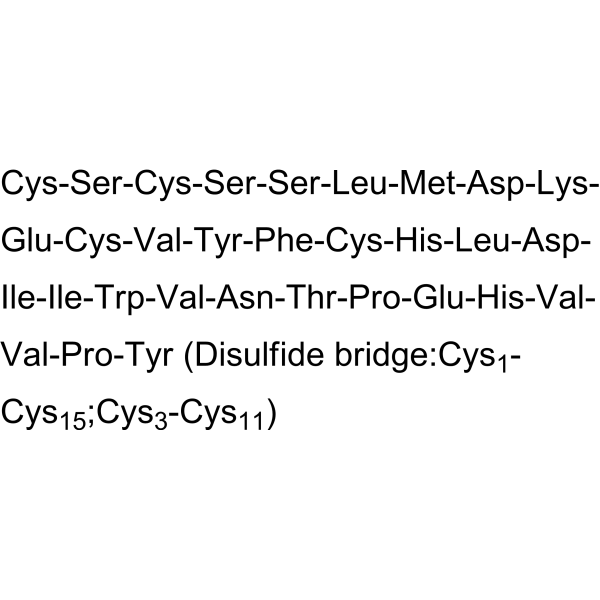
Sequence
Cys-Ser-Cys-Ser-Ser-Leu-Met-Asp-Lys-Glu-Cys-Val-Tyr-Phe-Cys-His-Leu-Asp-Ile-Ile-Trp-Val-Asn-Thr-Pro-Glu-His-Val-Val-Pro-Tyr (Disulfide bridge:Cys1-Cys15;Cys3-Cys11)
-
Sequence Shortening
CSCSSLMDKECVYFCHLDIIWVNTPEHVVPY (Disulfide bridge:Cys1-Cys15;Cys3-Cys11)
-
Shipping
Room temperature in continental US; may vary elsewhere.
-
Storage
Sealed storage, away from moisture
Powder -80°C 2 years -20°C 1 year * In solvent : -80°C, 6 months; -20°C, 1 month (sealed storage, away from moisture)


Publications (1)
-
Journal Impact Factor
-
Most Recent
-
Acta Pharmacol Sin
Role of thrombospondin-1 in high-salt-induced mesenteric artery endothelial impairment in rats. [Abstract]2024 Mar;45(3):545-557. PMID: 37932403


Solvent & Solubility
In Vitro:
DMSO : 33.33 mg/mL (9.19 mM; Need ultrasonic; Hygroscopic DMSO has a significant impact on the solubility of product, please use newly opened DMSO)
Please refer to the solubility information to select the appropriate solvent. Once prepared, please aliquot and store the solution to prevent product inactivation from repeated freeze-thaw cycles.
Storage method and period of stock solution: -80°C, 6 months; -20°C, 1 month (sealed storage, away from moisture). When stored at -80°C, please use it within 6 months. When stored at -20°C, please use it within 1 month.
Please refer to the solubility information to select the appropriate solvent. Once prepared, please aliquot and store the solution to prevent product inactivation from repeated freeze-thaw cycles.
Storage method and period of stock solution: -80°C, 6 months; -20°C, 1 month (sealed storage, away from moisture). When stored at -80°C, please use it within 6 months. When stored at -20°C, please use it within 1 month.
Concentration (start) × Volume (start) = Concentration (final) × Volume (final)


Purity & Documentation
-
Data Sheet (292 KB)
-
SDS (252 KB)
- English - EN (252 KB)
- Français - FR (252 KB)
- Deutsch - DE (252 KB)
- Norwegian - NO (252 KB)
- Español - ES (252 KB)
- Swedish - SV (252 KB)
- Italian - IT (252 KB)
- Korean - KR (252 KB)
- Portuguese - PT (252 KB)
-
Handling Instructions (2659 KB)
References
[1]. Matsumoto T, et al. Gender differences in vascular reactivity to endothelin-1 (1-31) in mesenteric arteries from diabetic mice. Peptides. 2008 Aug;29(8):1338-46. [Content Brief]
[2]. Yoshizumi M, et al. Effect of endothelin-1 (1-31) on human mesangial cell proliferation. Jpn J Pharmacol. 2000 Oct;84(2):146-55. [Content Brief]


Complete Stock Solution Preparation Table
Please refer to the solubility information to select the appropriate solvent. Once prepared, please aliquot and store the solution to prevent product inactivation from repeated freeze-thaw cycles.
Storage method and period of stock solution: -80°C, 6 months; -20°C, 1 month (sealed storage, away from moisture). When stored at -80°C, please use it within 6 months. When stored at -20°C, please use it within 1 month.
| Optional Solvent | Concentration Solvent Mass | 1 mg | 5 mg | 10 mg | 25 mg |
|---|---|---|---|---|---|
| DMSO | 1 mM | 0.2756 mL | 1.3781 mL | 2.7562 mL | 6.8905 mL |
| 5 mM | 0.0551 mL | 0.2756 mL | 0.5512 mL | 1.3781 mL |


Endothelin-1 (1-31) (Human) Related Classifications
HY-P4159 Related Classifications
 Powered by Bioz