



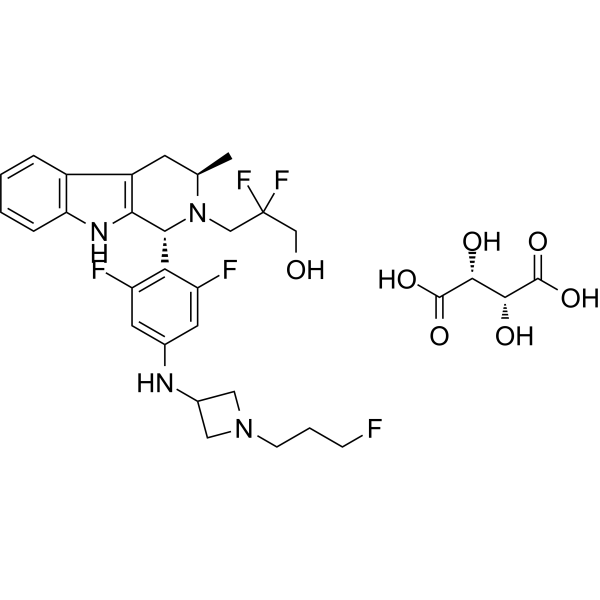
Giredestrant tartrate
Based on 6 publication(s) in Google Scholar
Giredestrant tartrate (GDC-9545 tartrate) is an orally active, full, selective Estrogen receptor α (ERα) degrader and antagonist with a DC50 of 0.03 nM. Giredestrant tartrate promotes the degradation of ERα protein, including the ESR1Y537S mutant ERα. Giredestrant tartrate reduces uterine wet weight in immature rats and induces a low cuboidal phenotype in their endometrial epithelium. Giredestrant tartrate induces tumor regression in both ESR1Y537S mutant and wild-type ERα tumor models. Giredestrant tartrate can be used for the research of ER+ breast cancer.
For research use only. We do not sell to patients.
- CAS No.: 2407529-33-1
- Formula: C31H37F5N4O7
- Molecular Weight:672.64
-
Storage:
Please store the product under the recommended conditions in the Certificate of Analysis.

To place orders, for customer services and technical support, please contact: MedChemExpress USA
Tel: 609-228-6898 E-mail: [email protected] [email protected]


-
 Biological Activity
-
Chemical Information
- Purity & Documentation
- References
-
 Help & FAQs


Publications Citing Use of MedChemExpress (MCE) Giredestrant tartrate
More

Biological Activity
Description
IC50 & Target
[1]|
ERα 0.03 nM (DC50) |
In Vitro
Giredestrant tartrate potently inhibits ERα-mediated luciferase activity in T-47D wild-type breast cancer cells, with an IC50 of 0.05 nM[1].
Giredestrant tartrate potently degrades ERα in MCF-7 wild-type breast cancer cells, with a DC50 of 0.03 nM and a maximum degradation efficiency of 101%[1].
Giredestrant tartrate inhibits the proliferation of MCF-7 wild-type breast cancer cells, with an EC50 of 0.4 nM[1].
Giredestrant (0.1 nM-1 μM; 24 h) tartrate induces significant ERα degradation in ER+ breast cancer cell lines including CAMA-1, EFM-19, HCC1500, MCF-7, MDA-MB-134VI, MDA-MB-330 and T-47D starting at a concentration of 0.1 nM, and exhibits higher efficiency than GDC-0810 (HY-12864) and GDC-0927 (HY-111484)[1].
Giredestrant (1 nM; 0.5-24 h) tartrate promotes rapid degradation of ERα in MCF-7 breast cancer cells, with a half-life of 1.8 h[1].
MedChemExpress (MCE) has not independently confirmed the accuracy of these methods. They are for reference only.
-
Cell Line:CAMA-1, EFM-19, HCC1500, MCF-7, MDA-MB-134VI, MDA-MB-330, T-47D ER+ breast cancer cell lines
-
Concentration:0.1 nM, 1 nM, 10 nM, 100 nM, 1 μM
-
Incubation Time:24 h
-
Result:Promoted significant ERα degradation across all seven tested cell lines, starting at the lowest concentration of 0.1 nM.
Was a more efficient degrader than fulvestrant, GDC-0810, and GDC-0927 in all cell lines.
-
Cell Line:MCF-7 wild-type breast cancer cells
-
Concentration:1 nM
-
Incubation Time:0.5, 1, 2, 4, 6, 24 h
-
Result:Promoted rapid ERα turnover with a half-life of 1.8 h, which was faster than GDC-0927 (6.0 h) and GDC-0810 (16.5 h), and comparable to Fulvestrant (HY-13636) (2.2 h).
Induced the highest ERα degradation at 24 h among the tested compounds.
In Vivo
Giredestrant (0.1-1 mg/kg; p.o.; once daily; for 29 consecutive days) tartrate induces tumor regression in the ESR1Y537S-mutant ER+ breast cancer PDX model, even when administered at a daily oral dose as low as 0.1 mg/kg[1].
Giredestrant (3 mg/kg; p.o.; once daily; for 26 consecutive days) tartrate inhibits the growth of wild-type ER+ breast cancer xenografts by up to 79%; when combined with Palbociclib (HY-50767), it induces a maximum tumor regression of 108%[1].
MedChemExpress (MCE) has not independently confirmed the accuracy of these methods. They are for reference only.
-
Animal Model:Immature female rats[1]
-
Dosage:0.1 mg/kg; 10 mg/kg
-
Administration:p.o.; daily; 4 days
-
Result:Caused a statistically significant reduction in the ratio of uterine wet weight to body weight at 10 mg/kg, comparable to the positive control SERD 11.
Induced low cuboidal uterine epithelial cells at 10 mg/kg, consistent with inverse agonism.
-
Animal Model:Immunocompromised mice (PDX model host)[1]
-
Dosage:0.1 mg/kg; 1 mg/kg
-
Administration:p.o.; daily; 29 days
-
Result:Suppressed tumor growth at 0.1 mg/kg and 1 mg/kg.
Induced tumor regression at 1 mg/kg, comparable to the positive control SERD 11 at 100 mg/kg.
Achieved 1 mg/kg efficacy with 10-fold lower plasma concentration than SERD 11 at 100 mg/kg, while promoting 1.8-fold higher ERα turnover.
-
Animal Model:Immunocompromised mice (xenograft model host)[1]
-
Dosage:3 mg/kg (single agent); 3 mg/kg (in combination with palbociclib 50 mg/kg)
-
Administration:p.o.; daily; 26 days
-
Result:Inhibited tumor growth by 79% as a single agent at 3 mg/kg.
Induced tumor regression up to 108% after 24 days when combined with palbociclib at 3 mg/kg, outperforming the combination of fulvestrant and palbociclib.
Resulted in well-tolerated treatments across all groups.


Chemical Information
-
CAS No. 2407529-33-1
-
Molecular Weight 672.64
-
Formula C31H37F5N4O7
-
SMILES
C[C@H](C1)N(CC(F)(F)CO)[C@H](C2=C(F)C=C(NC3CN(CCCF)C3)C=C2F)C4=C1C5=C(N4)C=CC=C5.OC([C@H](O)[C@@H](O)C(O)=O)=O
-
Synonyms
GDC-9545 tartrate; RG6171 tartrate
-
Shipping
Room temperature in continental US; may vary elsewhere.
-
Storage
Please store the product under the recommended conditions in the Certificate of Analysis.


Publications (6)
-
Journal Impact Factor
-
Most Recent
-
Cancer Discov
2024 Feb 8;14(2):274-289. PMID: 37982575 -
-
bioRxiv
Targeting Unique Ligand Binding Domain Structural Features Downregulates DKK1 in Y537S ESR1 Mutant Breast Cancer Cells. [Abstract]2024 Jun 2:2024.05.28.596307. PMID: 38854123 -
-
-


Purity & Documentation
References

Calculators
Concentration (start) × Volume (start) = Concentration (final) × Volume (final)


Giredestrant tartrate Related Classifications
HY-135903 Related Classifications
 Powered by Bioz
Keywords
- Giredestrant
- 2407529-33-1
- GDC-9545
- RG6171
- GDC9545
- GDC 9545
- RG 6171
- RG-6171
- Estrogen Receptor/ERR
- immature rats
- human liver microsomes
- T-47D wild-type breast cancer cells
- MCF-7 wild-type breast cancer cells
- ER+ breast cancer cells
- ERα
- ESR1 Y537S mutant ERα
- hERG channels
- estrogen receptor alpha
- rat liver microsomes
- Inhibitor
- inhibitor
- inhibit