



NOX-6-18 (dihydrocholide)
Based on 1 publication(s) in Google Scholar
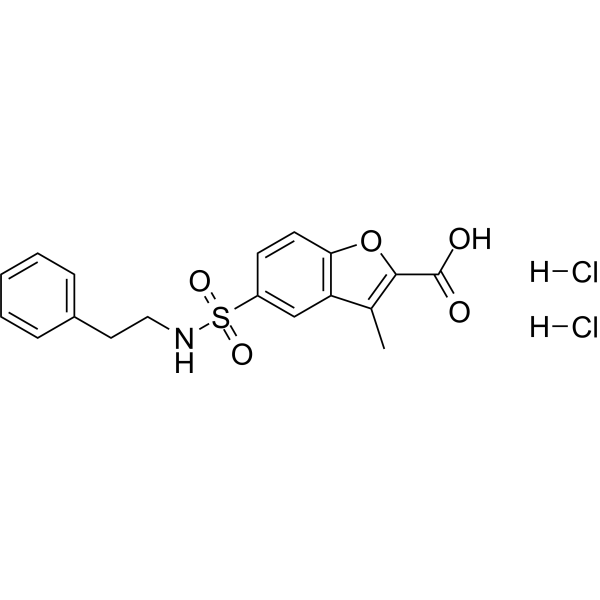
NOX-6-18 (dihydrocholide) (GPR132 antagonist 1 (diHYdrocholide)) is a GPR132 antagonist with an IC50 of 15.17 nM against the human target. NOX-6-18 (dihydrocholide) inhibits GPR132 activation via interaction with non-conserved residues, blocks activities induced by endogenous agonists and 9 (S)-HODE, and exhibits selectivity for other fatty acid-binding GPCRs. NOX-6-18 (dihydrocholide) regulates macrophage reprogramming, alleviates inflammatory responses, downregulates inflammatory markers and signaling pathways, and reduces the degree of hepatic steatosis and hepatic triglyceride levels. NOX-6-18 (dihydrocholide) regulates metabolic homeostasis, reduces weight gain, enhances glucose metabolism, improves glucose tolerance, decreases fasting blood glucose and insulin levels, and partially reverses reductions in energy expenditure and respiratory quotient. NOX-6-18 (dihydrocholide) can be used in the research of type 2 diabetes.
For research use only. We do not sell to patients.
- Formula: C18H19Cl2NO5S
- Molecular Weight:432.32
-
Storage:
Please store the product under the recommended conditions in the Certificate of Analysis.

To place orders, for customer services and technical support, please contact: MedChemExpress USA
Tel: 609-228-6898 E-mail: [email protected] [email protected]


-
 Biological Activity
-
Chemical Information
- Purity & Documentation
- References
-
 Help & FAQs


Publications Citing Use of MedChemExpress (MCE) NOX-6-18 (dihydrocholide)
More

Biological Activity
Description
IC50 & Target
[1]|
GPR132 15.17 nM (IC50) |
In Vitro
NOX-6-18 (dihydrocholide) (GPR132 antagonist 1 (diHYdrocholide)) potently inhibits 9(S)-HODE-induced GPR132 activation in GPR132-overexpressing HEK 293 cells with an IC50 of 15.17 nM[1].
NOX-6-18 (dihydrocholide) is a selective antagonist of GPR132, with no significant inhibitory activity against FFAR1, FFAR2, FFAR3, FFAR4, or GPR119 in agonist-stimulated HEK 293 cells[1].
NOX-6-18 (dihydrocholide) inhibits 9(S)-HODE-induced increases in phagocytic capacity in primary CD11c+ Ly6C− F4/80lo islet-resident macrophages[1].
NOX-6-18 (dihydrocholide) significantly reduces the 9(S)-HODE-induced expression of inflammatory markers Il1b, Tnf, Ccl2, and Cxcl1 in primary CD11c+ Ly6C− F4/80lo islet-resident macrophages[1].
MedChemExpress (MCE) has not independently confirmed the accuracy of these methods. They are for reference only.
In Vivo
MedChemExpress (MCE) has not independently confirmed the accuracy of these methods. They are for reference only.
-
Animal Model:Wild-type (WT), Gpr132fl/fl, Lyz2-cre+/−Gpr132fl/fl (male, female, high-fat diet induced Type 2 diabetes mellitus)[1]
-
Dosage:25 ng per gram body weight
-
Administration:i.p.; every other day; 4-6 weeks or 12-14 weeks
-
Result:Significantly reduced HFD-induced weight gain in male and female WT mice after 12-14 week treatment.
Improved glucose tolerance in male and female HFD-fed mice after 12-14 week treatment.
Improved insulin tolerance in male HFD-fed mice after 12-14 week treatment.
Reduced fasting plasma glucose and insulin levels in HFD-fed mice after 12-14 week treatment.
Reduced refeeding plasma glucose levels and increased refeeding insulin levels in HFD-fed mice after 12-14 week treatment.
Reduced liver and white adipose tissue (WAT) weight, hepatic steatosis, and hepatic triglyceride levels in HFD-fed mice after 12-14 week treatment.
Reduced CD11c+ islet cell numbers in pancreatic islets of HFD-fed mice after 12-14 week treatment.
Downregulated mRNA levels of inflammatory markers Il1b, Tnf, Ccl2, and Cxcl1 in CD11c+ Ly6C− F4/80lo islet-resident macrophages from HFD-fed mice after 12-14 week treatment.
Downregulated inflammatory cytokine mRNA levels in F4/80+ macrophages from liver and WAT of HFD-fed mice after 12-14 week treatment.
Partially reversed reduced energy expenditure and respiratory quotient in HFD-fed mice after 12-14 week treatment.
Significantly reduced HFD-induced weight gain after 4-6 week treatment.
Improved glucose tolerance in HFD-fed mice after 4-6 week treatment.
Downregulated mRNA levels of inflammatory markers Ccl2 and Cxcl1 in CD11c+ Ly6C− F4/80lo islet-resident macrophages from HFD-fed mice after 4-6 week treatment.
Reduced CD11c+ islet cell numbers in pancreatic islets of HFD-fed mice after 4-6 week treatment.


Chemical Information
-
Molecular Weight 432.32
-
Formula C18H19Cl2NO5S
-
SMILES
O=C(C1=C(C)C2=C(C=CC(S(=O)(NCCC3=CC=CC=C3)=O)=C2)O1)O.[H]Cl.[H]Cl
-
Synonyms
GPR132 antagonist 1 (dihydrocholide)
-
Shipping
Room temperature in continental US; may vary elsewhere.
-
Storage
Please store the product under the recommended conditions in the Certificate of Analysis.


Publications (1)
-
Journal Impact Factor
-
Most Recent
-
Int Immunopharmacol
GPR132 drives macrophage M1 polarization and aggravates inflammation-associated liver injury. [Abstract]2026 Apr 1:174:116349. PMID: 41679180


Purity & Documentation
References

Calculators
Concentration (start) × Volume (start) = Concentration (final) × Volume (final)


NOX-6-18 (dihydrocholide) Related Classifications
HY-157189A Related Classifications
 Powered by Bioz