



NOX-6-18
Based on 1 publication(s) in Google Scholar
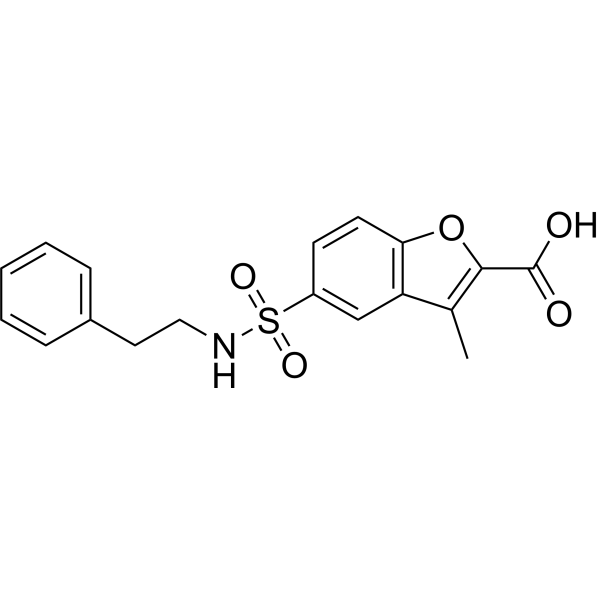
NOX-6-18 (GPR132 antagonist 1) is a GPR132 antagonist with an IC50 of 15.17 nM against the human target. NOX-6-18 inhibits GPR132 activation via interaction with non-conserved residues, blocks activities induced by endogenous agonists and 9 (S)-HODE, and exhibits selectivity for other fatty acid-binding GPCRs. NOX-6-18 regulates macrophage reprogramming, alleviates inflammatory responses, downregulates inflammatory markers and signaling pathways, and reduces the degree of hepatic steatosis and hepatic triglyceride levels. NOX-6-18 regulates metabolic homeostasis, reduces weight gain, enhances glucose metabolism, improves glucose tolerance, decreases fasting blood glucose and insulin levels, and partially reverses reductions in energy expenditure and respiratory quotient. NOX-6-18 can be used in the research of type 2 diabetes.
Nos produits utilisent uniquement pour la recherche. Nous ne vendons pas aux patients.
- Pureté : 99.72%
- CAS No.: 898211-21-7
- Formule: C18H17NO5S
- Masse moléculaire:359.40
-
Stockage:Powder -20°C, 3 years ; In solvent -80°C, 6 months , -20°C, 1 month

To place orders, for customer services and technical support, please contact: MedChemExpress USA
Tel: 609-228-6898 E-mail: [email protected] [email protected]


-
 Activité biologique
-
Chemical Information
-
Solvant et solubilité
- Protocole
- Pureté et documentation
- Références
-
 Help & FAQs


Publications Citing Use of MedChemExpress (MCE) NOX-6-18
More

Activité biologique
Description
IC50 & Target
[1]|
GPR132 15.17 nM (IC50) |
In Vitro
NOX-6-18 (GPR132 antagonist 1) potently inhibits 9(S)-HODE-induced GPR132 activation in GPR132-overexpressing HEK 293 cells with an IC50 of 15.17 nM[1].
NOX-6-18 is a selective antagonist of GPR132, with no significant inhibitory activity against FFAR1, FFAR2, FFAR3, FFAR4, or GPR119 in agonist-stimulated HEK 293 cells[1].
NOX-6-18 inhibits 9(S)-HODE-induced increases in phagocytic capacity in primary CD11c+ Ly6C− F4/80lo islet-resident macrophages[1].
NOX-6-18 significantly reduces the 9(S)-HODE-induced expression of inflammatory markers Il1b, Tnf, Ccl2, and Cxcl1 in primary CD11c+ Ly6C− F4/80lo islet-resident macrophages[1].
MedChemExpress (MCE) has not independently confirmed the accuracy of these methods. They are for reference only. Further protocols information, click here.
In Vivo
MedChemExpress (MCE) has not independently confirmed the accuracy of these methods. They are for reference only.
-
Animal Model:Wild-type (WT), Gpr132fl/fl, Lyz2-cre+/−Gpr132fl/fl (male, female, high-fat diet induced Type 2 diabetes mellitus)[1]
-
Dosage:25 ng per gram body weight
-
Administration:i.p.; every other day; 4-6 weeks or 12-14 weeks
-
Result:Significantly reduced HFD-induced weight gain in male and female WT mice after 12-14 week treatment.
Improved glucose tolerance in male and female HFD-fed mice after 12-14 week treatment.
Improved insulin tolerance in male HFD-fed mice after 12-14 week treatment.
Reduced fasting plasma glucose and insulin levels in HFD-fed mice after 12-14 week treatment.
Reduced refeeding plasma glucose levels and increased refeeding insulin levels in HFD-fed mice after 12-14 week treatment.
Reduced liver and white adipose tissue (WAT) weight, hepatic steatosis, and hepatic triglyceride levels in HFD-fed mice after 12-14 week treatment.
Reduced CD11c+ islet cell numbers in pancreatic islets of HFD-fed mice after 12-14 week treatment.
Downregulated mRNA levels of inflammatory markers Il1b, Tnf, Ccl2, and Cxcl1 in CD11c+ Ly6C− F4/80lo islet-resident macrophages from HFD-fed mice after 12-14 week treatment.
Downregulated inflammatory cytokine mRNA levels in F4/80+ macrophages from liver and WAT of HFD-fed mice after 12-14 week treatment.
Partially reversed reduced energy expenditure and respiratory quotient in HFD-fed mice after 12-14 week treatment.
Significantly reduced HFD-induced weight gain after 4-6 week treatment.
Improved glucose tolerance in HFD-fed mice after 4-6 week treatment.
Downregulated mRNA levels of inflammatory markers Ccl2 and Cxcl1 in CD11c+ Ly6C− F4/80lo islet-resident macrophages from HFD-fed mice after 4-6 week treatment.
Reduced CD11c+ islet cell numbers in pancreatic islets of HFD-fed mice after 4-6 week treatment.


Chemical Information
-
CAS No. 898211-21-7
-
Appearance Solid
-
Masse moléculaire 359.40
-
Formule C18H17NO5S
-
Color White to off-white
-
SMILES
O=C(C1=C(C)C2=C(C=CC(S(=O)(NCCC3=CC=CC=C3)=O)=C2)O1)O
-
Synonyms
GPR132 antagonist 1
-
Livraison
Room temperature in continental US; may vary elsewhere.
-
Stockage
Powder -20°C 3 years In solvent -80°C 6 months -20°C 1 month


Publications (1)
-
Journal Impact Factor
-
Most Recent
-
Int Immunopharmacol
GPR132 drives macrophage M1 polarization and aggravates inflammation-associated liver injury. [Abstract]2026 Apr 1:174:116349. PMID: 41679180


Solvant et solubilité
In Vitro:
DMSO : ≥ 100 mg/mL (278.24 mM; Hygroscopic DMSO has a significant impact on the solubility of product, please use newly opened DMSO)
* "≥" means soluble, but saturation unknown.
Please refer to the solubility information to select the appropriate solvent. Once prepared, please aliquot and store the solution to prevent product inactivation from repeated freeze-thaw cycles.
Storage method and period of stock solution: -80°C, 6 months; -20°C, 1 month. When stored at -80°C, please use it within 6 months. When stored at -20°C, please use it within 1 month.
Please refer to the solubility information to select the appropriate solvent. Once prepared, please aliquot and store the solution to prevent product inactivation from repeated freeze-thaw cycles.
Storage method and period of stock solution: -80°C, 6 months; -20°C, 1 month. When stored at -80°C, please use it within 6 months. When stored at -20°C, please use it within 1 month.
Concentration (start) × Volume (start) = Concentration (final) × Volume (final)
In Vivo:
Select the appropriate dissolution method based on your experimental animal and administration route.
- For the following dissolution methods, please ensure to first prepare a clear stock solution using an In Vitro approach and then sequentially add co-solvents:
- To ensure reliable experimental results, the clarified stock solution can be appropriately stored based on storage conditions. As for the working solution for In Vivo experiments, it is recommended to prepare freshly and use it on the same day.
- The percentages shown for the solvents indicate their volumetric ratio in the final prepared solution. If precipitation or phase separation occurs during preparation, heat and/or sonication can be used to aid dissolution.
Add each solvent one by one: 10% DMSO 40% PEG300 5% Tween-80 45% Saline
Solubility: ≥ 2.5 mg/mL (6.96 mM); Clear solution
This protocol yields a clear solution of ≥ 2.5 mg/mL (saturation unknown).
Taking 1 mL working solution as an example, add 100 μL DMSO stock solution (25.0 mg/mL) to 400 μL PEG300, and mix evenly; then add 50 μL Tween-80 and mix evenly; then add 450 μL Saline to adjust the volume to 1 mL.
Preparation of Saline: Dissolve 0.9 g sodium chloride in ddH₂O and dilute to 100 mL to obtain a clear Saline solution.
In Vivo Dissolution Calculator
Please enter the basic information of animal experiments:
-
-
-
-
Recommended: Prepare an additional quantity of animals to account for potential losses during experiments.
Please enter your animal formula composition:
-
%DMSO +
Recommended: Keep the proportion of DMSO in working solution below 2% if your animal is weak.
-
%+
-
+%Tween-80 + +
-
%Saline +
The co-solvents required include: DMSO, . All of co-solvents are available by MedChemExpress (MCE). , Tween 80. All of co-solvents are available by MedChemExpress (MCE).
Working solution concentration: 0.22 mg/mL
Method for preparing stock solution: mg drug dissolved in μL DMSO. Stock solution concentration: mg/mL.
1. Take μL DMSO stock solution;
2. Add μL .
μL , mix evenly;
3. Then add μL Tween 80, mix evenly;
4. Then add μL
Please ensure that the stock solution in the first step is dissolved to a clear state, and add co-solvents in sequence. You can use ultrasonic heating (ultrasonic cleaner, recommended frequency 20-40 kHz), vortexing, etc. to assist dissolution.

Protocole
-
Cell Cytotoxicity Assay
Cytotoxicity assays are usually based on the assessment of cell membrane damage, which can also be indirectly detected by measuring cell viability. Detection methods include MTT assay, CKK-8 assay, LDH assay and ATP assay, etc.
-
Research Protocol for Endocrine Diseases
Endocrine diseases often arise from disrupted hormone production, hormone signaling, or target-tissue responsiveness; for diabetes-focused endocrine disease models, insulin signaling regulates glucose uptake, hepatic glucose output, lipid metabolism, and β-cell compensation. Type 2 diabetes develops through interacting defects in insulin resistance, β-cell dysfunction, adipose inflammation, hepatic glucose overproduction, altered incretin signaling, and ectopic lipid metabolism. A major unresolved question is whether endocrine dysfunction is driven primarily by target-tissue insulin resistance, intrinsic β-cell failure, immune/inflammatory stress, or combined multi-organ failure that differs by disease stage.
-
Research Protocol for Metabolic Diseases
AMP-activated protein kinase, AMPK, is a conserved cellular energy sensor that responds to reduced cellular energy status and coordinates metabolism by increasing ATP-generating catabolic pathways while suppressing ATP-consuming anabolic processes. In metabolic disease research, the AMPK pathway is experimentally relevant because it regulates hepatic lipid synthesis, fatty acid oxidation, glucose production, skeletal-muscle glucose disposal, mTORC1-linked biosynthesis, autophagy, mitochondrial homeostasis, and whole-body energy balance. The central pathway logic is that energy stress, metformin, exercise-like stimulation, or direct AMPK activators increase AMPKα Thr172 phosphorylation and downstream substrate phosphorylation, including ACC and RAPTOR. Phosphorylation of ACC suppresses lipogenesis and supports fatty acid oxidation, whereas phosphorylation of RAPTOR suppresses mTORC1 signaling and links cellular energy status to growth and protein synthesis control. The pathway is linked
-
Liver Histomorphometry
Liver histomorphometry is a quantitative histological approach used to measure structural alterations in hepatic tissue, including parenchymal loss, steatosis, fibrosis, and vascular remodeling, by combining stained tissue section analysis with stereological or computerized image-based measurements. Classical morphometric frameworks quantify volume fractions of liver compartments and fibrotic regions using systematic sampling and image analysis, enabling objective comparison of pathological changes across experimental groups. These approaches are widely applied in liver cirrhosis and fibrosis studies to reduce subjectivity in histological scoring and improve reproducibility of tissue evaluation. Recent methodological advances integrate automated image analysis and radiomics-based extraction of histological features from standard liver stains (e. g. , H&E and fibrotic stains), enabling quantitative correlation between morphometric features and fibrosis stages in non-alcoholic fatty live


Pureté et documentation
-
Fiche technique (286 KB)
-
SDS (254 KB)
- English - EN (254 KB)
- Français - FR (254 KB)
- Deutsch - DE (254 KB)
- Norwegian - NO (254 KB)
- Español - ES (254 KB)
- Swedish - SV (254 KB)
- Italian - IT (254 KB)
- Korean - KR (254 KB)
- Portuguese - PT (254 KB)
-
Instruction de manipulation (2659 KB)
Références


Complete Stock Solution Preparation Table
Please refer to the solubility information to select the appropriate solvent. Once prepared, please aliquot and store the solution to prevent product inactivation from repeated freeze-thaw cycles.
Storage method and period of stock solution: -80°C, 6 months; -20°C, 1 month. When stored at -80°C, please use it within 6 months. When stored at -20°C, please use it within 1 month.
| Optional Solvent | Concentration Solvent Mass | 1 mg | 5 mg | 10 mg | 25 mg |
|---|---|---|---|---|---|
| DMSO | 1 mM | 2.7824 mL | 13.9121 mL | 27.8242 mL | 69.5604 mL |
| 5 mM | 0.5565 mL | 2.7824 mL | 5.5648 mL | 13.9121 mL | |
| 10 mM | 0.2782 mL | 1.3912 mL | 2.7824 mL | 6.9560 mL | |
| 15 mM | 0.1855 mL | 0.9275 mL | 1.8549 mL | 4.6374 mL | |
| 20 mM | 0.1391 mL | 0.6956 mL | 1.3912 mL | 3.4780 mL | |
| 25 mM | 0.1113 mL | 0.5565 mL | 1.1130 mL | 2.7824 mL | |
| 30 mM | 0.0927 mL | 0.4637 mL | 0.9275 mL | 2.3187 mL | |
| 40 mM | 0.0696 mL | 0.3478 mL | 0.6956 mL | 1.7390 mL | |
| 50 mM | 0.0556 mL | 0.2782 mL | 0.5565 mL | 1.3912 mL | |
| 60 mM | 0.0464 mL | 0.2319 mL | 0.4637 mL | 1.1593 mL | |
| 80 mM | 0.0348 mL | 0.1739 mL | 0.3478 mL | 0.8695 mL | |
| 100 mM | 0.0278 mL | 0.1391 mL | 0.2782 mL | 0.6956 mL |


NOX-6-18 Related Classifications
HY-157189 Related Classifications
 Powered by Bioz