



L-Cysteine hydrochloride (Standard)
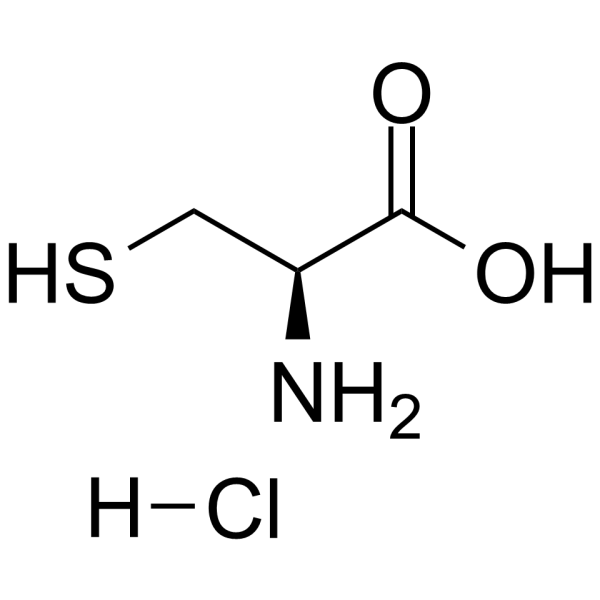
L-Cysteine (hydrochloride) (Standard) is the analytical standard of L-Cysteine (hydrochloride). This product is intended for research and analytical applications. L-Cysteine hydrochloride is an orally active conditionally essential amino acid, which acts as a precursor for biologically active molecules such as hydrogen sulphide (H2S), glutathione and taurine. L-Cysteine hydrochloride suppresses ghrelin and reduces appetite in rodents. L-Cysteine hydrochloride inhibits Aspergillus flavus growth and AFB synthesis by disrupting cell structure and antioxidant system balance. L-Cysteine hydrochloride enhances relaxant responses of rat aortic rings to NO and reduces responses to endothelium-derived relaxing factor (EDRF)[4].
For research use only. We do not sell to patients.
- Purity: 98%
- CAS No.: 52-89-1
- Formula: C3H8ClNO2S
- Molecular Weight:157.62
-
Storage:
Please store the product under the recommended conditions in the Certificate of Analysis.


To place orders, for customer services and technical support, please contact: MedChemExpress USA
Tel: 609-228-6898 E-mail: [email protected] [email protected]


-
 Product Information
-
Chemical Information
- Purity & Documentation
-
 Help & FAQs






Product Information
Information
Application
The compound is the grade of analytical standard, which is the reference standard supplied assay. It is commonly used in qualitative, quantitative and methodological research experiments in HPLC, GC and MS.


Chemical Information
-
CAS No. 52-89-1
-
Molecular Weight 157.62
-
Formula C3H8ClNO2S
-
SMILES
N[C@@H](CS)C(O)=O.[H]Cl
-
Structure Classification
-
Initial Source
-
Shipping
Room temperature in continental US; may vary elsewhere.
-
Storage
Please store the product under the recommended conditions in the Certificate of Analysis.


Purity & Documentation
References
[1]. McGavigan AK, et al. L-cysteine suppresses ghrelin and reduces appetite in rodents and humans. Int J Obes (Lond). 2015 Mar;39(3):447-55. [Content Brief]
[2]. Qiu M, et al. L-Cysteine hydrochloride inhibits Aspergillus flavus growth and AFB1 synthesis by disrupting cell structure and antioxidant system balance. J Hazard Mater. 2023 Oct 5;459:132218. [Content Brief]
[3]. Ellis A, et al. Differential actions of L-cysteine on responses to nitric oxide, nitroxyl anions and EDRF in the rat aorta. Br J Pharmacol. 2000 Jan;129(2):315-22. [Content Brief]

Calculators
Concentration (start) × Volume (start) = Concentration (final) × Volume (final)


L-Cysteine hydrochloride (Standard) Related Classifications
HY-Y0337AR Related Classifications
 Powered by Bioz