



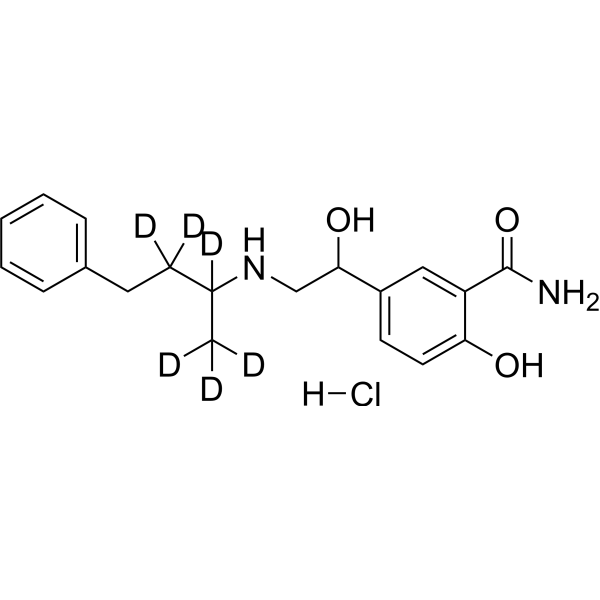
Labetalol-d6 hydrochloride
Labetalol hydrochloride-d6 (AH-5158 hydrochloride-d6) is deuterium labeled Labetalol hydrochloride (HY-B1108). Labetalol (AH5158) hydrochloride is an orally available, selective α1-adrenergic recepto and non-selective β-adrenergic receptor competitive antagonist. Labetalol hydrochloride is an antihypertensive molecule that partially crosses the blood-brain barrier and has little effect on cardiac output. Labetalol hydrochloride can be used in the study of cardiovascular diseases, such as hypertension during pregnancy.
For research use only. We do not sell to patients.
- Formula: C19H19D6ClN2O3
- Molecular Weight:370.90
-
Storage:
Please store the product under the recommended conditions in the Certificate of Analysis.

To place orders, for customer services and technical support, please contact: MedChemExpress USA
Tel: 609-228-6898 E-mail: [email protected] [email protected]


-
 Biological Activity
-
Chemical Information
- Purity & Documentation
- References
-
 Help & FAQs




Biological Activity
Description
Application
1. This compound can be used as a tracer
2. This compound can be used as an internal standard for quantitative analysis by NMR, GC-MS, or LC-MS.


Chemical Information
-
Molecular Weight 370.90
-
Formula C19H19D6ClN2O3
-
SMILES
O=C(N)C1=CC(C(O)CNC([2H])(C([2H])([2H])[2H])C([2H])([2H])CC2=CC=CC=C2)=CC=C1O.[H]Cl
-
Synonyms
AH5158-d6 hydrochloride; Sch-15719W-d6
-
Shipping
Room temperature in continental US; may vary elsewhere.
-
Storage
Please store the product under the recommended conditions in the Certificate of Analysis.


Purity & Documentation
References
[1]. Russak EM, et al. Impact of Deuterium Substitution on the Pharmacokinetics of Pharmaceuticals. Ann Pharmacother. 2019;53(2):211-236. [Content Brief]
[2]. Greenslade FC, et al. Labetalol binding to specific alpha- and beta-adrenergic sites in vitro and its antagonism of adrenergic responses in vivo. J Mol Cell Cardiol. 1979 Aug;11(8):803-11. [Content Brief]
[3]. Erdtsieck-Ernste EB, et al. Changes in adrenoceptors and monoamine metabolism in neonatal and adult rat brain after postnatal exposure to the antihypertensive labetalol. Br J Pharmacol. 1992 Jan;105(1):37-44. [Content Brief]
[4]. Johnson JD, et al. Catecholamines mediate stress-induced increases in peripheral and central inflammatory cytokines. Neuroscience. 2005;135(4):1295-307. [Content Brief]

Calculators
Concentration (start) × Volume (start) = Concentration (final) × Volume (final)


Labetalol-d6 hydrochloride Related Classifications
HY-W728545 Related Classifications
 Powered by Bioz