



MS8847

Based on 1 Customer Validation
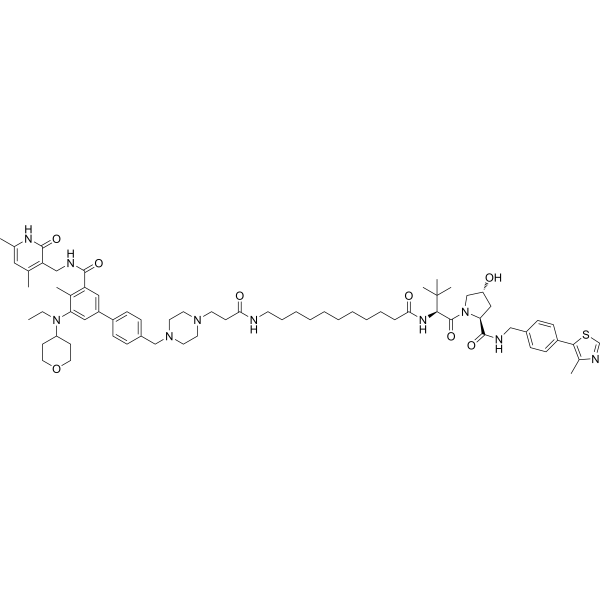
MS8847 is a PROTAC degrader and antiproliferative agent targeting EZH2 (DC50=34.4 nM in EOL-1 MLL-rAML cells). MS8847 recruits the E3 ligase von Hippel-Lindau (VHL) to mediate the degradation of EZH2 via the ubiquitin-proteasome system. MS8847 induces antiproliferative effects in MLL-rearranged acute myeloid leukemia cells and inhibits the growth of triple-negative breast cancer cell lines or 3D triple-negative breast cancer models. MS8847 is applicable to research related to MLL-rearranged acute myeloid leukemia and triple-negative breast cancer.
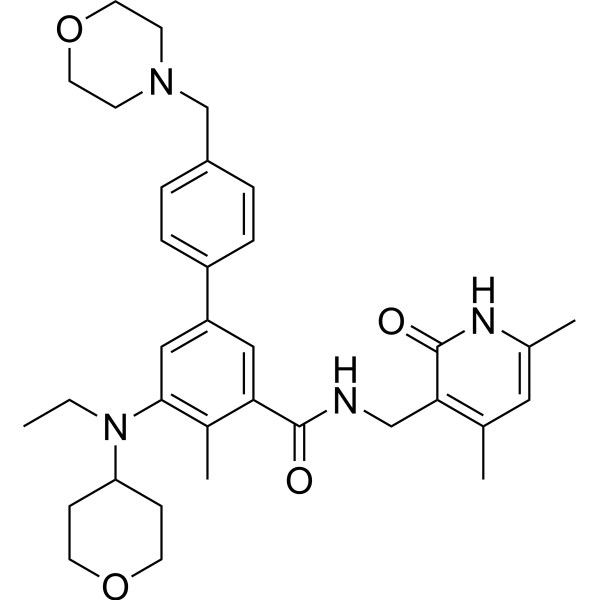
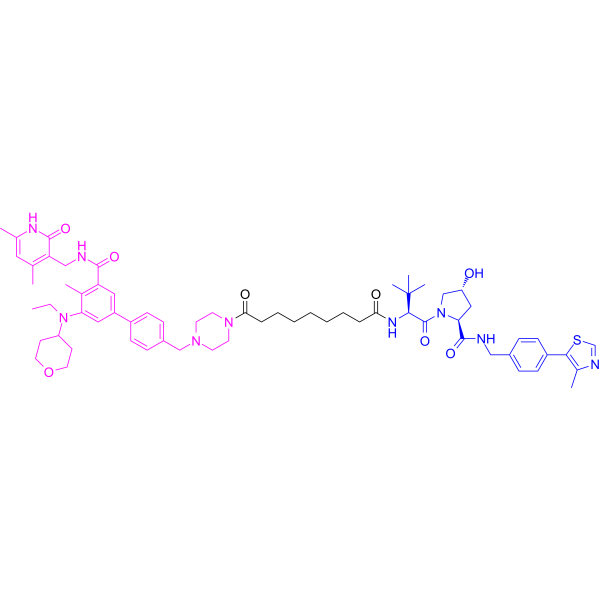
(Pink: EZH2 ligand (HY-185582); Blue: VHL ligand (HY-125845); Black: linker (HY-W014831)).
Nos produits utilisent uniquement pour la recherche. Nous ne vendons pas aux patients.
- Pureté : 99.78%
- CAS No.: 3050872-59-5
- Formule: C70H98N10O8S
- Masse moléculaire:1239.65
-
Stockage:Powder -20°C, 3 years , 4°C, 2 years ; In solvent -80°C, 6 months , -20°C, 1 month

To place orders, for customer services and technical support, please contact: MedChemExpress USA
Tel: 609-228-6898 E-mail: [email protected] [email protected]


-
 Activité biologique
-
Chemical Information
-
Solvant et solubilité
- Protocole
- Pureté et documentation
- Références
-
 Help & FAQs


Voir tous les produits spécifiques à Isoform PROTACs
MoreVoir tous les produits spécifiques à Isoform Histone Methyltransferase
More

Activité biologique
Description
IC50 & Target
|
VHL |
EZH2 |
Cellular Effect
|
Cell Line

|
Type | Value | Description | References |
|---|---|---|---|---|
| BT-549 | IC50 |
1.45 μM
Compound: 8; MS8847
|
Anti-proliferative activity against human BT-549 cells assessed as cell growth inhibition measured after 5 days incubation by CCK-8 assay
Anti-proliferative activity against human BT-549 cells assessed as cell growth inhibition measured after 5 days incubation by CCK-8 assay
|
[PMID: 38295690] |
| EOL1 | IC50 |
0.11 μM
Compound: 8; MS8847
|
Anti-proliferative activity against human EOL1 cells assessed as cell viability measured after 5 days incubation by CCK-8 assay
Anti-proliferative activity against human EOL1 cells assessed as cell viability measured after 5 days incubation by CCK-8 assay
|
[PMID: 38295690] |
| MDA-MB-468 | IC50 |
0.45 μM
Compound: 8; MS8847
|
Anti-proliferative activity against human MDA-MB-468 cells assessed as cell growth inhibition measured after 5 days incubation by CCK-8 assay
Anti-proliferative activity against human MDA-MB-468 cells assessed as cell growth inhibition measured after 5 days incubation by CCK-8 assay
|
[PMID: 38295690] |
| MV4-11 | IC50 |
0.17 μM
Compound: 8; MS8847
|
Anti-proliferative activity against human MV4-11 cells assessed as cell viability measured after 5 days incubation by CCK-8 assay
Anti-proliferative activity against human MV4-11 cells assessed as cell viability measured after 5 days incubation by CCK-8 assay
|
[PMID: 38295690] |
| RS4-11 | IC50 |
0.41 μM
Compound: 8; MS8847
|
Anti-proliferative activity against human RS4-11 cells assessed as cell viability measured after 5 days incubation by CCK-8 assay
Anti-proliferative activity against human RS4-11 cells assessed as cell viability measured after 5 days incubation by CCK-8 assay
|
[PMID: 38295690] |
In Vitro
MS8847 selectively targets EZH2-dependent cell growth and inhibits the proliferation of triple-negative breast cancer (TNBC) cells, with 5-day IC50 values of 1.45 μM (BT549) and 0.45 μM (MDA-MB-468), respectively. It also inhibits the proliferation of MLL-r AML cell lines, with 5-day IC50 values of 0.11 μM (EOL-1), 0.17 μM (MV4;11) and 0.41 μM (RS4;11), respectively[1].
MS8847 (0.1-1 μM; 24 h) completely degrades EZH2 protein in EOL-1 MLL-r AML cells[1].
MS8847 (1 nM-0.3 μM; 24 h) potently degrades EZH2 in a concentration-dependent manner in EOL-1 MLL-rAML cells, with a DC50 of 34.4 nM, and also degrades EED and SUZ12[1].
MS8847 (2.5-20 μM; 5 d) significantly inhibits cell growth and reduces spheroid size in a 3D in vitro BT549 TNBC model[1].
MedChemExpress (MCE) has not independently confirmed the accuracy of these methods. They are for reference only.
-
Cell Line:EOL-1 (MLL-r AML cell line)
-
Concentration:1-1000 nM; 0.03-0.3 μM
-
Incubation Time:24 h
-
Result:Achieved a half-maximal degradation concentration (DC50) of 34.4 nM for EZH2.
Potently degraded PRC2 core component EED, and degraded SUZ12 to a lesser extent.
Reduced the H3K27me3 mark.
-
Cell Line:EOL-1 (MLL-r AML cell line)
-
Concentration:300 nM
-
Incubation Time:2 h; 4 h; 8 h; 12 h; 24 h; 48 h
-
Result:Initiated EZH2 degradation at 8 h and reached maximum degradation by 24 h.
Reduced the H3K27me3 mark over time.
-
Cell Line:EOL-1 (MLL-r AML cell line)
-
Concentration:0.03-0.3 μM (direct treatment); 0.5 μM (post 2 h pre-incubation with inhibitors/ligands)
-
Incubation Time:24 h (direct treatment); 24 h (post 2 h pre-incubation with inhibitors/ligands)
-
Result:Effectively induced EZH2 degradation at 0.03, 0.1, 0.3 μM.
Rescued EZH2 degradation induction via pre-treatment with MLN4942, EPZ-6438, or VHL-1.
Failed to induce EZH2 degradation with negative controls MS8847N1 and MS8847N2.
-
Cell Line:EOL-1, MV4;11, RS4;11 (MLL-r AML cell lines)
-
Concentration:0.03-0.3 μM
-
Incubation Time:24 h
-
Result:Induced complete EZH2 degradation at 0.1 and 0.3 μM in EOL-1 cells.
Induced near-complete EZH2 degradation at 0.03, 0.1, 0.3 μM in MV4;11 cells.
Induced EZH2 degradation at 0.1 and 0.3 μM in RS4;11 cells.
-
Cell Line:BT549, MDA-MB-468 (TNBC cell lines)
-
Concentration:0.1-3 μM
-
Incubation Time:48 h
-
Result:Induced potent EZH2 degradation in both BT549 and MDA-MB-468 cells following 48 h treatment.
Parmacokinetics
| Species | Dose | Route | Cmax | Plasma Concentration |
|---|---|---|---|---|
| Mice[1] | 50 mg/kg | i.p. | 3.9 μM | >1 μM |
In Vivo
MedChemExpress (MCE) has not independently confirmed the accuracy of these methods. They are for reference only.
-
Animal Model:Swiss Albino (male)[1]
-
Dosage:50 mg/kg
-
Administration:i.p.; single dose
-
Result:Observed a maximum plasma concentration (Cmax) of 3.9 μM at 4 hours.
Retained over 1 μM in plasma at 9 hours.
Exhibited no obvious clinical signs of toxicity at the tested dose.


Chemical Information
-
CAS No. 3050872-59-5
-
Appearance Solid
-
Masse moléculaire 1239.65
-
Formule C70H98N10O8S
-
Color White to off-white
-
SMILES
CC1=CC(C)=C(CNC(C2=C(C)C(N(C3CCOCC3)CC)=CC(C4=CC=C(CN5CCN(CCC(NCCCCCCCCCCC(N[C@@H](C(C)(C)C)C(N6[C@H](C(NCC7=CC=C(C8=C(C)N=CS8)C=C7)=O)C[C@@H](O)C6)=O)=O)=O)CC5)C=C4)=C2)=O)C(N1)=O
-
Livraison
Room temperature in continental US; may vary elsewhere.
-
Stockage
Powder -20°C 3 years 4°C 2 years In solvent -80°C 6 months -20°C 1 month


Solvant et solubilité
In Vitro:
DMSO : 100 mg/mL (80.67 mM; Need ultrasonic; Hygroscopic DMSO has a significant impact on the solubility of product, please use newly opened DMSO)
Please refer to the solubility information to select the appropriate solvent. Once prepared, please aliquot and store the solution to prevent product inactivation from repeated freeze-thaw cycles.
Storage method and period of stock solution: -80°C, 6 months; -20°C, 1 month. When stored at -80°C, please use it within 6 months. When stored at -20°C, please use it within 1 month.
Please refer to the solubility information to select the appropriate solvent. Once prepared, please aliquot and store the solution to prevent product inactivation from repeated freeze-thaw cycles.
Storage method and period of stock solution: -80°C, 6 months; -20°C, 1 month. When stored at -80°C, please use it within 6 months. When stored at -20°C, please use it within 1 month.
Concentration (start) × Volume (start) = Concentration (final) × Volume (final)


Pureté et documentation
-
Fiche technique (274 KB)
-
SDS (251 KB)
- English - EN (251 KB)
- Français - FR (251 KB)
- Deutsch - DE (251 KB)
- Norwegian - NO (251 KB)
- Español - ES (251 KB)
- Swedish - SV (251 KB)
- Italian - IT (251 KB)
- Korean - KR (251 KB)
- Portuguese - PT (251 KB)
-
Instruction de manipulation (2659 KB)
Références


Complete Stock Solution Preparation Table
Please refer to the solubility information to select the appropriate solvent. Once prepared, please aliquot and store the solution to prevent product inactivation from repeated freeze-thaw cycles.
Storage method and period of stock solution: -80°C, 6 months; -20°C, 1 month. When stored at -80°C, please use it within 6 months. When stored at -20°C, please use it within 1 month.
| Optional Solvent | Concentration Solvent Mass | 1 mg | 5 mg | 10 mg | 25 mg |
|---|---|---|---|---|---|
| DMSO | 1 mM | 0.8067 mL | 4.0334 mL | 8.0668 mL | 20.1670 mL |
| 5 mM | 0.1613 mL | 0.8067 mL | 1.6134 mL | 4.0334 mL | |
| 10 mM | 0.0807 mL | 0.4033 mL | 0.8067 mL | 2.0167 mL | |
| 15 mM | 0.0538 mL | 0.2689 mL | 0.5378 mL | 1.3445 mL | |
| 20 mM | 0.0403 mL | 0.2017 mL | 0.4033 mL | 1.0083 mL | |
| 25 mM | 0.0323 mL | 0.1613 mL | 0.3227 mL | 0.8067 mL | |
| 30 mM | 0.0269 mL | 0.1344 mL | 0.2689 mL | 0.6722 mL | |
| 40 mM | 0.0202 mL | 0.1008 mL | 0.2017 mL | 0.5042 mL | |
| 50 mM | 0.0161 mL | 0.0807 mL | 0.1613 mL | 0.4033 mL | |
| 60 mM | 0.0134 mL | 0.0672 mL | 0.1344 mL | 0.3361 mL | |
| 80 mM | 0.0101 mL | 0.0504 mL | 0.1008 mL | 0.2521 mL |


MS8847 Related Classifications
HY-162250 Related Classifications
 Powered by Bioz