



N-Aminofluorescein
Based on 1 publication(s) in Google Scholar
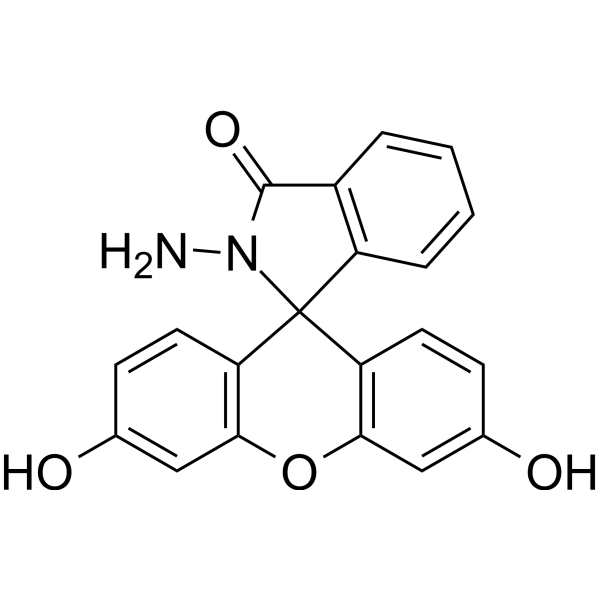
N-Aminofluorescein is a fluorescein hydrazide with spiro form, a highly selective and sensitive fluorescence probe for Cu2+. N-Aminofluorescein has no selective fluorescence response to other common metal ions, can be used for direct detection of Cu2+ in biological systems with λex/em=495/516 nm. N-Aminofluorescein can be used to measure the concentration of copper ions in cells.
For research use only. We do not sell to patients.
- Purity: 99.70%
- CAS No.: 98907-26-7
- Formula: C20H14N2O4
- Molecular Weight:346.34
-
Storage:
-20°C, protect from light
* In solvent : -80°C, 6 months; -20°C, 1 month (protect from light)

To place orders, for customer services and technical support, please contact: MedChemExpress USA
Tel: 609-228-6898 E-mail: [email protected] [email protected]


-
 Biological Activity
-
Chemical Information
-
Solvent & Solubility
- Purity & Documentation
- References
-
 Help & FAQs


Publications Citing Use of MedChemExpress (MCE) N-Aminofluorescein
More

Biological Activity
Description
In Vitro
Guide (The following is our recommended protocol. This protocol is for reference only and should be modified according to your specific needs).
N-Aminofluorescein consists of a fluorescein moiety and a hydrazide group, which can recognize and bind Cu2+ and promote amide hydrolysis[1].
N-Aminofluorescein is selective for Cu2+, showing absorption and emission bands at 632 nm and 515 nm, respectively, in 70% HEPES buffered aqueous solution (pH 7.4) containing Cu2+[2].
Guide (The following is our recommended protocol. This protocol is provided as a guideline and should be modified according to your specific needs).
General procedure for Cu2+ determination[1]:
1. Prepare a 1 mM stock solution of spirolactam fluorescein hydrazide in ethanol;
2. Perform the fluorescence turn-on reaction in 0.01 M Tris-HCl buffer (pH 7.2) by adding 10 μM N-Aminofluorescein;
3. Add an appropriate amount of sample solution so that the final concentration of Cu2+ does not exceed 10 μM, and adjust the final volume to 10 mL with 0.01 M Tris-HCl buffer (pH 7.2);
4. After 2 h, transfer 3 mL of the solution into a 1 cm quartz cuvette, and measure at room temperature with λex/em = 495/516 nm and excitation and emission slit widths of 5 nm;
5. Prepare a blank solution without Cu2+ and measure under the same conditions for comparison.
MedChemExpress (MCE) has not independently confirmed the accuracy of these methods. They are for reference only.
Emission (Em)
516
Excitation (Ex)
495


Chemical Information
-
CAS No. 98907-26-7
-
Appearance Solid
-
Molecular Weight 346.34
-
Formula C20H14N2O4
-
Color Off-white to light yellow
-
SMILES
O=C1N(N)C2(C3=C(OC4=C2C=CC(O)=C4)C=C(O)C=C3)C5=C1C=CC=C5
-
Shipping
Room temperature in continental US; may vary elsewhere.
-
Storage
-20°C, protect from light
* In solvent : -80°C, 6 months; -20°C, 1 month (protect from light)


Publications (1)
-
Journal Impact Factor
-
Most Recent
-
Neurochem Int
2026 Jun:196:106150. PMID: 41912085


Solvent & Solubility
In Vitro:
DMSO : 100 mg/mL (288.73 mM; Need ultrasonic; Hygroscopic DMSO has a significant impact on the solubility of product, please use newly opened DMSO)
Please refer to the solubility information to select the appropriate solvent. Once prepared, please aliquot and store the solution to prevent product inactivation from repeated freeze-thaw cycles.
Storage method and period of stock solution: -80°C, 6 months; -20°C, 1 month (protect from light). When stored at -80°C, please use it within 6 months. When stored at -20°C, please use it within 1 month.
Please refer to the solubility information to select the appropriate solvent. Once prepared, please aliquot and store the solution to prevent product inactivation from repeated freeze-thaw cycles.
Storage method and period of stock solution: -80°C, 6 months; -20°C, 1 month (protect from light). When stored at -80°C, please use it within 6 months. When stored at -20°C, please use it within 1 month.
Concentration (start) × Volume (start) = Concentration (final) × Volume (final)


Purity & Documentation
-
Data Sheet (280 KB)
-
SDS (252 KB)
- English - EN (252 KB)
- Français - FR (252 KB)
- Deutsch - DE (252 KB)
- Norwegian - NO (252 KB)
- Español - ES (252 KB)
- Swedish - SV (252 KB)
- Italian - IT (252 KB)
- Korean - KR (252 KB)
- Portuguese - PT (252 KB)
-
Handling Instructions (2659 KB)
References
[1]. Chen X, et al. A selective fluorescence-on reaction of spiro form fluorescein hydrazide with Cu(II). Anal Chim Acta. 2006 Aug 11;575(2):217-22. [Content Brief]
[3]. Zhi HT, et al. Anticancer efficacy triggered by synergistically modulating the homeostasis of anions and iron: Design, synthesis and biological evaluation of dual-functional squaramide-hydroxamic acid conjugates. Bioorg Chem. 2024 Jun;147:107421. [Content Brief]


Complete Stock Solution Preparation Table
Please refer to the solubility information to select the appropriate solvent. Once prepared, please aliquot and store the solution to prevent product inactivation from repeated freeze-thaw cycles.
Storage method and period of stock solution: -80°C, 6 months; -20°C, 1 month (protect from light). When stored at -80°C, please use it within 6 months. When stored at -20°C, please use it within 1 month.
| Optional Solvent | Concentration Solvent Mass | 1 mg | 5 mg | 10 mg | 25 mg |
|---|---|---|---|---|---|
| DMSO | 1 mM | 2.8873 mL | 14.4367 mL | 28.8734 mL | 72.1834 mL |
| 5 mM | 0.5775 mL | 2.8873 mL | 5.7747 mL | 14.4367 mL | |
| 10 mM | 0.2887 mL | 1.4437 mL | 2.8873 mL | 7.2183 mL | |
| 15 mM | 0.1925 mL | 0.9624 mL | 1.9249 mL | 4.8122 mL | |
| 20 mM | 0.1444 mL | 0.7218 mL | 1.4437 mL | 3.6092 mL | |
| 25 mM | 0.1155 mL | 0.5775 mL | 1.1549 mL | 2.8873 mL | |
| 30 mM | 0.0962 mL | 0.4812 mL | 0.9624 mL | 2.4061 mL | |
| 40 mM | 0.0722 mL | 0.3609 mL | 0.7218 mL | 1.8046 mL | |
| 50 mM | 0.0577 mL | 0.2887 mL | 0.5775 mL | 1.4437 mL | |
| 60 mM | 0.0481 mL | 0.2406 mL | 0.4812 mL | 1.2031 mL | |
| 80 mM | 0.0361 mL | 0.1805 mL | 0.3609 mL | 0.9023 mL | |
| 100 mM | 0.0289 mL | 0.1444 mL | 0.2887 mL | 0.7218 mL |


N-Aminofluorescein Related Classifications
HY-D1601 Related Classifications
 Powered by Bioz