



Perfluoropentanoic acid

Based on 1 Customer Validation
Perfluoropentanoic acid (PFPeA), a short-chain perfluorinated compound, serves as an important indicator of perfluorinated compound pollution in ecosystems. Perfluoropentanoic acid exhibits certain toxicity to mice.
For research use only. We do not sell to patients.
- Purity : 98.0%
- CAS No.: 2706-90-3
- Formula: C5HF9O2
- Molecular Weight:264.05
-
Storage:Pure form -20°C, 3 years , 4°C, 2 years ; In solvent -80°C, 6 months , -20°C, 1 month


To place orders, for customer services and technical support, please contact: MedChemExpress USA
Tel: 609-228-6898 E-mail: [email protected] [email protected]


-
 Biological Activity
-
Chemical Information
-
Solvent & Solubility
- Purity & Documentation
- References
-
 Help & FAQs


-

HY-21197
Perfluoroenanthic acidPollutant -

HY-W275295
Perfluorododecanoic acidToxic Compound -

HY-W002199
6:2 Fluorotelomer alcoholCyclin D1/ETS1 Modulator -

HY-W142432
Perfluoroundecanoic acidOxidative Stress Inducer -

HY-21200
Perfluoroheptanesulfonic acidPerfluoroalkyl Compounds -

HY-21194
Perfluorohexanoic acid -

HY-21193R
Perfluoropentanoic acid (Standard)Standard of Perfluoropentanoic acid -

HY-W203683
Perfluorononanoic acidPPARα Activator -

HY-W008600R
Sodium octane-1-sulfonate (Standard)Biochemical Assay Reagents -
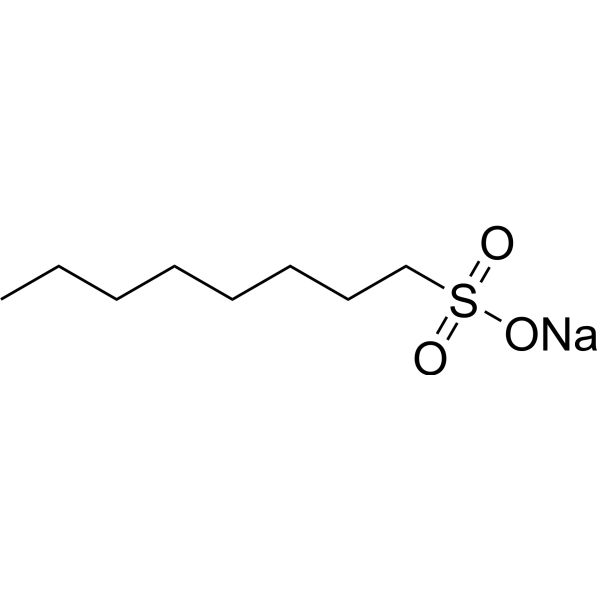
HY-W008600
Sodium octane-1-sulfonateBiochemical Assay Reagents


Biological Activity
Description
IC50 & Target
[2]|
PPARδ |
PPARγ |
IL-6 |
In Vitro
Perfluoropentanoic acid can significantly affect the structure and spatial distribution of planktonic microbial communities and may threaten water quality through microbial metabolism[1].
MedChemExpress (MCE) has not independently confirmed the accuracy of these methods. They are for reference only.
In Vivo
MedChemExpress (MCE) has not independently confirmed the accuracy of these methods. They are for reference only.
-
Animal Model:Female B6C3F1 mice aged 7-8 weeks old[2]
-
Dosage:1.25, 2.5, 5% w/v
-
Administration:Topical application on the dorsal surface of each ear (25 μL/ear), once daily for 28 consecutive days
-
Result:Resulted in significant absorption, as evidenced by increased serum and urine concentrations.
Significantly increased liver weight at 5% dosage, accompanied by hepatocellular hypertrophy in the centrilobular region.
Elevated glucose and decreased urea nitrogen at 5% dosage in serum.
Caused epidermal hyperplasia, hyperkeratosis, dermal mixed cell inflammation, and focal fibrosis in the skin.
Increased cellularity of B cells, CD4+ and CD8+ T cells, and NK cells, with enhanced eosinophil frequency and number in draining lymph nodes.
Upregulated lipid metabolism-related genes (e.g., Cd36, Lpl, Serpine1) and altered PPAR isoform expression (Pparδ downregulation, Pparγ upregulation) in the liver, while skin gene expression showed increased inflammatory cytokines (IL-6, TSLP) and danger signals (S100a7a, S100a8), along with upregulated skin barrier genes (Flg, Krt10).


Chemical Information
-
CAS No. 2706-90-3
-
Appearance Liquid (Density: 1.713 g/cm3)
-
Molecular Weight 264.05
-
Formula C5HF9O2
-
Color Colorless to light yellow
-
SMILES
O=C(O)C(F)(F)C(F)(F)C(F)(F)C(F)(F)F
-
Synonyms
PFPeA; Perfluorovaleric acid
-
Shipping
Room temperature in continental US; may vary elsewhere.
-
Storage
Pure form -20°C 3 years 4°C 2 years In solvent -80°C 6 months -20°C 1 month


Solvent & Solubility
In Vitro:
DMSO : 200 mg/mL (757.43 mM; Need ultrasonic; Hygroscopic DMSO has a significant impact on the solubility of product, please use newly opened DMSO)
Please refer to the solubility information to select the appropriate solvent. Once prepared, please aliquot and store the solution to prevent product inactivation from repeated freeze-thaw cycles.
Storage method and period of stock solution: -80°C, 6 months; -20°C, 1 month. When stored at -80°C, please use it within 6 months. When stored at -20°C, please use it within 1 month.
Please refer to the solubility information to select the appropriate solvent. Once prepared, please aliquot and store the solution to prevent product inactivation from repeated freeze-thaw cycles.
Storage method and period of stock solution: -80°C, 6 months; -20°C, 1 month. When stored at -80°C, please use it within 6 months. When stored at -20°C, please use it within 1 month.
Concentration (start) × Volume (start) = Concentration (final) × Volume (final)
In Vivo:
Select the appropriate dissolution method based on your experimental animal and administration route.
- For the following dissolution methods, please ensure to first prepare a clear stock solution using an In Vitro approach and then sequentially add co-solvents:
- To ensure reliable experimental results, the clarified stock solution can be appropriately stored based on storage conditions. As for the working solution for In Vivo experiments, it is recommended to prepare freshly and use it on the same day.
- The percentages shown for the solvents indicate their volumetric ratio in the final prepared solution. If precipitation or phase separation occurs during preparation, heat and/or sonication can be used to aid dissolution.
Add each solvent one by one: 10% DMSO 40% PEG300 5% Tween-80 45% Saline
Solubility: ≥ 5 mg/mL (18.94 mM); Clear solution
This protocol yields a clear solution of ≥ 5 mg/mL (saturation unknown).
Taking 1 mL working solution as an example, add 100 μL DMSO stock solution (50.0 mg/mL) to 400 μL PEG300, and mix evenly; then add 50 μL Tween-80 and mix evenly; then add 450 μL Saline to adjust the volume to 1 mL.
Preparation of Saline: Dissolve 0.9 g sodium chloride in ddH₂O and dilute to 100 mL to obtain a clear Saline solution.
Add each solvent one by one: 10% DMSO 90% (20% SBE-β-CD in Saline)
Solubility: ≥ 5 mg/mL (18.94 mM); Clear solution
This protocol yields a clear solution of ≥ 5 mg/mL (saturation unknown).
Taking 1 mL working solution as an example, add 100 μL DMSO stock solution (50.0 mg/mL) to 900 μL 20% SBE-β-CD in Saline, and mix evenly.
Preparation of 20% SBE-β-CD in Saline (4°C, storage for one week): 2 g SBE-β-CD powder is dissolved in 10 mL Saline, completely dissolve until clear.
In Vivo Dissolution Calculator
Please enter the basic information of animal experiments:
-
-
-
-
Recommended: Prepare an additional quantity of animals to account for potential losses during experiments.
Please enter your animal formula composition:
-
%DMSO +
Recommended: Keep the proportion of DMSO in working solution below 2% if your animal is weak.
-
%+
-
+%Tween-80 + +
-
%Saline +
The co-solvents required include: DMSO, . All of co-solvents are available by MedChemExpress (MCE). , Tween 80. All of co-solvents are available by MedChemExpress (MCE).
Working solution concentration: 0.22 mg/mL
Method for preparing stock solution: mg drug dissolved in μL DMSO. Stock solution concentration: mg/mL.
1. Take μL DMSO stock solution;
2. Add μL .
μL , mix evenly;
3. Then add μL Tween 80, mix evenly;
4. Then add μL
Please ensure that the stock solution in the first step is dissolved to a clear state, and add co-solvents in sequence. You can use ultrasonic heating (ultrasonic cleaner, recommended frequency 20-40 kHz), vortexing, etc. to assist dissolution.


Purity & Documentation
-
Data Sheet (274 KB)
-
SDS (580 KB)
- English - EN (580 KB)
- Français - FR (580 KB)
- Deutsch - DE (580 KB)
- Norwegian - NO (580 KB)
- Español - ES (580 KB)
- Swedish - SV (580 KB)
- Italian - IT (580 KB)
- Korean - KR (580 KB)
- Portuguese - PT (580 KB)
-
Handling Instructions (2659 KB)
References
[1]. Jian-Yi Wu, et al. Planktonic microbial responses to perfluorinated compound (PFC) pollution: Integrating PFC distributions with community coalescence and metabolism. Sci Total Environ. 2021 Sep 20:788:147743. [Content Brief]
[2]. Weatherly LM, et al. Systemic toxicity induced by topical application of perfluoroheptanoic acid (PFHpA), perfluorohexanoic acid (PFHxA), and perfluoropentanoic acid (PFPeA) in a murine model. Food Chem Toxicol. 2023 Jan;171:113515. [Content Brief]


Complete Stock Solution Preparation Table
Please refer to the solubility information to select the appropriate solvent. Once prepared, please aliquot and store the solution to prevent product inactivation from repeated freeze-thaw cycles.
Storage method and period of stock solution: -80°C, 6 months; -20°C, 1 month. When stored at -80°C, please use it within 6 months. When stored at -20°C, please use it within 1 month.
| Optional Solvent | Concentration Solvent Mass | 1 mg | 5 mg | 10 mg | 25 mg |
|---|---|---|---|---|---|
| DMSO | 1 mM | 3.7872 mL | 18.9358 mL | 37.8716 mL | 94.6790 mL |
| 5 mM | 0.7574 mL | 3.7872 mL | 7.5743 mL | 18.9358 mL | |
| 10 mM | 0.3787 mL | 1.8936 mL | 3.7872 mL | 9.4679 mL | |
| 15 mM | 0.2525 mL | 1.2624 mL | 2.5248 mL | 6.3119 mL | |
| 20 mM | 0.1894 mL | 0.9468 mL | 1.8936 mL | 4.7340 mL | |
| 25 mM | 0.1515 mL | 0.7574 mL | 1.5149 mL | 3.7872 mL | |
| 30 mM | 0.1262 mL | 0.6312 mL | 1.2624 mL | 3.1560 mL | |
| 40 mM | 0.0947 mL | 0.4734 mL | 0.9468 mL | 2.3670 mL | |
| 50 mM | 0.0757 mL | 0.3787 mL | 0.7574 mL | 1.8936 mL | |
| 60 mM | 0.0631 mL | 0.3156 mL | 0.6312 mL | 1.5780 mL | |
| 80 mM | 0.0473 mL | 0.2367 mL | 0.4734 mL | 1.1835 mL | |
| 100 mM | 0.0379 mL | 0.1894 mL | 0.3787 mL | 0.9468 mL |


Perfluoropentanoic acid Related Classifications
HY-21193 Related Classifications
 Powered by Bioz