



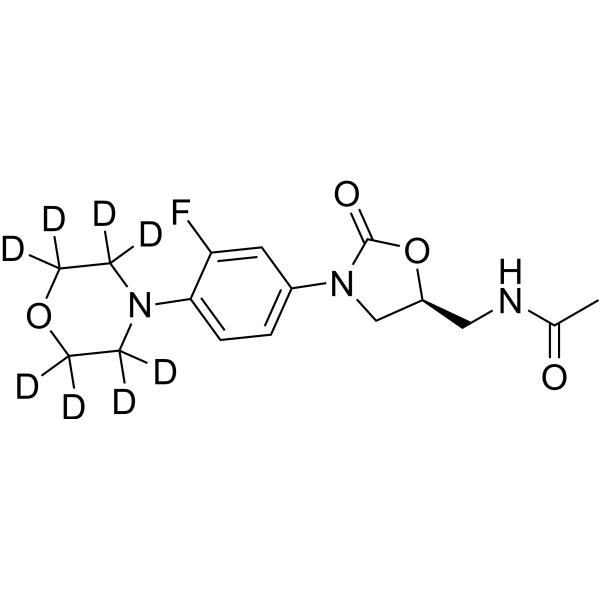
Linezolid-d8
Based on 1 publication(s) in Google Scholar
PNU-100766-d8 is deuterated labeled Linezolid (HY-10394). Linezolid (PNU-100766) is the first member of the class of oxazolidinone synthetic antibiotic. Linezolid acts by inhibiting the initiation of bacterial protein synthesis. Linezolid is used for the treatment of serious infections caused by Gram-positive bacteria that are resistant to several other antibiotics.
For research use only. We do not sell to patients.
- Purity : 99.73%
- CAS No.: 1032182-14-1
- Formula: C16H12D8FN3O4
- Molecular Weight:345.40
-
Storage:
4°C, protect from light
* In solvent : -80°C, 6 months; -20°C, 1 month (protect from light)

To place orders, for customer services and technical support, please contact: MedChemExpress USA
Tel: 609-228-6898 E-mail: [email protected] [email protected]


-
 Biological Activity
-
Chemical Information
- Protocols
- Purity & Documentation
- References
-
 Help & FAQs


Publications Citing Use of MedChemExpress (MCE) Linezolid-d8
MoreAll Antibiotic Isoforms
More

Biological Activity
Description
In Vitro
Stable heavy isotopes of hydrogen, carbon, and other elements have been incorporated into drug molecules, largely as tracers for quantitation during the drug development process. Deuteration has gained attention because of its potential to affect the pharmacokinetic and metabolic profiles of drugs[1].
Linezolid (PNU-100766) prevents the synthesis of bacterial protein via binding to rRNA on both the 30S and 50S ribosomal subunits[4].
MedChemExpress (MCE) has not independently confirmed the accuracy of these methods. They are for reference only.
Application
1. This compound can be used as a tracer
2. This compound can be used as an internal standard for quantitative analysis by NMR, GC-MS, or LC-MS.


Chemical Information
-
CAS No. 1032182-14-1
-
Unlabeled CAS 165800-03-3
-
Appearance Solid
-
Molecular Weight 345.40
-
Formula C16H12D8FN3O4
-
Color White to off-white
-
SMILES
CC(NC[C@H]1CN(C2=CC=C(N3C([2H])([2H])C([2H])([2H])OC([2H])([2H])C3([2H])[2H])C(F)=C2)C(O1)=O)=O
-
Synonyms
PNU-100766-d8
-
Shipping
Room temperature in continental US; may vary elsewhere.
-
Storage
4°C, protect from light
* In solvent : -80°C, 6 months; -20°C, 1 month (protect from light)


Publications (1)
-
Journal Impact Factor
-
Most Recent


Purity & Documentation
-
Data Sheet (271 KB)
-
SDS (418 KB)
- English - EN (418 KB)
- Français - FR (418 KB)
- Deutsch - DE (418 KB)
- Norwegian - NO (418 KB)
- Español - ES (418 KB)
- Swedish - SV (418 KB)
- Italian - IT (418 KB)
- Korean - KR (418 KB)
- Portuguese - PT (418 KB)
-
Handling Instructions (2659 KB)
References
[1]. Russak EM, et al. Impact of Deuterium Substitution on the Pharmacokinetics of Pharmaceuticals. Ann Pharmacother. 2019 Feb;53(2):211-216. [Content Brief]
[2]. Clemett D, Markham A. Linezolid. Drugs. 2000 Apr;59(4):815-27; discussion 828. [Content Brief]
[3]. Chiappini E, Conti C, Galli L et al. Clinical efficacy and tolerability of linezolid in pediatric patients: a systematic review. Clin Ther. 2010 Jan;32(1):66-88. [Content Brief]
[4]. Perry CM, Jarvis B. Linezolid: a review of its use in the management of serious gram-positive infections. Drugs. 2001;61(4):525-51. [Content Brief]
[5]. He MZ, Jiang YW, Cai C. Mechanisms and epidemiology of linezolid resistance in staphylococci.Zhonghua Jie He He Hu Xi Za Zhi. 2012 May;35(5):360-2. [Content Brief]
[6]. Karau MJ, Tilahun AY, Schmidt SM, Clark CR, Patel R, Rajagopalan G. Linezolid is Superior to Vancomycin in Experimental Pneumonia Caused by Superantigen-Producing Staphylococcus aureus in HLA class II Transgenic Mice. Antimicrob Agents Chemother. 2012 Jul 30. [Content Brief]

Calculators
Concentration (start) × Volume (start) = Concentration (final) × Volume (final)


Linezolid-d8 Related Classifications
HY-10394S1 Related Classifications
 Powered by Bioz