



Poly(ethylene glycol) diacrylate (MW 10000)

Based on 1 Customer Validation
Poly(ethylene glycol) diacrylate (PEGDA) (MW 10000) is a versatile polymer material that is widely used as a building material for hydrogel scaffolds, especially in the fields of tissue engineering and regenerative medicine. Poly(ethylene glycol) diacrylate (MW 10000) can be used to create a three-dimensional (3D) breast cancer cell culture model.
For research use only. We do not sell to patients.
- Purity : 98.0%
- CAS No.: 26570-48-9
- Formula: (C2H4O)nC6H6O3
- Molecular Weight:10000.00 (Average)
-
Storage:Powder -20°C, 3 years ; In solvent -80°C, 6 months , -20°C, 1 month


To place orders, for customer services and technical support, please contact: MedChemExpress USA
Tel: 609-228-6898 E-mail: [email protected] [email protected]


-
 Biological Activity
-
Chemical Information
-
Solvent & Solubility
- Purity & Documentation
- References
-
 Help & FAQs


-

HY-W110542L
Poly(ethylene glycol) diacrylate (MW 3500) -

HY-W110542G
Poly(ethylene glycol) diacrylate (MW 6000) -

HY-W110542J
Poly(ethylene glycol) diacrylate (MW 700) -

HY-W110542O
Poly(ethylene glycol) diacrylate (MW 575),MEHQ as inhibitor -

HY-W110542N
Poly(ethylene glycol) diacrylate (MW 250),MEHQ as inhibitor -

HY-W110542P
Poly(ethylene glycol) diacrylate (MW 4000), MEHQ as inhibitor -

HY-W110542D
Poly(ethylene glycol) diacrylate (MW 1000) -
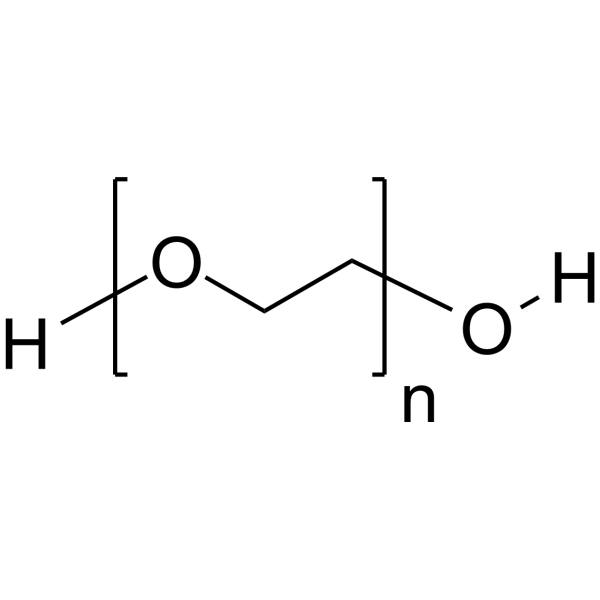
HY-Y0873
PEG300 -
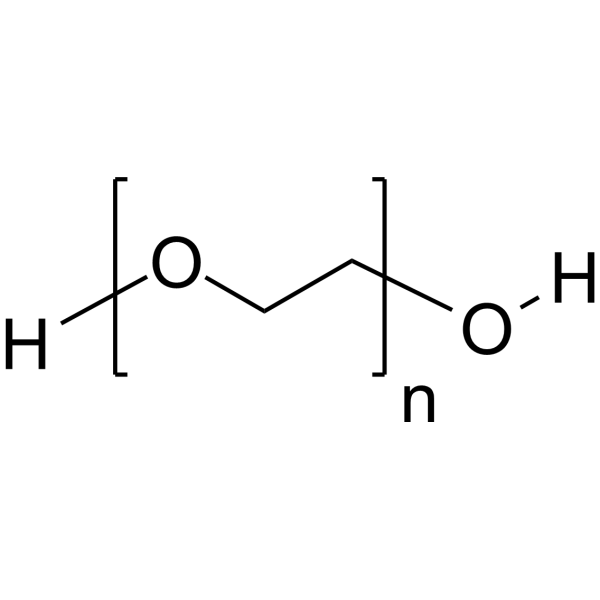
HY-Y0873A
PEG400 -

HY-W110542M
Poly(ethylene glycol) diacrylate (MW 20000) -
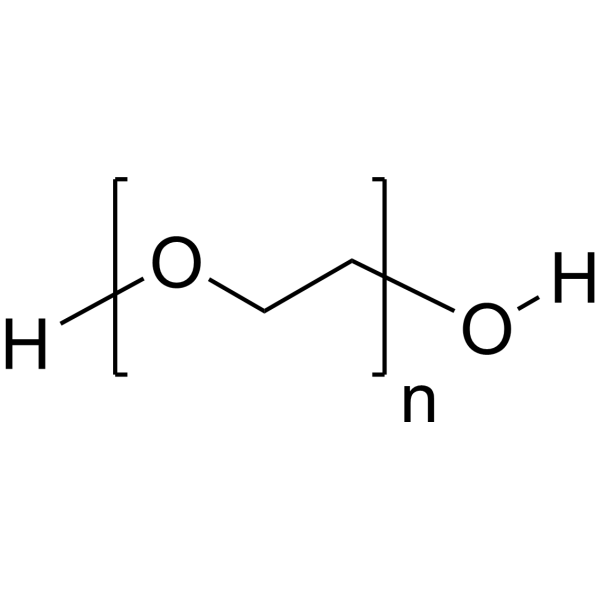
HY-Y0873J
PEG8000 -
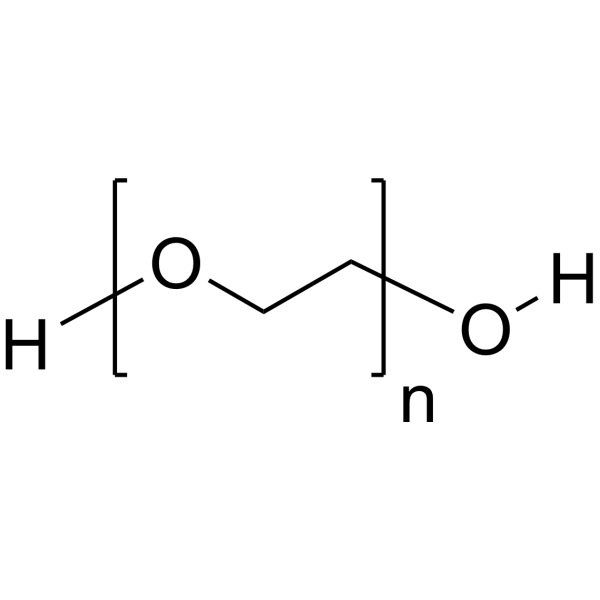
HY-Y0873C
PEG3350


Biological Activity
Description
In Vitro
Poly(ethylene glycol) diacrylate (MW 10000) yields hydrogels that facilitate the 3D culture of breast cancer cells (MCF7, SK-BR-3, MDA-MB-231) and can be used to investigate the behavioral responses of cells under different matrix properties[2].
Product Properties:
This product is readily soluble in water and can be prepared into hydrogel precursor solutions of varying concentrations. Adding the photoinitiator LAP (HY-44076) to this precursor solution triggers crosslinking upon illumination, yielding a hydrogel with a certain mechanical strength.
Instructions:
1. Dissolve this product at a concentration of 10-20 (w/w)% in pure water or phosphate buffer at room temperature, depending on the intended use. Add 0.1-0.3% (w/w)% LAP photoinitiator to prepare a gel precursor solution.
2. Add the above solution to the mold and refrigerate. Irradiation under 405 nm light for 30-60 seconds will form PEGDA hydrogel.
MedChemExpress (MCE) has not independently confirmed the accuracy of these methods. They are for reference only.


Chemical Information
-
CAS No. 26570-48-9
-
Appearance Solid
-
Molecular Weight 10000.00 (Average)
-
Formula (C2H4O)nC6H6O3
-
Color White to off-white
-
SMILES
O=C(C=C)OCCOC(C=C)=O.[n]
-
Synonyms
PEGDA (MW 10000)
-
Shipping
Room temperature in continental US; may vary elsewhere.
-
Storage
Powder -20°C 3 years In solvent -80°C 6 months -20°C 1 month


Solvent & Solubility
In Vitro:
H2O : 100 mg/mL (Need ultrasonic)
DMSO : 50 mg/mL (Need ultrasonic; Hygroscopic DMSO has a significant impact on the solubility of product, please use newly opened DMSO)
In Vivo:
Select the appropriate dissolution method based on your experimental animal and administration route.
- For the following dissolution methods, please ensure to first prepare a clear stock solution using an In Vitro approach and then sequentially add co-solvents:
- To ensure reliable experimental results, the clarified stock solution can be appropriately stored based on storage conditions. As for the working solution for In Vivo experiments, it is recommended to prepare freshly and use it on the same day.
- The percentages shown for the solvents indicate their volumetric ratio in the final prepared solution. If precipitation or phase separation occurs during preparation, heat and/or sonication can be used to aid dissolution.
Add each solvent one by one: 10% DMSO 40% PEG300 5% Tween-80 45% Saline
Solubility: ≥ 5 mg/mL; Clear solution
This protocol yields a clear solution of ≥ 5 mg/mL (saturation unknown).
Taking 1 mL working solution as an example, add 100 μL DMSO stock solution (50.0 mg/mL) to 400 μL PEG300, and mix evenly; then add 50 μL Tween-80 and mix evenly; then add 450 μL Saline to adjust the volume to 1 mL.
Preparation of Saline: Dissolve 0.9 g sodium chloride in ddH₂O and dilute to 100 mL to obtain a clear Saline solution.
Add each solvent one by one: 10% DMSO 90% (20% SBE-β-CD in Saline)
Solubility: ≥ 5 mg/mL; Clear solution
This protocol yields a clear solution of ≥ 5 mg/mL (saturation unknown).
Taking 1 mL working solution as an example, add 100 μL DMSO stock solution (50.0 mg/mL) to 900 μL 20% SBE-β-CD in Saline, and mix evenly.
Preparation of 20% SBE-β-CD in Saline (4°C, storage for one week): 2 g SBE-β-CD powder is dissolved in 10 mL Saline, completely dissolve until clear.
In Vivo Dissolution Calculator
Please enter the basic information of animal experiments:
-
-
-
-
Recommended: Prepare an additional quantity of animals to account for potential losses during experiments.
Working solution concentration: 0.22 mg/mL
This product has good water solubility, please refer to the measured solubility data in water/PBS/Saline for details.


Purity & Documentation
-
Data Sheet (270 KB)
-
SDS (477 KB)
- English - EN (477 KB)
- Français - FR (477 KB)
- Deutsch - DE (477 KB)
- Norwegian - NO (477 KB)
- Español - ES (477 KB)
- Swedish - SV (477 KB)
- Italian - IT (477 KB)
- Korean - KR (477 KB)
- Portuguese - PT (477 KB)
-
Handling Instructions (2659 KB)
References

Calculators
Concentration (start) × Volume (start) = Concentration (final) × Volume (final)


Poly(ethylene glycol) diacrylate (MW 10000) Related Classifications
HY-W110542H Related Classifications
 Powered by Bioz