



Pseudomonas quinolone signal
Based on 2 publication(s) in Google Scholar
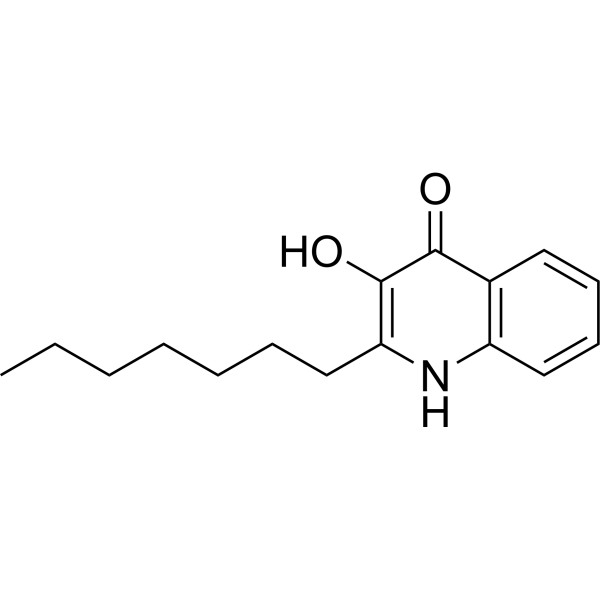
Pseudomonas quinolone signal (PQS) is a quorum-sensing signaling molecule produced by Pseudomonas aeruginosa. The synthesis of Pseudomonas quinolone signal relies on the las quorum-sensing system, and its biological activity is associated with the rhl system. Pseudomonas quinolone signal regulates the expression of the virulence gene lasB. Additionally, Pseudomonas quinolone signal plays roles in iron acquisition, cytotoxicity, outer-membrane vesicle biogenesis, and host immune modulation.
For research use only. We do not sell to patients.
- Purity: 99.84%
- CAS No.: 108985-27-9
- Formula: C16H21NO2
- Molecular Weight:259.35
-
Storage:
4°C, stored under nitrogen
* In solvent : -80°C, 6 months; -20°C, 1 month (stored under nitrogen)

To place orders, for customer services and technical support, please contact: MedChemExpress USA
Tel: 609-228-6898 E-mail: [email protected] [email protected]


-
 Biological Activity
-
Chemical Information
-
Solvent & Solubility
- Purity & Documentation
- References
-
 Help & FAQs




Publications Citing Use of MedChemExpress (MCE) Pseudomonas quinolone signal
More

Biological Activity
Description
In Vitro
Pseudomonas quinolone signal (0-200 μM; 18 h) can induce the expression of the lasB-lacZ fusion gene and activate β-galactosidase activity in P. aeruginosa strain PAO-R1 (lasR⁻) (pTS400)[1].
Pseudomonas quinolone signal (40 μM; 5-24 h) promotes the synthesis of pyochelin and pyocyanin, increases bacterial sensitivity to H2O2, and reduces iron concentration in the culture medium in P. aeruginosa PAO1[2].
MedChemExpress (MCE) has not independently confirmed the accuracy of these methods. They are for reference only.


Chemical Information
-
CAS No. 108985-27-9
-
Appearance Solid
-
Molecular Weight 259.35
-
Formula C16H21NO2
-
Color White to light brown
-
SMILES
O=C1C(O)=C(CCCCCCC)NC2=C1C=CC=C2
-
Synonyms
PQS
-
Shipping
Room temperature in continental US; may vary elsewhere.
-
Storage
4°C, stored under nitrogen
* In solvent : -80°C, 6 months; -20°C, 1 month (stored under nitrogen)


Publications (2)
-
Journal Impact Factor
-
Most Recent
-
BMC Infect Dis
Harmine acts as a quorum sensing inhibitor decreasing the virulence and antibiotic resistance of Pseudomonas aeruginosa. [Abstract]2024 Jul 31;24(1):760. PMID: 39085766 -
J Antibiot (Tokyo)
Repurposing Tirazone as an effective quorum-sensing inhibitor against Pseudomonas aeruginosa virulence and biofilm formation. [Abstract]2026 Apr;79(4):248-263. PMID: 41708876


Solvent & Solubility
In Vitro:
DMSO : 50 mg/mL (192.79 mM; ultrasonic and warming and heat to 60°C; Hygroscopic DMSO has a significant impact on the solubility of product, please use newly opened DMSO)
Please refer to the solubility information to select the appropriate solvent. Once prepared, please aliquot and store the solution to prevent product inactivation from repeated freeze-thaw cycles.
Storage method and period of stock solution: -80°C, 6 months; -20°C, 1 month (stored under nitrogen). When stored at -80°C, please use it within 6 months. When stored at -20°C, please use it within 1 month.
Please refer to the solubility information to select the appropriate solvent. Once prepared, please aliquot and store the solution to prevent product inactivation from repeated freeze-thaw cycles.
Storage method and period of stock solution: -80°C, 6 months; -20°C, 1 month (stored under nitrogen). When stored at -80°C, please use it within 6 months. When stored at -20°C, please use it within 1 month.
Concentration (start) × Volume (start) = Concentration (final) × Volume (final)
In Vivo:
Select the appropriate dissolution method based on your experimental animal and administration route.
- For the following dissolution methods, please ensure to first prepare a clear stock solution using an In Vitro approach and then sequentially add co-solvents:
- To ensure reliable experimental results, the clarified stock solution can be appropriately stored based on storage conditions. As for the working solution for In Vivo experiments, it is recommended to prepare freshly and use it on the same day.
- The percentages shown for the solvents indicate their volumetric ratio in the final prepared solution. If precipitation or phase separation occurs during preparation, heat and/or sonication can be used to aid dissolution.
Add each solvent one by one: 10% DMSO 40% PEG300 5% Tween-80 45% Saline
Solubility: ≥ 2.5 mg/mL (9.64 mM); Clear solution
This protocol yields a clear solution of ≥ 2.5 mg/mL (saturation unknown).
Taking 1 mL working solution as an example, add 100 μL DMSO stock solution (25.0 mg/mL) to 400 μL PEG300, and mix evenly; then add 50 μL Tween-80 and mix evenly; then add 450 μL Saline to adjust the volume to 1 mL.
Preparation of Saline: Dissolve 0.9 g sodium chloride in ddH₂O and dilute to 100 mL to obtain a clear Saline solution.
In Vivo Dissolution Calculator
Please enter the basic information of animal experiments:
-
-
-
-
Recommended: Prepare an additional quantity of animals to account for potential losses during experiments.
Please enter your animal formula composition:
-
%DMSO +
Recommended: Keep the proportion of DMSO in working solution below 2% if your animal is weak.
-
%+
-
+%Tween-80 + +
-
%Saline +
The co-solvents required include: DMSO, . All of co-solvents are available by MedChemExpress (MCE). , Tween 80. All of co-solvents are available by MedChemExpress (MCE).
Working solution concentration: 0.22 mg/mL
Method for preparing stock solution: mg drug dissolved in μL DMSO. Stock solution concentration: mg/mL. * In solvent : -80°C, 6 months; -20°C, 1 month (stored under nitrogen)
1. Take μL DMSO stock solution;
2. Add μL .
μL , mix evenly;
3. Then add μL Tween 80, mix evenly;
4. Then add μL
Please ensure that the stock solution in the first step is dissolved to a clear state, and add co-solvents in sequence. You can use ultrasonic heating (ultrasonic cleaner, recommended frequency 20-40 kHz), vortexing, etc. to assist dissolution.


Purity & Documentation
-
Data Sheet (272 KB)
-
SDS (394 KB)
- English - EN (394 KB)
- Français - FR (394 KB)
- Deutsch - DE (394 KB)
- Norwegian - NO (394 KB)
- Español - ES (394 KB)
- Swedish - SV (394 KB)
- Italian - IT (394 KB)
- Korean - KR (394 KB)
- Portuguese - PT (394 KB)
-
Handling Instructions (2659 KB)
References
[1]. Pesci E C, et al. Quinolone signaling in the cell-to-cell communication system of Pseudomonas aeruginosa[J]. Proceedings of the National Academy of Sciences, 1999, 96(20): 11229-11234. [Content Brief]
[2]. Bredenbruch F, et al. The Pseudomonas aeruginosa quinolone signal (PQS) has an iron-chelating activity. Environ Microbiol. 2006 Aug;8(8):1318-29. [Content Brief]
[3]. Cooke AC, et al. Pseudomonas Quinolone Signal-Induced Outer Membrane Vesicles Enhance Biofilm Dispersion in Pseudomonas aeruginosa. mSphere. 2020 Nov 25;5(6):e01109-20. [Content Brief]
[4]. Lin J, et al. The Pseudomonas Quinolone Signal (PQS): Not Just for Quorum Sensing Anymore. Front Cell Infect Microbiol. 2018 Jul 4;8:230. [Content Brief]


Complete Stock Solution Preparation Table
Please refer to the solubility information to select the appropriate solvent. Once prepared, please aliquot and store the solution to prevent product inactivation from repeated freeze-thaw cycles.
Storage method and period of stock solution: -80°C, 6 months; -20°C, 1 month (stored under nitrogen). When stored at -80°C, please use it within 6 months. When stored at -20°C, please use it within 1 month.
| Optional Solvent | Concentration Solvent Mass | 1 mg | 5 mg | 10 mg | 25 mg |
|---|---|---|---|---|---|
| DMSO | 1 mM | 3.8558 mL | 19.2790 mL | 38.5579 mL | 96.3948 mL |
| 5 mM | 0.7712 mL | 3.8558 mL | 7.7116 mL | 19.2790 mL | |
| 10 mM | 0.3856 mL | 1.9279 mL | 3.8558 mL | 9.6395 mL | |
| 15 mM | 0.2571 mL | 1.2853 mL | 2.5705 mL | 6.4263 mL | |
| 20 mM | 0.1928 mL | 0.9639 mL | 1.9279 mL | 4.8197 mL | |
| 25 mM | 0.1542 mL | 0.7712 mL | 1.5423 mL | 3.8558 mL | |
| 30 mM | 0.1285 mL | 0.6426 mL | 1.2853 mL | 3.2132 mL | |
| 40 mM | 0.0964 mL | 0.4820 mL | 0.9639 mL | 2.4099 mL | |
| 50 mM | 0.0771 mL | 0.3856 mL | 0.7712 mL | 1.9279 mL | |
| 60 mM | 0.0643 mL | 0.3213 mL | 0.6426 mL | 1.6066 mL | |
| 80 mM | 0.0482 mL | 0.2410 mL | 0.4820 mL | 1.2049 mL | |
| 100 mM | 0.0386 mL | 0.1928 mL | 0.3856 mL | 0.9639 mL |


Pseudomonas quinolone signal Related Classifications
HY-128200 Related Classifications
 Powered by Bioz