



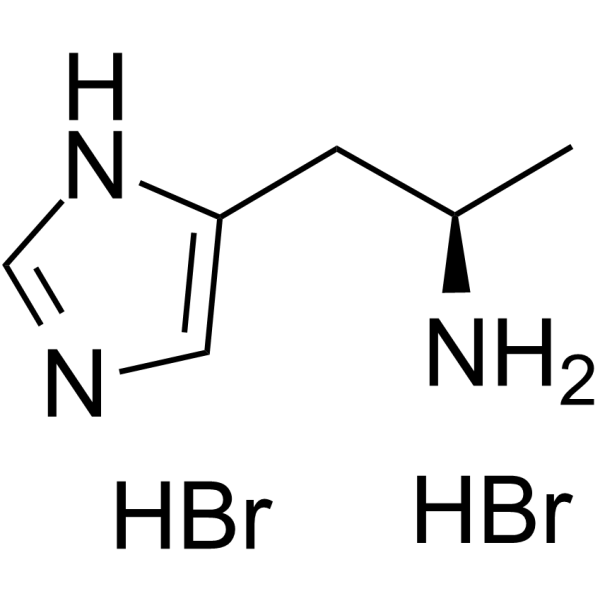
(R)-(-)-α-Methylhistamine dihydrobromide
(R)-(-)-α-Methylhistamine dihydrobromide is a potent, selective and brain-penetrant agonist of H3 histamine receptor, with a Kd of 50.3 nM. (R)-(-)-α-Methylhistamine dihydrobromide can enhance memory retention, attenuates memory impairment in rats.
For research use only. We do not sell to patients.
- CAS No.: 868698-49-1
- Formula: C6H13Br2N3
- Molecular Weight:287.00
-
Storage:
4°C, protect from light, stored under nitrogen
* In solvent : -80°C, 6 months; -20°C, 1 month (protect from light, stored under nitrogen)

To place orders, for customer services and technical support, please contact: MedChemExpress USA
Tel: 609-228-6898 E-mail: [email protected] [email protected]


-
 Biological Activity
-
Chemical Information
- Purity & Documentation
- References
-
 Help & FAQs


All Histamine Receptor Isoforms
More

Biological Activity
Description
|
H3 Receptor 50.3 nM (Kd) |
In Vitro
(R)-(-)-α-Methylhistamine dihydrobromide is an H3-agonist that is >10 times as potent as histamine (HA). Its selectivity toward H3-receptors is >1000 times as high as that of HA. (R)-(-)-α-Methylhistamine dihydrobromide has only weak affinities for H1 and H2 receptor with a pKi=4.8 and <3.5, repectively. (R)-(-)-α-Methylhistamine dihydrobromide displays >200-fold selectivity over H4 receptors[1][2][3].
MedChemExpress (MCE) has not independently confirmed the accuracy of these methods. They are for reference only.
In Vivo
(R)-(-)-α-Methylhistamine dihydrochloride (6.3 mg/kg; i.p.) significantly decreases the steady-state t-MH level in the mouse brain, whereas these compounds produced no significant changes in the HA level[3].
MedChemExpress (MCE) has not independently confirmed the accuracy of these methods. They are for reference only.
-
Animal Model:Male Sprague‐Dawley rats (10-12 week)[3]
-
Dosage:10 mg/kg
-
Administration:IP; 60 min before training
-
Result:Reversed propofol‐induced memory retention.


Chemical Information
-
CAS No. 868698-49-1
-
Appearance Oil
-
Molecular Weight 287.00
-
Formula C6H13Br2N3
-
Color Brown to reddish brown
-
SMILES
C[C@@H](N)CC1=CN=CN1.Br.Br
-
Shipping
Room temperature in continental US; may vary elsewhere.
-
Storage
4°C, protect from light, stored under nitrogen
* In solvent : -80°C, 6 months; -20°C, 1 month (protect from light, stored under nitrogen)


Purity & Documentation
-
Data Sheet (277 KB)
-
SDS (252 KB)
- English - EN (252 KB)
- Français - FR (252 KB)
- Deutsch - DE (252 KB)
- Norwegian - NO (252 KB)
- Español - ES (252 KB)
- Swedish - SV (252 KB)
- Italian - IT (252 KB)
- Korean - KR (252 KB)
- Portuguese - PT (252 KB)
-
Handling Instructions (2659 KB)
References
[1]. Arrang JM, et al. Highly potent and selective ligands for histamine H3-receptors. Nature. 1987 May 14-20;327(6118):117-23. [Content Brief]
[3]. Oishi R, et al. Effects of the histamine H3-agonist (R)-alpha-methylhistamine and the antagonist thioperamideon histamine metabolism in the mouse and rat brain. J Neurochem. 1989 May;52(5):1388-92. [Content Brief]
[4]. Yamasaki S, et al. The disposition of (R)-alpha-methylhistamine, a histamine H3-receptor agonist, in rats. J Pharm Pharmacol. 1994 May;46(5):371-4. [Content Brief]
[5]. Li WW, et al. (R)-alpha-methylhistamine suppresses inhibitory neurotransmission in hippocampal CA1 pyramidal neurons counteracting propofol-induced amnesia in rats. CNS Neurosci Ther. 2014 Sep;20(9):851-9. [Content Brief]

Calculators
Concentration (start) × Volume (start) = Concentration (final) × Volume (final)


(R)-(-)-α-Methylhistamine dihydrobromide Related Classifications
HY-100999 Related Classifications
 Powered by Bioz