



ACE2 Protein, Human (HEK293, His)
Based on 1 Customer Validation
The ACE2 protein is an important regulator of blood volume and cardiovascular homeostasis. ACE2 Protein, Human (HEK293, His) is the recombinant human-derived ACE2 protein, expressed by HEK293 , with C-His labeled tag.
- Species: Human
- Source: HEK293
-
Storage:Stored at -20°C for 2 years from date of receipt. After reconstitution, it is stable at 4°C for 1 week or -20°C for longer (with carrier protein). It is recommended to freeze aliquots at -20°C or -80°C for extended storage.


To place orders, for customer services and technical support, please contact: MedChemExpress USA
Tel: 609-228-6898 E-mail: [email protected] [email protected]


-
 Biological Activity
-
Technical Parameters
-
Product Properties
- Documentation
- Help & FAQs




Biological Activity
Description
The ACE2 protein is an important regulator of blood volume and cardiovascular homeostasis. ACE2 Protein, Human (HEK293, His) is the recombinant human-derived ACE2 protein, expressed by HEK293 , with C-His labeled tag.
Background
ACE2, an indispensable counter-regulatory carboxypeptidase within the renin-angiotensin hormone system, plays a pivotal role in maintaining cardiovascular homeostasis by intricately regulating blood volume and systemic vascular resistance. Through its enzymatic activity, ACE2 converts angiotensin I to angiotensin 1-9 and angiotensin II to angiotensin 1-7, exerting anti-hypertrophic effects in cardiomyocytes and acting as a vasodilator with anti-proliferative properties. Beyond its central role in the renin-angiotensin system, ACE2 exhibits broad enzymatic activity, cleaving various vasoactive peptides such as neurotensin, kinetensin, and des-Arg bradykinin. Moreover, ACE2 is proficient in cleaving other biological peptides, including apelins, casomorphins, and dynorphin A. Notably, ACE2's C-terminus, homologous to collectrin, orchestrates the trafficking of the neutral amino acid transporter SL6A19 to the gut epithelial cell membrane, thereby regulating its surface expression and catalytic activity. Importantly, ACE2 also serves as a receptor for human coronaviruses SARS-CoV, SARS-CoV-2, and HCoV-NL63, implicating it in microbial infection pathways.
Verified Bioactivity
1.Measured by its binding ability in a functional ELISA. Immobilized 2019-nCoV Spike Protein (RBD, mFc) at 2 μg/mL (100 μL/well) can bind human ACE2 protein (His) and the EC50 is <30 ng/mL.
2.Measured by its ability to cleave a fluorogenic peptide substrate McaYVADAPK (Dnp)OH and the specific activity is >1000 pmols/min/μg.
MCE Validation Data
-
Purity - SDS-PAGE
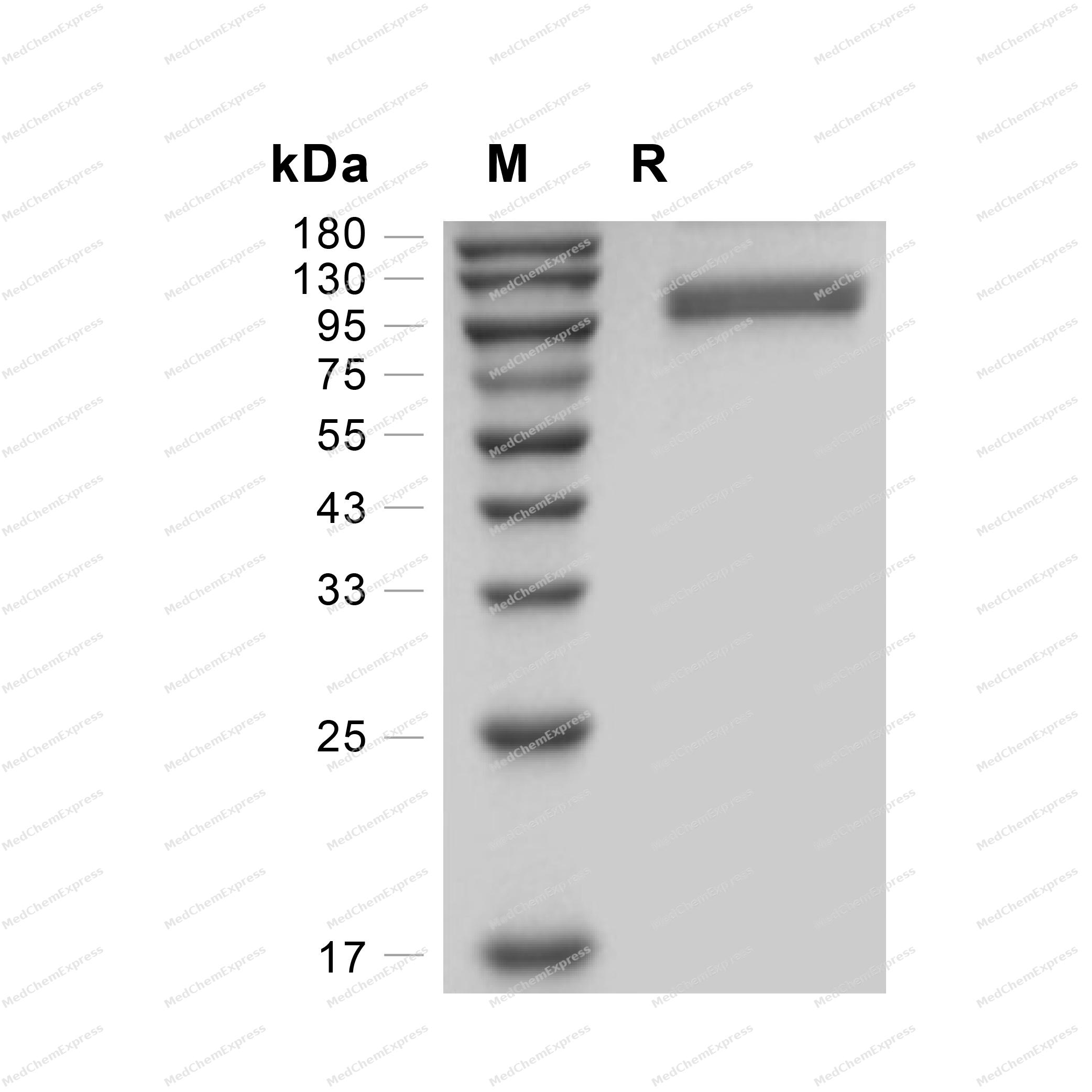
Purity - SDS-PAGE

Assay Procedure
Materials
Detection Buffer: 50 mM Tris, 1 M NaCl, pH 7.5
ACE2 Protein, Human (HEK293, His) (HY-P73489)
Substrate: Mca-YVADAPK(Dnp)-OH (HY-P2616A), dissolved in DMSO to 2 mM
Standard: MCA-Pro-Leu-OH
Procedure
1. Dilute MCA-Pro-Leu-OH to 100, 50, 25, 12.5, 6.25, 3.125, 1.5625, 0 μmol/L with detection buffer respectively. Add 100 μL of each to the wells to start the reaction. Read at excitation and emission wavelengths of 320 nm and 405 nm (top read) respectively. Plot a standard curve with the standard concentration as the abscissa and the measured RFU as the ordinate to obtain the standard curve formula.
2. Dilute Human ACE2 to 1 μg/mL with detection buffer.
3. Dilute the substrate to 20 μM with detection buffer.
4. Add 1 μg/mL Human ACE2 to the black well plate, 50 μL per well, and add 50 μL of 20 μM substrate. For blank wells, add 50 μL detection buffer and 50 μL of 20 μM substrate.
5. Read in kinetic mode for 5 minutes at excitation and emission wavelengths of 320 nm and 405 nm respectively.
6. Calculate the specific activity:
Specific Activity (pmol/min/μg) = | Adjusted Vmax* (RFU/min) x Conversion Factor ** (pmol/RFU) |
| amount of enzyme (μg) |
*Adjusted for Control
**Derived using calibration standard
Per Well:
Human ACE2: 0.05 μg
Substrate: 10 μM


Technical Parameters
-
Species Human
-
Source HEK293
-
Tag C-His
-
Accession
Q9BYF1-1 (Q18-S740)
-
Molecular Construction
-
N-term
-
ACE2 (Q18-S740)
Accession # Q9BYF1-1 -
His
-
C-term
-
-
Protein Length
Extracellular Domain
-
Synonyms
ACE2; Angiotensin I Converting Enzyme 2; Angiotensin Converting Enzyme 2; Angiotensin-Converting Enzyme 2; ACEH; ACE-Related Carboxypeptidase; Angiotensin I Converting Enzyme (Peptidyl-Dipeptidase A) 2; Metalloprotease MPROT15; Angiotensin-Converting Enzy
-
AA Sequence
QSTIEEQAKTFLDKFNHEAEDLFYQSSLASWNYNTNITEENVQNMNNAGDKWSAFLKEQSTLAQMYPLQEIQNLTVKLQLQALQQNGSSVLSEDKSKRLNTILNTMSTIYSTGKVCNPDNPQECLLLEPGLNEIMANSLDYNERLWAWESWRSEVGKQLRPLYEEYVVLKNEMARANHYEDYGDYWRGDYEVNGVDGYDYSRGQLIEDVEHTFEEIKPLYEHLHAYVRAKLMNAYPSYISPIGCLPAHLLGDMWGRFWTNLYSLTVPFGQKPNIDVTDAMVDQAWDAQRIFKEAEKFFVSVGLPNMTQGFWENSMLTDPGNVQKAVCHPTAWDLGKGDFRILMCTKVTMDDFLTAHHEMGHIQYDMAYAAQPFLLRNGANEGFHEAVGEIMSLSAATPKHLKSIGLLSPDFQEDNETEINFLLKQALTIVGTLPFTYMLEKWRWMVFKGEIPKDQWMKKWWEMKREIVGVVEPVPHDETYCDPASLFHVSNDYSFIRYYTRTLYQFQFQEALCQAAKHEGPLHKCDISNSTEAGQKLFNMLRLGKSEPWTLALENVVGAKNMNVRPLLNYFEPLFTWLKDQNKNSFVGWSTDWSPYADQSIKVRISLKSALGDKAYEWNDNEMYLFRSSVAYAMRQYFLKVKNQMILFGEEDVRVANLKPRISFNFFVTAPKNVSDIIPRTEVEKAIRMSRSRINDAFRLNDNSLEFLGIQPTLGPPNQPPVS
-
Molecular Weight
Approximately 95-110 kDa, based on SDS-PAGE under reducing conditions.
-
Glycosylation
Yes
-
Purity
≥ 95%, as determined by reducing SDS-PAGE.


Product Properties
Lyophilized powder
Lyophilized from a 0.2 μm filtered solution of PBS, pH 7.4.
<1 EU/μg, determined by LAL method.
It is not recommended to reconstitute to a concentration less than 100 μg/mL in ddH2O. For long term storage it is recommended to add a carrier protein (0.1% BSA, 5% HSA, 10% FBS or 5% Trehalose).
Stored at -20°C for 2 years from date of receipt. After reconstitution, it is stable at 4°C for 1 week or -20°C for longer (with carrier protein). It is recommended to freeze aliquots at -20°C or -80°C for extended storage.
Room temperature in continental US; may vary elsewhere.


Documentation
-
Data Sheet (240 KB)
-
SDS (251 KB)
- English - EN (251 KB)
- Français - FR (251 KB)
- Deutsch - DE (251 KB)
- Norwegian - NO (251 KB)
- Español - ES (251 KB)
- Swedish - SV (251 KB)
- Italian - IT (251 KB)
- Korean - KR (251 KB)
- Portuguese - PT (251 KB)
-
Handling Instructions (2659 KB)

Calculators
Concentration (start) × Volume (start) = Concentration (final) × Volume (final)


 Powered by Bioz

