



ACE2 Protein, Mouse (HEK293, His-Fc)

Based on 1 Customer Validation
ACE2 protein is an important carboxypeptidase in the renin-angiotensin system, which can regulate blood volume and vascular resistance and maintain cardiovascular homeostasis. It converts angiotensin I to the antihypertrophic angiotensin 1-9 and angiotensin II to the vasodilatory angiotensin 1-7, thereby opposing vasoconstriction. ACE2 Protein, Mouse (HEK293, His-Fc) is the recombinant mouse-derived ACE2 protein, expressed by HEK293 , with C-hFc, C-His, C-8*His labeled tag.
- Species: Mouse
- Source: HEK293
-
Storage:Stored at -20°C for 2 years from date of receipt. After reconstitution, it is stable at 4°C for 1 week or -20°C for longer (with carrier protein). It is recommended to freeze aliquots at -20°C or -80°C for extended storage.


To place orders, for customer services and technical support, please contact: MedChemExpress USA
Tel: 609-228-6898 E-mail: [email protected] [email protected]


-
 Biological Activity
-
Technical Parameters
-
Product Properties
- Documentation
- Help & FAQs




Biological Activity
Description
ACE2 protein is an important carboxypeptidase in the renin-angiotensin system, which can regulate blood volume and vascular resistance and maintain cardiovascular homeostasis. It converts angiotensin I to the antihypertrophic angiotensin 1-9 and angiotensin II to the vasodilatory angiotensin 1-7, thereby opposing vasoconstriction. ACE2 Protein, Mouse (HEK293, His-Fc) is the recombinant mouse-derived ACE2 protein, expressed by HEK293 , with C-hFc, C-His, C-8*His labeled tag.
Background
ACE2, an essential counter-regulatory carboxypeptidase within the renin-angiotensin hormone system, serves as a critical regulator of blood volume and systemic vascular resistance, contributing to cardiovascular homeostasis. Its enzymatic activity includes the conversion of angiotensin I to angiotensin 1-9, a peptide with anti-hypertrophic effects in cardiomyocytes, and angiotensin II to angiotensin 1-7, known for its vasodilatory and anti-proliferative properties, thereby counteracting the vasoconstrictor actions of angiotensin II. ACE2 further plays a role in amino acid transport, acting as a binding partner for the amino acid transporter SLC6A19, regulating its cell surface trafficking and activity. Additionally, ACE2 contributes to the regulation of various vasoactive peptides, such as neurotensin, kinetensin, and des-Arg bradykinin, as well as other biological peptides like apelins, casomorphins, and dynorphin A. Its multifaceted functions position ACE2 as a pivotal player in cardiovascular and amino acid homeostasis.
Verified Bioactivity
Measured by its binding ability in a functional ELISA. Immobilized Mouse ACE2, at 2 μg/mL (100 μL/well) can bind Biotinylated SARS-CoV-2 S1 protein. The ED50 for this effect is 149.1 ng/mL, corresponding to a specific activity is 6706.9 Unit/mg.
MCE Validation Data
-
Purity - SDS-PAGE
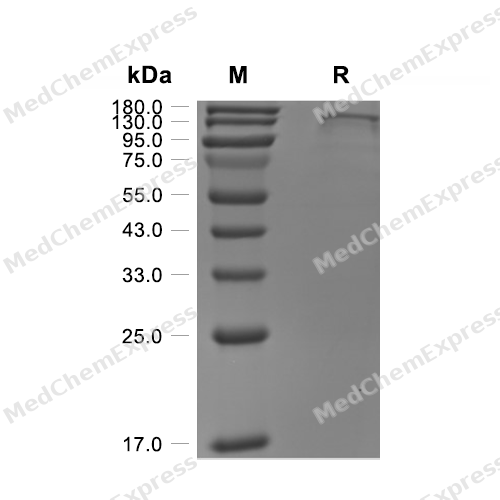
Purity - SDS-PAGE
-
Bioactivity - ELISA
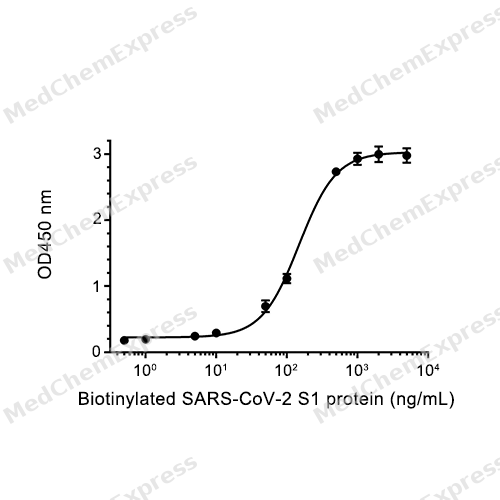
Bioactivity - ELISA

Assay Procedure
Materials
ACE2 Protein, Mouse (HEK293, His-Fc) (HY-P74433)
Biotin
Pre-chilled sterile water
Washing buffer: 1×PBST
Blocking buffer: 1% BSA in PBST
TMB chromogenic solution: Mix chromogenic solution A and chromogenic solution B at a 1:1 ratio before use, prepared freshly.
Stop solution (2 M H2SO4)
Procedure
Biotin Labeling
1. Dissolution of Biotin reagent: Take Biotin out from -10 ~ -30℃, immediately dissolve 1 tube of Biotin in 180 μL of cold pure water. Gently pipette up and down to mix well, preparing 10 mM Biotin.
2. Calculate the volume of EZ-LinkTM Sulfo-NHS-LC-LC-Biotin, No-WeighTM Format to be added.
3. Incubate at room temperature (RT) in the dark for 45 min;
4. Quantification of labeled protein: Use BCA assay for protein concentration quantification. The concentration of the labeled Biotinylated SARS-CoV-2 S1 is 208 μg/mL.
ELISA Detection
1. Coating: Dilute Mouse ACE2 protein to 2 μg/mL with 1×PBS, add 100 μL/well, and incubate overnight at 2-8℃.
2. Plate washing: Wash the plate with washing buffer, 260 μL/well, wash once, and pat dry.
3. Blocking: Add 1×PBST containing 1% BSA (blocking buffer) at 150 μL per well, incubate at 25℃ with 450 rpm shaking for 4 h.
4. Dilute Biotinylated SARS-CoV-2 S1 to the following concentrations: 0, 0.001, 0.005, 0.01, 0.05, 0.1, 0.5, 1, 5, 10, 50, 100, 500, 1000 ng/mL.
5. Add receptor protein: 100 μL/well, incubate at 25℃ with 450 rpm shaking for 2 h.
6. Plate washing: Wash the plate with washing buffer, 260 μL/well, wash 5 times with 1 min soaking each time, then pat dry.
7. Add secondary antibody: Dilute the secondary antibody at a ratio of 1:2000, add 100 μL/well, incubate at 25℃ with 450 rpm shaking for 1 h.
8. Plate washing: Wash the plate with washing buffer, 260 μL/well, wash 3 times with 1 min soaking each time, then pat dry.
9. Add TMB chromogenic solution: 100 μL/well, incubate at room temperature in the dark for 15 min.
10. Terminate reaction: Add 2 M H2SO4 at 100 μL/well.
11. Plate reading: Read the absorbance at 450 nm.
12. Use GraphPad Prism software to plot a curve with the OD value as the y-axis and the Biotinylated Mouse ACE2 Protein concentration as the x-axis, then calculate the ED50 value.


Technical Parameters
-
Species Mouse
-
Source HEK293
-
Tag C-8*His;C-hFc
-
Accession
Q8R0I0-1 (Q18-T740)
-
Molecular Construction
-
N-term
-
ACE2 (Q18-T740)
Accession # Q8R0I0-1 -
hFc-8*His
-
C-term
-
-
Protein Length
Extracellular Domain
-
Synonyms
ACE2; Angiotensin I Converting Enzyme 2; Angiotensin Converting Enzyme 2; Angiotensin-Converting Enzyme 2; ACEH; ACE-Related Carboxypeptidase; Angiotensin I Converting Enzyme (Peptidyl-Dipeptidase A) 2; Metalloprotease MPROT15; Angiotensin-Converting Enzy
-
AA Sequence
QSLTEENAKTFLNNFNQEAEDLSYQSSLASWNYNTNITEENAQKMSEAAAKWSAFYEEQSKTAQSFSLQEIQTPIIKRQLQALQQSGSSALSADKNKQLNTILNTMSTIYSTGKVCNPKNPQECLLLEPGLDEIMATSTDYNSRLWAWEGWRAEVGKQLRPLYEEYVVLKNEMARANNYNDYGDYWRGDYEAEGADGYNYNRNQLIEDVERTFAEIKPLYEHLHAYVRRKLMDTYPSYISPTGCLPAHLLGDMWGRFWTNLYPLTVPFAQKPNIDVTDAMMNQGWDAERIFQEAEKFFVSVGLPHMTQGFWANSMLTEPADGRKVVCHPTAWDLGHGDFRIKMCTKVTMDNFLTAHHEMGHIQYDMAYARQPFLLRNGANEGFHEAVGEIMSLSAATPKHLKSIGLLPSDFQEDSETEINFLLKQALTIVGTLPFTYMLEKWRWMVFRGEIPKEQWMKKWWEMKREIVGVVEPLPHDETYCDPASLFHVSNDYSFIRYYTRTIYQFQFQEALCQAAKYNGSLHKCDISNSTEAGQKLLKMLSLGNSEPWTKALENVVGARNMDVKPLLNYFQPLFDWLKEQNRNSFVGWNTEWSPYADQSIKVRISLKSALGANAYEWTNNEMFLFRSSVAYAMRKYFSIIKNQTVPFLEEDVRVSDLKPRVSFYFFVTSPQNVSDVIPRSEVEDAIRMSRGRINDVFGLNDNSLEFLGIHPTLEPPYQPPVT
-
Molecular Weight
Approximately 130 kDa, based on SDS-PAGE under reducing conditions, due to the glycosylation.
-
Glycosylation
Yes
-
Purity
≥ 95%, as determined by reducing SDS-PAGE.


Product Properties
Lyophilized powder.
Lyophilized from a 0.22 μm filtered solution of PBS, pH 7.4.
<1 EU/μg, determined by LAL method.
It is not recommended to reconstitute to a concentration less than 100 μg/mL in ddH2O. For long term storage it is recommended to add a carrier protein (0.1% BSA, 5% HSA, 10% FBS or 5% Trehalose).
Stored at -20°C for 2 years from date of receipt. After reconstitution, it is stable at 4°C for 1 week or -20°C for longer (with carrier protein). It is recommended to freeze aliquots at -20°C or -80°C for extended storage.
Room temperature in continental US; may vary elsewhere.


Documentation
-
Data Sheet (240 KB)
-
SDS (252 KB)
- English - EN (252 KB)
- Français - FR (252 KB)
- Deutsch - DE (252 KB)
- Norwegian - NO (252 KB)
- Español - ES (252 KB)
- Swedish - SV (252 KB)
- Italian - IT (252 KB)
- Korean - KR (252 KB)
- Portuguese - PT (252 KB)
-
Handling Instructions (2659 KB)

Calculators
Concentration (start) × Volume (start) = Concentration (final) × Volume (final)


 Powered by Bioz

