



ADK/Adenosine Kinase Protein, Human (HEK293)

Based on 1 Customer Validation
ADK is an enzyme that catalyzes the transfer of gamma-phosphate from adenosine triphosphate (ATP) to adenosine (Ado) to form adenosine monophosphate (AMP). ADK acts as a potential regulator of extracellular adenosine and intracellular adenine nucleotide concentrations. ADK is a therapeutic target for controlling obesity and non-alcoholic fatty liver disease. ADK/Adenosine Kinase Protein, Human (HEK293) is the recombinant human-derived ADK/Adenosine Kinase protein, expressed by HEK293 , with tag free.
- Species: Human
- Source: HEK293
-
Storage:Stored at -80°C for 1 year from date of receipt. It is stable at -20°C for 3 months after opening. It is recommended to freeze aliquots at -80°C for extended storage. Avoid repeated freeze-thaw cycles.


To place orders, for customer services and technical support, please contact: MedChemExpress USA
Tel: 609-228-6898 E-mail: [email protected] [email protected]


-
 Biological Activity
-
Technical Parameters
-
Product Properties
- Documentation
- References
- Help & FAQs




Biological Activity
Description
ADK is an enzyme that catalyzes the transfer of gamma-phosphate from adenosine triphosphate (ATP) to adenosine (Ado) to form adenosine monophosphate (AMP). ADK acts as a potential regulator of extracellular adenosine and intracellular adenine nucleotide concentrations. ADK is a therapeutic target for controlling obesity and non-alcoholic fatty liver disease. ADK/Adenosine Kinase Protein, Human (HEK293) is the recombinant human-derived ADK/Adenosine Kinase protein, expressed by HEK293 , with tag free.
Background
Adenosine kinase is an enzyme that catalyzes the transfer of γ-phosphate from adenosine triphosphate (ATP) to adenosine (Ado) to form adenosine monophosphate (AMP). Catalyze the phosphorylation of purine nucleoside adenosine at the 5 'position in an ATP-dependent manner. ADK acts as a potential regulator of extracellular adenosine and intracellular adenine nucleotide concentrations. ADK promotes excess fat deposition and liver inflammation by inhibiting fatty acid oxidation in hepatocytes and producing hepatocellular proinflammatory mediators, which is a therapeutic target for controlling obesity and non-alcoholic fatty liver disease[1][2][3].
Verified Bioactivity
Measured by its ability to phosphorylate Adenosine that incubate at room temperature for 60 minutes. The specific activity is > 15 pmol/min/μg.
MCE Validation Data
-
Purity - SDS-PAGE
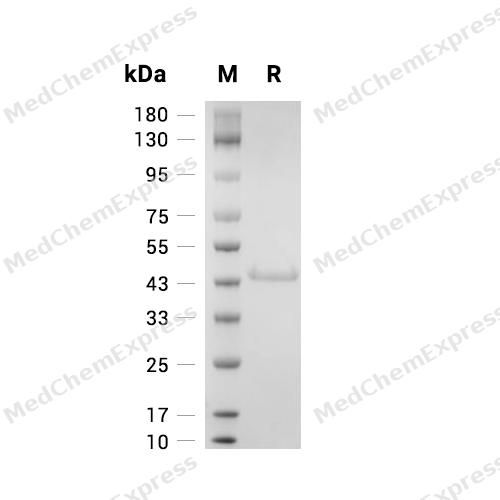
Purity - SDS-PAGE

Assay Procedure
Materials
Assay buffer (10×): 250 mM HEPES, 1.5 M NaCl, 100 mM MgCl2, 100 mM CaCl2, pH 7.0
ADK/Adenosine Kinase Protein, Human (HEK293) (HY-P75530)
Substrates: Adenosine, ATP
Detection Kit: Kinase-LumiTM Enhanced Chemiluminescent Kinase Activity Detection Kit
Standard: ATP
Procedure
1. Dilute the 10× assay Buffer to 1× with ddH2O.
2. Dilute ATP to 0, 0.024414063, 0.048828125, 0.09765625, 0.1953125, 0.390625, 0.78125, 1.5625, 3.125, 6.25, 12.5, 25, and 50 μM with 1× assay buffer.
3. Add 50 μL of ATP solution at different concentrations to each well, then add 50 μL of kinase detection reagent.
4. Incubate at room temperature for 10 min.
5. Measure the RLU values using a microplate reader with chemiluminescence detection.
6. Obtain the standard curve equation with the measured RLU values as the ordinate and the amount of ATP as the abscissa.
7. Dilute Human ADK protein to 50 μg/mL with 1× assay buffer.
8. Dilute ATP to 90 μM with 1× assay buffer and mix well, then dilute adenosine to 2 mM and mix.
9. Add 25 μL of 50 μg/mL protein solution to a 96-well plate, then add 25 μL of the mixed solution; for blank wells, add 25 μL of 1× assay buffer, then add 25 μL of the mixed solution.
10. Incubate at room temperature (22-25°C) for 60 minutes.
11. After incubation, add 50 μL of kinase detection reagent to each well.
12. Incubate at room temperature for 10 min.
13. Measure the RLU values using a microplate reader.
14. Calculate the specific activity:
Specific Activity (pmol/min/μg) = | Phosphate released* (nmol) x 1000 (pmol/nmol) |
| Incubation time** (min) x amount of enzyme (μg) |
*Derived from the phosphate standard curve via linear regression and corrected for substrate blank.
**Given the consistent conditions throughout the assay, use the cumulative incubation time prior to adding Kinase Activity Detection reagents for calculations.
Per Well:
Human ADK: 1.25 μg


Technical Parameters
-
Species Human
-
Source HEK293
-
Tag Tag Free
-
Accession
AAH03568.1 (M1-H345)
-
Molecular Construction
-
N-term
-
ADK (M1-H345)
Accession # AAH03568 -
C-term
-
-
Protein Length
Full Length
-
Synonyms
ADK; N6,N6-Dimethyladenosine Kinase; Adenosine Kinase; N6-Isopentenyladenosine Kinase; AK; N6-Methyladenosine Kinase; Adenosine 5'-Phosphotransferase; Testicular Tissue Protein Li 14
-
AA Sequence
MTSVRENILFGMGNPLLDISAVVDKDFLDKYSLKPNDQILAEDKHKELFDELVKKFKVEYHAGGSTQNSIKVAQWMIQQPHKAATFFGCIGIDKFGEILKRKAAEAHVDAHYYEQNEQPTGTCAACITGDNRSLIANLAAANCYKKEKHLDLEKNWMLVEKARVCYIAGFFLTVSPESVLKVAHHASENNRIFTLNLSAPFFSQFYKESLMKVMPYVDILFGNETEAATFAREQGFETKDIKEIAKKTQALPKMNSKRQRIVIFTQGRDDTIMATESEVTAFAVLDQDQKEIIDTNGAGDAFVGGFLSQLVSDKPLTECIRAGHYAASIIIRRTGCTFPEKPDFH
-
Predicted Molecular Mass
38.7 kDa
-
Molecular Weight
Approximately 45 kDa, based on SDS-PAGE under reducing conditions, due to the glycosylation.
-
Glycosylation
Yes
-
Purity
≥ 95%, as determined by reducing SDS-PAGE.


Product Properties
Solution
1.Supplied as a 0.22 μm filtered solution of 20 mM Tris, 300 mM NaCl, pH 8.0, 0.5 mM PMSF, 0.5 mM TCEP, 20% glycerol.
2.Supplied as a 0.22 μm filtered solution in 20 mM Tris-HCL, 300 mM NaCl, 0.5 mM PMSF, 0.5 mM TCEP, pH 8.0, 20% glycerol.
Please refer to the lot-specific COA for specific buffer information.
Note: For SPR assay, please replace the buffer. Primary amine components (e.g., Tris, imidazole) can affect protein-coupled chips.
<1 EU/μg, determined by LAL method.
Stored at -80°C for 1 year from date of receipt. It is stable at -20°C for 3 months after opening. It is recommended to freeze aliquots at -80°C for extended storage. Avoid repeated freeze-thaw cycles.
Shipping with dry ice.


Documentation
-
Data Sheet (264 KB)
-
SDS (252 KB)
- English - EN (252 KB)
- Français - FR (252 KB)
- Deutsch - DE (252 KB)
- Norwegian - NO (252 KB)
- Español - ES (252 KB)
- Swedish - SV (252 KB)
- Italian - IT (252 KB)
- Korean - KR (252 KB)
- Portuguese - PT (252 KB)
-
Handling Instructions (2659 KB)


References
[1]. Li H, et al. Hepatocyte Adenosine Kinase Promotes Excessive Fat Deposition and Liver Inflammation. Gastroenterology. 2023 Jan;164(1):134-146. [Content Brief]
[2]. Bjursell MK, et al. Adenosine kinase deficiency disrupts the methionine cycle and causes hypermethioninemia, encephalopathy, and abnormal liver function. Am J Hum Genet. 2011 Oct 7;89(4):507-15. [Content Brief]
[3]. McNally T, et al. Cloning and expression of the adenosine kinase gene from rat and human tissues. Biochem Biophys Res Commun. 1997 Feb 24;231(3):645-50. [Content Brief]

Calculators
Concentration (start) × Volume (start) = Concentration (final) × Volume (final)


 Powered by Bioz

