



Arginase-1/ARG1 Protein, Human (N-His)
Based on 1 publication(s) in Google Scholar
Arginase-1 (ARG1) protein, crucial in the urea cycle, converts L-arginine to urea and L-ornithine. ARG1 also regulates L-arginine levels outside the liver, impacting immune responses. ARG1's release by granulocytes suppresses T cell and NK cell functions. In ILC2s, ARG1 promotes lung inflammation. However, ARG1's role in human monocytic/macrophage/dendritic cells is unclear. Arginase-1/ARG1 Protein, Human (N-His) is the recombinant human-derived Arginase-1/ARG1 protein, expressed by E. coli , with N-6*His labeled tag.
- Species: Human
- Source: E. coli
-
Storage:Stored at -20°C for 2 years from date of receipt. After reconstitution, it is stable at 4°C for 1 week or -20°C for longer (with carrier protein). It is recommended to freeze aliquots at -20°C or -80°C for extended storage.


To place orders, for customer services and technical support, please contact: MedChemExpress USA
Tel: 609-228-6898 E-mail: [email protected] [email protected]


-
 Biological Activity
-
Technical Parameters
-
Product Properties
- Documentation
- Help & FAQs




Biological Activity
Description
Arginase-1 (ARG1) protein, crucial in the urea cycle, converts L-arginine to urea and L-ornithine. ARG1 also regulates L-arginine levels outside the liver, impacting immune responses. ARG1's release by granulocytes suppresses T cell and NK cell functions. In ILC2s, ARG1 promotes lung inflammation. However, ARG1's role in human monocytic/macrophage/dendritic cells is unclear. Arginase-1/ARG1 Protein, Human (N-His) is the recombinant human-derived Arginase-1/ARG1 protein, expressed by E. coli , with N-6*His labeled tag.
Background
Arginase-1 (ARG1) protein is a crucial component of the urea cycle, facilitating the conversion of L-arginine to urea and L-ornithine. This cycle primarily occurs in the liver and, to a lesser extent, in the kidneys. Beyond its role in nitrogen metabolism, ARG1 plays a pivotal role in L-arginine homeostasis in nonhepatic tissues, where it competes with nitric oxide synthase (NOS) for intracellular arginine, impacting innate and adaptive immune responses. The antimicrobial effector pathway in polymorphonuclear granulocytes involves ARG1, released upon cell death, which depletes arginine in the microenvironment, leading to suppressed T cell and natural killer (NK) cell proliferation and cytokine secretion. In group 2 innate lymphoid cells (ILC2s), ARG1 promotes acute type 2 inflammation in the lung, influencing ILC2 proliferation. However, the precise immunological role of ARG1 in the monocytic/macrophage/dendritic cell lineage in humans remains uncertain.
Verified Bioactivity
Measured by its binding ability in the production of urea during the hydrolysis of arginine. The specific activity is 129570.707 pmol/min/µg.
MCE Validation Data
-
Purity - SDS-PAGE
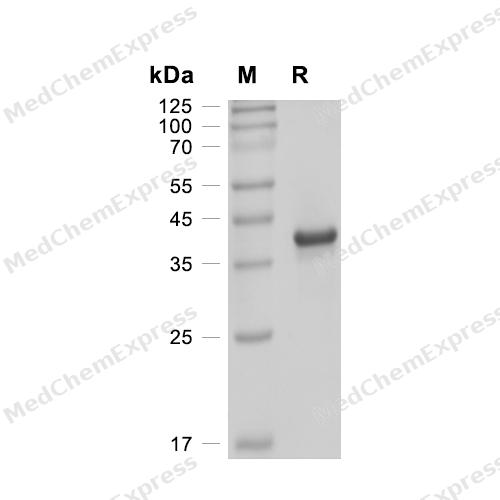
Purity - SDS-PAGE


Publications (1)
-
Journal Impact Factor
-
Most Recent


Technical Parameters
-
Species Human
-
Source E. coli
-
Tag N-6*His
-
Accession
P05089 (M1-K322)
-
Molecular Construction
-
N-term
-
6*His
-
ARGI1 (M1-K322)
Accession # P05089 -
C-term
-
-
Protein Length
Full Length
-
Synonyms
ARG1; Type I Arginase; Arginase 1; Arginase, Liver; Arginase-1; Arginase; Liver-Type Arginase
-
AA Sequence
MSAKSRTIGIIGAPFSKGQPRGGVEEGPTVLRKAGLLEKLKEQECDVKDYGDLPFADIPNDSPFQIVKNPRSVGKASEQLAGKVAEVKKNGRISLVLGGDHSLAIGSISGHARVHPDLGVIWVDAHTDINTPLTTTSGNLHGQPVSFLLKELKGKIPDVPGFSWVTPCISAKDIVYIGLRDVDPGEHYILKTLGIKYFSMTEVDRLGIGKVMEETLSYLLGRKKRPIHLSFDVDGLDPSFTPATGTPVVGGLTYREGLYITEEIYKTGLLSGLDIMEVNPSLGKTPEEVTRTVNTAVAITLACFGLAREGNHKPIDYLNPPK
-
Predicted Molecular Mass
35 kDa
-
Molecular Weight
Approximately 40 kDa, based on SDS-PAGE under reducing conditions.
-
Purity
≥ 90%, as determined by reducing SDS-PAGE.


Product Properties
Lyophilized powder.
Lyophilized from a 0.22 μm filtered solution of 50 mM Tris-HCl, 300 mM NaCl, pH 7.4, 5% trehalose, 5% mannitol and 0.01% Tween 80.
Note: For SPR assay, please replace the buffer. Primary amine components (e.g., Tris, imidazole) can affect protein-coupled chips.
<1 EU/μg, determined by LAL method.
It is not recommended to reconstitute to a concentration less than 100 μg/mL in ddH2O.
Stored at -20°C for 2 years from date of receipt. After reconstitution, it is stable at 4°C for 1 week or -20°C for longer (with carrier protein). It is recommended to freeze aliquots at -20°C or -80°C for extended storage.
Room temperature in continental US; may vary elsewhere.


Documentation
-
Data Sheet (237 KB)
-
SDS (251 KB)
- English - EN (251 KB)
- Français - FR (251 KB)
- Deutsch - DE (251 KB)
- Norwegian - NO (251 KB)
- Español - ES (251 KB)
- Swedish - SV (251 KB)
- Italian - IT (251 KB)
- Korean - KR (251 KB)
- Portuguese - PT (251 KB)
-
Handling Instructions (2659 KB)

Calculators
Concentration (start) × Volume (start) = Concentration (final) × Volume (final)


 Powered by Bioz

