



Arylsulfatase A/ARSA Protein, Mouse (HEK293, His)
Based on 1 Customer Validation
Arylsulfatase A (ARSA) possesses arylsulfatase and calcium ion binding activities. It plays a critical role in sperm-zona pellucida binding and is located in the plasma membrane. ARSA is expressed in the brain and genitourinary system, reflecting its involvement in various processes. It is associated with metachromatic leukodystrophy and broadly expressed across tissues, highlighting its significance in diverse contexts. Arylsulfatase A/ARSA Protein, Mouse (HEK293, His) is the recombinant mouse-derived Arylsulfatase A/ARSA protein, expressed by HEK293 , with C-10*His labeled tag.
- Species: Mouse
- Source: HEK293
-
Storage:Stored at -20°C for 2 years from date of receipt. After reconstitution, it is stable at 4°C for 1 week or -20°C for longer (with carrier protein). It is recommended to freeze aliquots at -20°C or -80°C for extended storage.


To place orders, for customer services and technical support, please contact: MedChemExpress USA
Tel: 609-228-6898 E-mail: [email protected] [email protected]


-
 Biological Activity
-
Technical Parameters
-
Product Properties
- Documentation
- Help & FAQs




Biological Activity
Description
Arylsulfatase A (ARSA) possesses arylsulfatase and calcium ion binding activities. It plays a critical role in sperm-zona pellucida binding and is located in the plasma membrane. ARSA is expressed in the brain and genitourinary system, reflecting its involvement in various processes. It is associated with metachromatic leukodystrophy and broadly expressed across tissues, highlighting its significance in diverse contexts. Arylsulfatase A/ARSA Protein, Mouse (HEK293, His) is the recombinant mouse-derived Arylsulfatase A/ARSA protein, expressed by HEK293 , with C-10*His labeled tag.
Background
Arylsulfatase A (ARSA) is predicted to possess arylsulfatase activity and calcium ion binding activity. It plays a critical role upstream of the binding activity of sperm to the zona pellucida and is located in the plasma membrane, serving as an integral component of the membrane. ARSA is expressed in the brain and genitourinary system, reflecting its involvement in various physiological processes. This gene is associated with metachromatic leukodystrophy, a condition characterized by the abnormal accumulation of sulfatides in the central and peripheral nervous systems. The broad expression of ARSA across tissues, including the testis, lung, and numerous other organs, underscores its significance in diverse biological contexts.
Verified Bioactivity
Measured by its ability to hydrolyze the substrate 4-Nitrocatechol Sulfate (PNCS). The specific activity is 9.387×10^4 pmoL/min/µg, as measured under the described conditions.
MCE Validation Data
-
Purity - SDS-PAGE
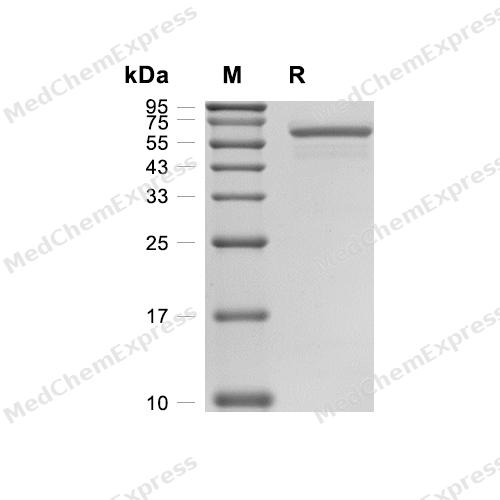
Purity - SDS-PAGE

Assay Procedure
Materials
Assay buffer: 50 mM NaOAc, 0.5 M NaCl, pH 4.5
Arylsulfatase A/ARSA Protein, Mouse (HEK293, His) (HY-P75499)
Substrate: 4-Nitrocatechol Sulfate (PNCS) , diluted to 100 mM in ddH2O
Standard: 4-Nitrocatechol (PNC, HY-W066890)
Sodium Hydroxide (NaOH) : 2.0 M stored in deionized water
96-well transparent plate
Microplate reader
Procedure
1. Standard Curve: Prepare PNC at concentrations of 0, 0.078125×10⁶, 0.15625×10⁶, 0.3125×10⁶, 0.625×10⁶, 1.25×10⁶, 2.5×10⁶, 5×10⁶ pmol. Measure the OD510 for each concentration. Plot the standard curve with standard concentration (pmol) on the x-axis and the OD510 on the y-axis.
2. Dilute Mouse ARSA in assay buffer to concentrations of 2, 20, 200 μg/mL.
3. Dilute the substrate to 2 mM in assay buffer.
4. Experimental group: Mix 75 μL of 2, 20, 200 μg/mL Mouse ARSA with 75 μL of 2 mM substrate.
Blank Control: Combine 75 μL of assay buffer with 75 μL of substrate.
Set up three replicates for each group and add to 1.5 mL centrifμge tubes.
5. Incubate in a water bath at 37°C for 1 hour.
6. Add 150 μL of 0.2 M NaOH to stop the reaction.
7. Transfer 200 μL to a transparent 96-well plate.
8. Read the absorbance at 510 nm in endpoint mode.
9. Calculate specific activity:
Specific Activity (pmol/min/μg) = | Adjusted Abs * (OD) x Conversion Factor ** (pmol/OD) |
| Incubation time (min) x amount of enzyme (μg) |
*Adjusted for Substrate Blank
**Derived using calibration standard
Per Well:
Mouse ARSA: 1 μg
Substrate: 1 mM


Technical Parameters
-
Species Mouse
-
Source HEK293
-
Tag C-10*His
-
Accession
P50428/NP_033843.2 (S18-S506)
-
Molecular Construction
-
N-term
-
ARSA (S18-S506)
Accession # P50428/NP_033843.2 -
10*His
-
C-term
-
-
Protein Length
Full Length of Mature Protein
-
Synonyms
ARSA; Epididymis Secretory Sperm Binding Protein; Arylsulfatase A; Metachromatic Leucodystrophy; ASA; Arylsulfatase A Isoform 2; Cerebroside-Sulfatase; MLD
-
AA Sequence
SPPNILLIFADDLGYGDLGSYGHPSSTTPNLDQLAEGGLRFTDFYVPVSLCTPSRAALLTGRLPVRSGMYPGVLGPSSQGGLPLEEVTLAEVLAARGYLTGMAGKWHLGVGPEGAFLPPHQGFHRFLGIPYSHDQGPCQNLTCFPPDIPCKGGCDQGLVPIPLLANLTVEAQPPWLPGLEARYVSFSRDLMADAQRQGRPFFLYYASHHTHYPQFSGQSFTKRSGRGPFGDSLMELDGAVGALMTTVGDLGLLEETLVIFTADNGPELMRMSNGGCSGLLRCGKGTTFEGGVREPALVYWPGHITPGVTHELASSLDLLPTLAALTGAPLPNVTLDGVDISPLLLGTGKSPRKSVFFYPPYPDEIHGVFAVRNGKYKAHFFTQGSAHSDTTSDPACHAANRLTAHEPPLLYDLSQDPGENYNVLESIEGVSPEALQALKHIQLLKAQYDAAMTFGPSQIAKGEDPALQICCQPSCTPHPVCCHCPGSQS
-
Molecular Weight
Approximately 60 kDa, based on SDS-PAGE under reducing conditions, due to the glycosylation.
-
Glycosylation
Yes
-
Purity
≥ 95%, as determined by reducing SDS-PAGE.


Product Properties
Lyophilized powder.
Lyophilized from a 0.22 μm filtered solution of PBS, pH 7.4.
<1 EU/μg, determined by LAL method.
It is not recommended to reconstitute to a concentration less than 100 μg/mL in ddH2O. For long term storage it is recommended to add a carrier protein (0.1% BSA, 5% HSA, 10% FBS or 5% Trehalose).
Stored at -20°C for 2 years from date of receipt. After reconstitution, it is stable at 4°C for 1 week or -20°C for longer (with carrier protein). It is recommended to freeze aliquots at -20°C or -80°C for extended storage.
Room temperature in continental US; may vary elsewhere.


Documentation
-
Data Sheet (238 KB)
-
SDS (251 KB)
- English - EN (251 KB)
- Français - FR (251 KB)
- Deutsch - DE (251 KB)
- Norwegian - NO (251 KB)
- Español - ES (251 KB)
- Swedish - SV (251 KB)
- Italian - IT (251 KB)
- Korean - KR (251 KB)
- Portuguese - PT (251 KB)
-
Handling Instructions (2659 KB)

Calculators
Concentration (start) × Volume (start) = Concentration (final) × Volume (final)


 Powered by Bioz

