



NPR2 Protein, Human (P. pastoris, His)
Based on 1 publication(s) in Google Scholar
NPR2 Protein, Human (P. pastoris, His) serves as the receptor for C-type natriuretic peptide NPPC/CNP, activating guanylate cyclase upon ligand binding. NPR2 potentially regulates skeletal growth, indicating involvement in bone development. Its interaction with C-type natriuretic peptide highlights its significance in mediating cellular responses, especially in signaling pathways influencing skeletal growth dynamics. NPR2 Protein, Human (P. pastoris, His) is the recombinant human-derived Atrial natriuretic peptide receptor 2/NPR2, expressed by P. pastoris , with N-His labeled tag.
- Species: Human
- Source: P. pastoris
-
Storage:Stored at -20°C for 2 years from date of receipt. After reconstitution, it is stable at 4°C for 1 week or -20°C for longer (with carrier protein). It is recommended to freeze aliquots at -20°C or -80°C for extended storage.


To place orders, for customer services and technical support, please contact: MedChemExpress USA
Tel: 609-228-6898 E-mail: [email protected] [email protected]


-
 Biological Activity
-
Technical Parameters
-
Product Properties
- Documentation
- Help & FAQs




Biological Activity
Description
NPR2 Protein, Human (P. pastoris, His) serves as the receptor for C-type natriuretic peptide NPPC/CNP, activating guanylate cyclase upon ligand binding. NPR2 potentially regulates skeletal growth, indicating involvement in bone development. Its interaction with C-type natriuretic peptide highlights its significance in mediating cellular responses, especially in signaling pathways influencing skeletal growth dynamics. NPR2 Protein, Human (P. pastoris, His) is the recombinant human-derived Atrial natriuretic peptide receptor 2/NPR2, expressed by P. pastoris , with N-His labeled tag.
Background
Atrial natriuretic peptide receptor 2 (NPR2) functions as a receptor for the C-type natriuretic peptide NPPC/CNP hormone, exhibiting guanylate cyclase activity upon ligand binding. This receptor plays a potential role in the regulation of skeletal growth, suggesting its involvement in processes that govern bone development and maintenance. The interaction between NPR2 and C-type natriuretic peptide highlights its significance in mediating cellular responses to this hormone, particularly in the context of signaling pathways that influence skeletal growth dynamics.
Verified Bioactivity
The enzyme activity of this recombinant protein is testing in progress, we cannot offer a guarantee yet.
MCE Validation Data
-
Purity - SDS-PAGE
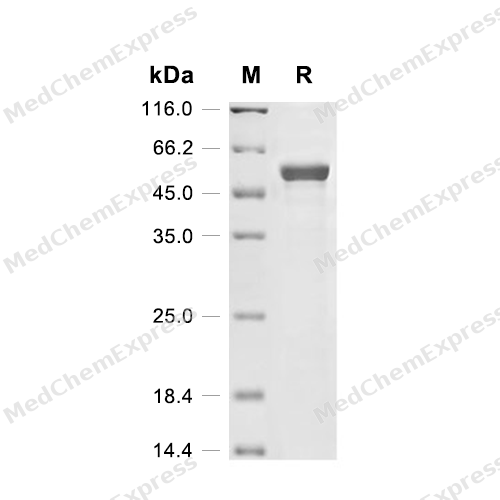
Purity - SDS-PAGE


Publications (1)
-
Journal Impact Factor
-
Most Recent
-
Bioorg Chem
Nonapeptide AOP-P1 ameliorates UVB-induced hyperpigmentation by suppressing melanogenesis via targeting natriuretic peptide receptor 2. [Abstract]2026 Aug 15:178:109960. PMID: 42105524


Technical Parameters
-
Species Human
-
Source P. pastoris
-
Tag N-His
-
Accession
P20594-1 (R23-I458)
-
Molecular Construction
-
N-term
-
His
-
ANPRB (R23-I458)
Accession # P20594-1 -
C-term
-
-
Protein Length
Extracellular Domain
-
Synonyms
NPR2; Atrial Natriuretic Peptide B-Type Receptor; Prev. ANPRB; Atrionatriuretic Peptide Receptor B; Prev. AMDM; Natriuretic Peptide Receptor B; Prev. NPRB; Guanylate Cyclase; GC-B; ANPR-B; Atrial Natriuretic Peptide Receptor Type B; GUC2B; Atrial Natriure
-
AA Sequence
RNLTLAVVLPEHNLSYAWAWPRVGPAVALAVEALGRALPVDLRFVSSELEGACSEYLAPLSAVDLKLYHDPDLLLGPGCVYPAASVARFASHWRLPLLTAGAVASGFSAKNDHYRTLVRTGPSAPKLGEFVVTLHGHFNWTARAALLYLDARTDDRPHYFTIEGVFEALQGSNLSVQHQVYAREPGGPEQATHFIRANGRIVYICGPLEMLHEILLQAQRENLTNGDYVFFYLDVFGESLRAGPTRATGRPWQDNRTREQAQALREAFQTVLVITYREPPNPEYQEFQNRLLIRAREDFGVELGPSLMNLIAGCFYDGILLYAEVLNETIQEGGTREDGLRIVEKMQGRRYHGVTGLVVMDKNNDRETDFVLWAMGDLDSGDFQPAAHYSGAEKQIWWTGRPIPWVKGAPPSDNPPCAFDLDDPSCDKTPLSTLAI
-
Predicted Molecular Mass
50 kDa
-
Molecular Weight
Approximately 51 kDa, based on SDS-PAGE under reducing conditions.
-
Glycosylation
Yes
-
Purity
≥ 90%, as determined by reducing SDS-PAGE.


Product Properties
Lyophilized powder
1.Lyophilized from a 0.22 μm filtered solution of PBS, pH 7.4.
2.Lyophilized from a 0.22 μm filtered solution of 10 mM Tris-HCl, 1 mM EDTA, 6% Trehalose, pH 8.0.
Note: For SPR assay, please replace the buffer. Primary amine components (e.g., Tris, imidazole) can affect protein-coupled chips.
3.Lyophilized from a 0.22 μm filtered solution of PBS, 6% Trehalose, pH 7.4.
Please refer to the lot-specific COA for specific buffer information.
<1.0 EU/μg, determined by LAL method.
It is not recommended to reconstitute to a concentration less than 100 μg/mL in ddH2O.
Stored at -20°C for 2 years from date of receipt. After reconstitution, it is stable at 4°C for 1 week or -20°C for longer (with carrier protein). It is recommended to freeze aliquots at -20°C or -80°C for extended storage.
Room temperature in continental US; may vary elsewhere.


Documentation
-
Data Sheet (237 KB)
-
SDS (251 KB)
- English - EN (251 KB)
- Français - FR (251 KB)
- Deutsch - DE (251 KB)
- Norwegian - NO (251 KB)
- Español - ES (251 KB)
- Swedish - SV (251 KB)
- Italian - IT (251 KB)
- Korean - KR (251 KB)
- Portuguese - PT (251 KB)
-
Handling Instructions (2659 KB)

Calculators
Concentration (start) × Volume (start) = Concentration (final) × Volume (final)


 Powered by Bioz

