



B3GALTL Protein, Human (HEK293, His)

Based on 1 Customer Validation
B3GALTL Protein s a novel glycosyltransferase found in multicellular animals such as mammals, insects, and nematodes. B3GALTL plays important roles in variety of biological processes and encodes enzymes that catalyze the attachment of asugar molecule to specific acceptor sites. And it is involved in the synthesis of the disaccharide Glc-β1,3-Fuc-O-. Furthermore, mutations in the B3GALTL gene cause Peters Plus syndrome. B3GALTL Protein, Human (HEK293, His) is the recombinant human-derived B3GALTL protein, expressed by HEK293 , with N-His labeled tag.
- Species: Human
- Source: HEK293
-
Storage:Stored at -20°C for 2 years from date of receipt. After reconstitution, it is stable at 4°C for 1 week or -20°C for longer (with carrier protein). It is recommended to freeze aliquots at -20°C or -80°C for extended storage.


To place orders, for customer services and technical support, please contact: MedChemExpress USA
Tel: 609-228-6898 E-mail: [email protected] [email protected]


-
 Biological Activity
-
Technical Parameters
-
Product Properties
- Documentation
- Help & FAQs




Biological Activity
Description
B3GALTL Protein s a novel glycosyltransferase found in multicellular animals such as mammals, insects, and nematodes. B3GALTL plays important roles in variety of biological processes and encodes enzymes that catalyze the attachment of asugar molecule to specific acceptor sites. And it is involved in the synthesis of the disaccharide Glc-β1,3-Fuc-O-. Furthermore, mutations in the B3GALTL gene cause Peters Plus syndrome. B3GALTL Protein, Human (HEK293, His) is the recombinant human-derived B3GALTL protein, expressed by HEK293 , with N-His labeled tag.
Background
B3GALTL is a novel glycosyltransferase found in multicellular animals such as mammals, insects, and nematodes. B3GALTL plays important roles in variety of biological processes and encodes enzymes that catalyze the attachment of asugar molecule to specific acceptor sites. B3GALTL is involved in the synthesis of the disaccharide Glc-β1,3-Fuc-O-, which occurs on thrombospondin type 1 repeat (TSR) of many biologically important molecules. It is present in many human and mouse tissues, with heart, kidney, and brain being major sites of expression in both species. Mutations in the B3GALTL gene cause Peters Plus syndrome. In addition, B3GALTL is overexpressed in thyroid oncocytic tumors[1][2].
Verified Bioactivity
The enzyme activity of this recombinant protein is testing in progress, we cannot offer a guarantee yet.
MCE Validation Data
-
Purity - SDS-PAGE
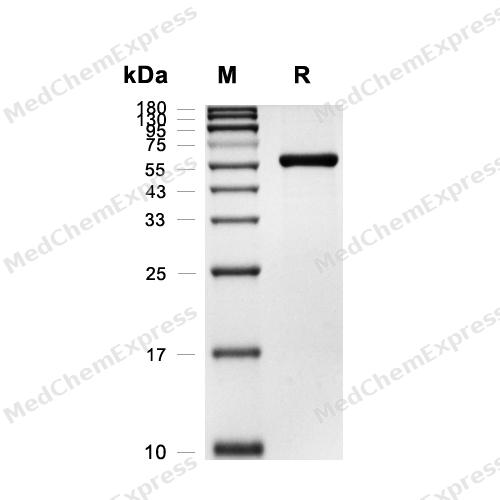
Purity - SDS-PAGE


Technical Parameters
-
Species Human
-
Source HEK293
-
Tag N-10*His
-
Accession
JC8008 (S29-F494)
-
Gene ID/
-
Molecular Construction
-
N-term
-
His
-
B3GALTL (S29-F494)
Accession # JC8008 -
C-term
-
-
Protein Length
Full Length of Mature Protein
-
Synonyms
B3GTL; B3GALTL; B3GLCT; Beta-3-glycosyltransferase-like; Beta 3-glucosyltransferase; Beta3Glc-T; EC:2.4.1.-; Beta-1,3-glucosyltransferase
-
AA Sequence
SEDTKKEVKQSQDLEKSGISRKNDIDLKGIVFVIQSQSNSFHAKRAEQLKKSILKQAADLTQELPSVLLLHQLAKQEGAWTILPLLPHFSVTYSRNSSWIFFCEEETRIQIPKLLETLRRYDPSKEWFLGKALHDEEATIIHHYAFSENPTVFKYPDFAAGWALSIPLVNKLTKRLKSESLKSDFTIDLKHEIALYIWDKGGGPPLTPVPEFCTNDVDFYCATTFHSFLPLCRKPVKKKDIFVAVKTCKKFHGDRIPIVKQTWESQASLIEYYSDYTENSIPTVDLGIPNTDRGHCGKTFAILERFLNRSQDKTAWLVIVDDDTLISISRLQHLLSCYDSGKPVFLGERYGYGLGTGGYSYITGGGGMVFSREAVRRLLASKCRCYSNDAPDDMVLGMCFSGLGIPVTHSPLFHQARPVDYPKDYLSHQVPISFHKHWNIDPVKVYFTWLAPSDEDKARQETQKGF
-
Molecular Weight
Approximately 54 kDa, based on SDS-PAGE under reducing conditions, due to the glycosylation.
-
Glycosylation
Yes
-
Purity
≥ 95%, as determined by reducing SDS-PAGE.


Product Properties
Lyophilized powder.
Lyophilized from a 0.22 μm filtered solution of PBS, pH 7.4.
<1 EU/μg, determined by LAL method.
It is not recommended to reconstitute to a concentration less than 100 μg/mL in ddH2O. For long term storage it is recommended to add a carrier protein (0.1% BSA, 5% HSA, 10% FBS or 5% Trehalose).
Stored at -20°C for 2 years from date of receipt. After reconstitution, it is stable at 4°C for 1 week or -20°C for longer (with carrier protein). It is recommended to freeze aliquots at -20°C or -80°C for extended storage.
Room temperature in continental US; may vary elsewhere.


Documentation
-
Data Sheet (238 KB)
-
SDS (251 KB)
- English - EN (251 KB)
- Français - FR (251 KB)
- Deutsch - DE (251 KB)
- Norwegian - NO (251 KB)
- Español - ES (251 KB)
- Swedish - SV (251 KB)
- Italian - IT (251 KB)
- Korean - KR (251 KB)
- Portuguese - PT (251 KB)
-
Handling Instructions (2659 KB)

Calculators
Concentration (start) × Volume (start) = Concentration (final) × Volume (final)


 Powered by Bioz

