



Basigin/CD147 Protein, Cynomolgus (HEK293, His)

Based on 1 Customer Validation
Basigin, also called CD147 or EMMPRIN, is a transmembrane glycoprotein that belongs to the immunoglobulin superfamily with homology to both the immunoglobulin V domain and major histocompatibility complex class II antigen 尾-chain. Basigin is the receptor for cyclophilins, S100A9 and platelet glycoprotein VI. Basigin tightly associates with monocarboxylate transporters and is essential for their cell surface translocation and activities . Basigin/CD147 Protein, Cynomolgus (HEK293, His) is the recombinant cynomolgus-derived Basigin/CD147 protein, expressed by HEK293 , with C-His labeled tag.
- Species: Cynomolgus
- Source: HEK293
-
Storage:Stored at -20°C for 2 years from date of receipt. After reconstitution, it is stable at 4°C for 1 week or -20°C for longer (with carrier protein). It is recommended to freeze aliquots at -20°C or -80°C for extended storage.


To place orders, for customer services and technical support, please contact: MedChemExpress USA
Tel: 609-228-6898 E-mail: [email protected] [email protected]


-
 Biological Activity
-
Technical Parameters
-
Product Properties
- Documentation
- Help & FAQs




Biological Activity
Description
Basigin, also called CD147 or EMMPRIN, is a transmembrane glycoprotein that belongs to the immunoglobulin superfamily with homology to both the immunoglobulin V domain and major histocompatibility complex class II antigen 尾-chain. Basigin is the receptor for cyclophilins, S100A9 and platelet glycoprotein VI. Basigin tightly associates with monocarboxylate transporters and is essential for their cell surface translocation and activities [1][2][3]. Basigin/CD147 Protein, Cynomolgus (HEK293, His) is the recombinant cynomolgus-derived Basigin/CD147 protein, expressed by HEK293 , with C-His labeled tag.
Background
Basigin has isoforms; the common form (basigin or basigin-2) has two immunoglobulin domains, and the extended form (basigin-1) has three. Basigin-1 serves as the receptor for the rod-derived cone viability factor. In the same membrane plane, basigin also associates with other proteins including GLUT1, CD44 and CD98. The carbohydrate portion of basigin is recognized by lectins, such as galectin-3 and E-selectin. These molecular recognitions form the basis for the role of basigin in the transport of nutrients, migration of inflammatory leukocytes and induction of matrix metalloproteinases. Basigin is important in vision, spermatogenesis and other physiological phenomena, and plays significant roles in the pathogenesis of numerous diseases, including cancer. Basigin is also the receptor for an invasive protein RH5, which is present in malaria parasites[1].
The CD147 gene, designated BSG for basigin, is located on chromosome 19p13.3 and encodes a 29 kD protein, though migration on SDS-PAGE usually occurs between 35–65 kD, depending on the degree of glycosylation. Three glycosylation sites have been identified within the CD147 Ig like domains: two within the membrane proximal Ig domain and one within the distal Ig domain[3].
Verified Bioactivity
Measured by its binding ability in a functional ELISA. When Recombinant SARS-COV-2 S Protein is immobilized at 1 µg/mL (100 µL/well) can bind Recombinant Cynomolgus CD147. The ED50 for this effect is 10.35 μg/mL.
MCE Validation Data
-
Purity - SDS-PAGE
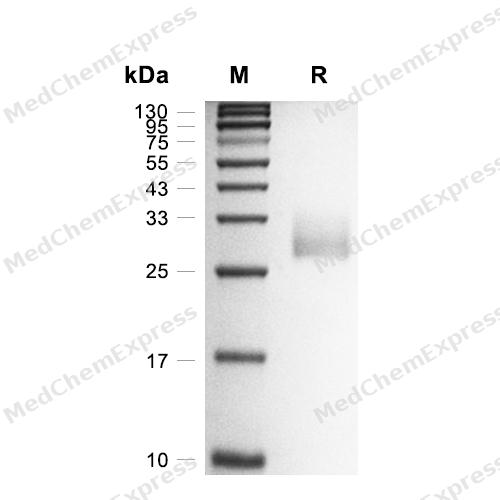
Purity - SDS-PAGE
-
Bioactivity - ELISA
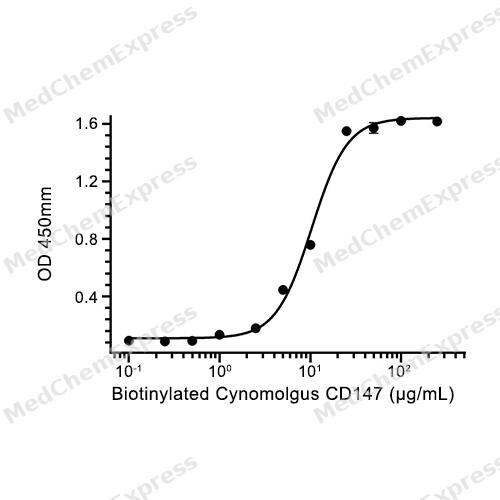
Bioactivity - ELISA


Technical Parameters
-
Species Cynomolgus
-
Source HEK293
-
Tag C-6*His
-
Accession
XP_005587354 (A19-H209)
-
Molecular Construction
-
N-term
-
Basigin (A19-H209)
Accession # XP_005587354 -
6*His
-
C-term
-
-
Protein Length
Partial
-
Synonyms
BSG; Leukocyte Activation Antigen M6; Prev. OK; Hepatoma-Associated Antigen; EMMPRIN; OK Blood Group Antigen; Basigin; HAb18G; Tumor Cell-Derived Collagenase Stimulatory Factor; TCSF; Extracellular Matrix Metalloproteinase Inducer; 5F7; EMPRIN; Ok Blood G
-
AA Sequence
AYGAAGTVSTSVENIGSKTLLTCSLNDSSTEVTGHRWLKGGAVLKEDTLPGQKTDFEVDSDDLGGEYSCVFLPEPTGRADIQLDALLSGAPRVKAVKSSEHVSEGETAVLACKSESLPPVTTWVWYKITDSGDQVIVNGSQGRFFVSSSQGRSELRIENLNMEADPGKYGCNGTSSEGTDQATVTLRVRSH
-
Molecular Weight
Approximately 27-33 kDa, based on SDS-PAGE under reducing conditions, due to the glycosylation.
-
Glycosylation
Yes
-
Purity
≥ 95%, as determined by reducing SDS-PAGE.


Product Properties
Lyophilized powder.
Lyophilized from a 0.22 μm filtered solution of PBS, pH 7.4.
<1 EU/μg, determined by LAL method.
It is not recommended to reconstitute to a concentration less than 100 μg/mL in ddH2O. For long term storage it is recommended to add a carrier protein (0.1% BSA, 5% HSA, 10% FBS or 5% Trehalose).
Stored at -20°C for 2 years from date of receipt. After reconstitution, it is stable at 4°C for 1 week or -20°C for longer (with carrier protein). It is recommended to freeze aliquots at -20°C or -80°C for extended storage.
Room temperature in continental US; may vary elsewhere.


Documentation
-
Data Sheet (261 KB)
-
SDS (251 KB)
- English - EN (251 KB)
- Français - FR (251 KB)
- Deutsch - DE (251 KB)
- Norwegian - NO (251 KB)
- Español - ES (251 KB)
- Swedish - SV (251 KB)
- Italian - IT (251 KB)
- Korean - KR (251 KB)
- Portuguese - PT (251 KB)
-
Handling Instructions (2659 KB)

Calculators
Concentration (start) × Volume (start) = Concentration (final) × Volume (final)


 Powered by Bioz

