



Cadherin-13 Protein, Mouse (HEK293, His)

Based on 1 Customer Validation
Cadherin-13 proteins are calcium-dependent cell adhesion molecules that exhibit a preference for homogeneous interactions, promote connections between adjacent cells, and may play a role in cell type sorting. Cadherin-13 Protein, Mouse (HEK293, His) is the recombinant mouse-derived Cadherin-13 protein, expressed by HEK293 , with C-His labeled tag.
- Species: Mouse
- Source: HEK293
-
Storage:Stored at -20°C for 2 years from date of receipt. After reconstitution, it is stable at 4°C for 1 week or -20°C for longer (with carrier protein). It is recommended to freeze aliquots at -20°C or -80°C for extended storage.


To place orders, for customer services and technical support, please contact: MedChemExpress USA
Tel: 609-228-6898 E-mail: [email protected] [email protected]


-
 Biological Activity
-
Technical Parameters
-
Product Properties
- Documentation
- Help & FAQs




Biological Activity
Description
Cadherin-13 proteins are calcium-dependent cell adhesion molecules that exhibit a preference for homogeneous interactions, promote connections between adjacent cells, and may play a role in cell type sorting. Cadherin-13 Protein, Mouse (HEK293, His) is the recombinant mouse-derived Cadherin-13 protein, expressed by HEK293 , with C-His labeled tag.
Background
Cadherin-13, a calcium-dependent cell adhesion protein, stands out for its unique features in comparison to classical cadherins. Unlike the typical cadherin EC1 domain strand-swapping mechanism for homodimerization, Cadherin-13 achieves this through a distinct homophilic adhesive interface, connecting two elongated EC1-EC2 domains near their Ca2+-binding sites. This arrangement forms a tetrahedral, X-like shape, showcasing a different mode of homodimerization. This protein is implicated in potentially acting as a negative regulator of neural cell growth, and its ability to preferentially interact with itself in a homophilic manner suggests a role in contributing to the sorting of heterogeneous cell types within neural tissues.
Verified Bioactivity
Measured by the ability of the immobilized protein to inhibit the adhesion of HUVEC human umbilical vein endothelial cells. When 5 x 10⁴ cells/well are added to Recombinant Mouse Cadherin-13 coated plates, cell adhesion is inhibited in a dose dependent manner after 2.5 hours at 37 °C. The ED50 for this effect is 4.025 μg/mL, corresponding to a specific activity is 248.447 units/mg.
MCE Validation Data
-
Purity - SDS-PAGE
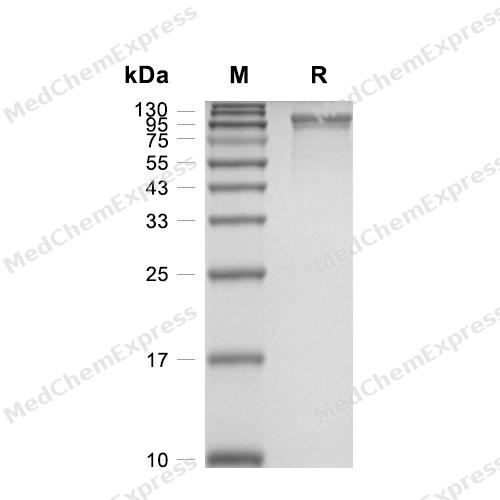
Purity - SDS-PAGE
-
Bioactivity - Cell-Based Assay
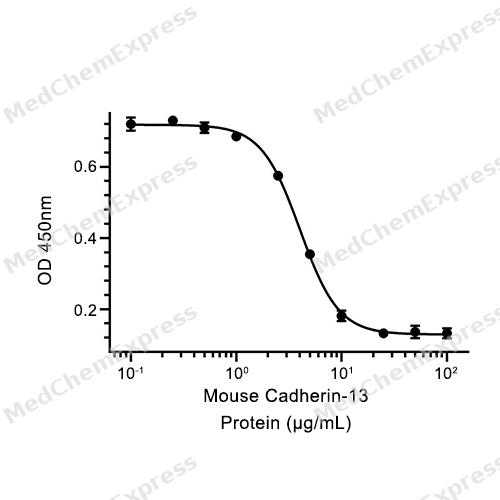
Bioactivity - Cell-Based Assay


Technical Parameters
-
Species Mouse
-
Source HEK293
-
Tag C-10*His
-
Accession
Q9WTR5 (D23-A692)
-
Molecular Construction
-
N-term
-
Cadherin-13 (D23-A692)
Accession # Q9WTR5 -
His
-
C-term
-
-
Protein Length
Partial
-
Synonyms
CDH13; Cadherin-13; Cadherin 13; T-Cad; CDHH; P105; T-Cadherin; Cadherin 13, H-Cadherin (Heart); H-Cadherin (Heart); Truncated Cadherin; Heart Cadherin; H-Cadherin
-
AA Sequence
DDLECTPGFQRKVLHIHQPAEFIEDQPVLNLTFNDCKGNEKLHYEVSSPHFKVNSDGTLVALRNITAVGRTLFVHARTPHAEDMAELVIVGGKDIQGSLQDIFKFARTSPVPRQKRSIVVSPILIPENQRQPFPRDVGKVVDSDRPEGSKFRLTGKGVDQDPKGTFRINENTGSVSVTRTLDRETIATYQLYVETTDASGKTLEGPVPLEVIVIDQNDNRPIFREGPYIGHVMEGSPTGTTVMRMTAFDADDPATDNALLRYNIRQQTPDKPSPNMFYIDPEKGDIVTVVSPALLDRETLENPKYELIIEAQDMAGLDVGLTGTATATIVIDDKNDHSPKFTKKEFQATVEEGAVGVIVNLTVEDKDDPTTGAWRAAYTIINGNPGQSFEIHTNPQTNEGMLSVVKPLDYEISAFHTLLIKVENEDPLVPDVSYGPSSTATVHITVLDVNEGPVFYPDPMMVTKQENISVGSVLLTVNATDPDSLQHQTIRYSIYKDPAGWLSINPINGTVDTTAVLDRESPFVHNSVYTALFLAIDSGNPPATGTGTLLITLEDINDNAPVIYPTVAEVCDDARNLSVVILGASDKDLHPNTDPFKFEIHKQTVPDKVWKISKINNTHALVSLLQNLNKANYNLPIMVTDSGKPPMTNITDLRVQVCSCKNSKVDCNGA
-
Molecular Weight
Approximately 90-110 kDa, based on SDS-PAGE under reducing conditions, due to the glycosylation.
-
Glycosylation
Yes
-
Purity
≥ 95%, as determined by reducing SDS-PAGE.


Product Properties
Lyophilized powder.
Lyophilized from a 0.22 μm filtered solution of PBS, pH 7.4.
<1 EU/μg, determined by LAL method.
It is not recommended to reconstitute to a concentration less than 100 μg/mL in ddH2O. For long term storage it is recommended to add a carrier protein (0.1% BSA, 5% HSA, 10% FBS or 5% Trehalose).
Stored at -20°C for 2 years from date of receipt. After reconstitution, it is stable at 4°C for 1 week or -20°C for longer (with carrier protein). It is recommended to freeze aliquots at -20°C or -80°C for extended storage.
Room temperature in continental US; may vary elsewhere.


Documentation
-
Data Sheet (240 KB)
-
SDS (251 KB)
- English - EN (251 KB)
- Français - FR (251 KB)
- Deutsch - DE (251 KB)
- Norwegian - NO (251 KB)
- Español - ES (251 KB)
- Swedish - SV (251 KB)
- Italian - IT (251 KB)
- Korean - KR (251 KB)
- Portuguese - PT (251 KB)
-
Handling Instructions (2659 KB)

Calculators
Concentration (start) × Volume (start) = Concentration (final) × Volume (final)


 Powered by Bioz

