



Calnexin Protein, Mouse (HEK293, His)

Based on 1 Customer Validation
Calnexin interacts with monoglucosylated glycoproteins, helping their assembly and retention in the endoplasmic reticulum (ER). Calnexin Protein, Mouse (HEK293, His) is the recombinant mouse-derived Calnexin protein, expressed by HEK293 , with C-His labeled tag.
- Species: Mouse
- Source: HEK293
-
Storage:Stored at -20°C for 2 years from date of receipt. After reconstitution, it is stable at 4°C for 1 week or -20°C for longer (with carrier protein). It is recommended to freeze aliquots at -20°C or -80°C for extended storage.


To place orders, for customer services and technical support, please contact: MedChemExpress USA
Tel: 609-228-6898 E-mail: [email protected] [email protected]


-
 Biological Activity
-
Technical Parameters
-
Product Properties
- Documentation
- Help & FAQs




Biological Activity
Description
Calnexin interacts with monoglucosylated glycoproteins, helping their assembly and retention in the endoplasmic reticulum (ER). Calnexin Protein, Mouse (HEK293, His) is the recombinant mouse-derived Calnexin protein, expressed by HEK293 , with C-His labeled tag.
Background
Calnexin protein, a calcium-binding chaperone located in the endoplasmic reticulum (ER), plays a pivotal role in interacting with newly synthesized monoglucosylated glycoproteins, contributing to protein assembly and retention of unassembled protein subunits within the ER. With a key function in the ER's quality control apparatus, calnexin participates in the retention of incorrectly folded proteins. Notably, it associates with partial T-cell antigen receptor complexes in immature thymocytes, suggesting a role in signaling and regulation of thymocyte maturation. Additionally, calnexin may be involved in receptor-mediated endocytosis at the synapse. Its interactions extend to various proteins, including MAPK3/ERK1, KCNH2, SERPINA2P/SERPINA2, SGIP1, PPIB, SMIM22, TMX2, TMEM35A/NACHO, CHRNA7, RETREG2, RETREG3, DNM1L, and ADAM7, highlighting its versatility in forming complexes and participating in diverse cellular processes. The palmitoylated form specifically interacts with the ribosome-translocon complex component SSR1, promoting efficient folding of glycoproteins and emphasizing its role in protein maturation within the ER.
Verified Bioactivity
Measured by its ability to enhance the proliferation of SH-SY5Y cells. The ED50 for this effect is 10.92 ng/mL in the presence of 0.5 μg/mL PRNP, corresponding to a specific activity is 9.158×10⁴ units/mg.
MCE Validation Data
-
Purity - SDS-PAGE
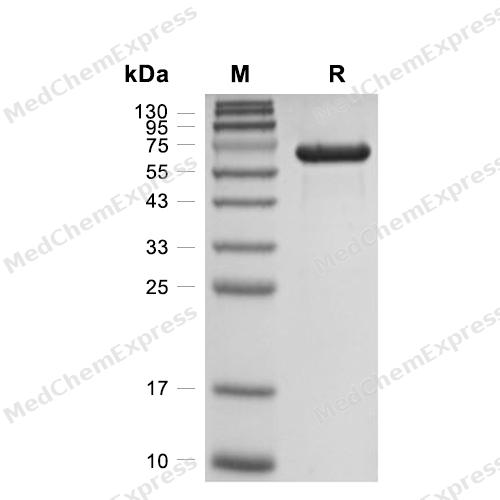
Purity - SDS-PAGE
-
Bioactivity - Cell-Based Assay
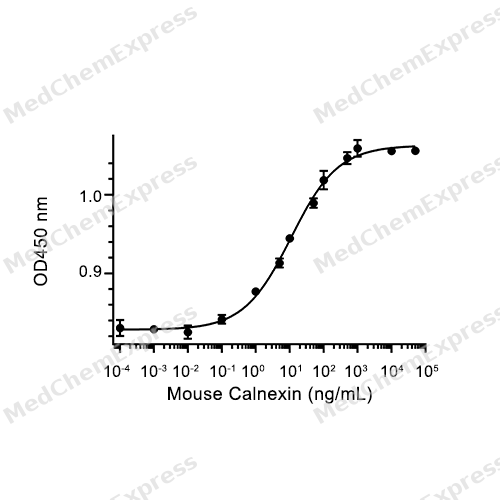
Bioactivity - Cell-Based Assay


Technical Parameters
-
Species Mouse
-
Source HEK293
-
Tag C-10*His
-
Accession
P35564 (H21-P482)
-
Molecular Construction
-
N-term
-
Calnexin (H21-P482)
Accession # P35564 -
His
-
C-term
-
-
Protein Length
Lumenal Domain
-
Synonyms
CANX; Major Histocompatibility Complex Class I Antigen-Binding Protein P88; Calnexin; CNX; IP90; Epididymis Secretory Sperm Binding Protein; P90
-
AA Sequence
HDGHDDDAIDIEDDLDDVIEEVEDSKSKSDASTPPSPKVTYKAPVPTGEVYFADSFDRGSLSGWILSKAKKDDTDDEIAKYDGKWEVDEMKETKLPGDKGLVLMSRAKHHAISAKLNKPFLFDTKPLIVQYEVNFQNGIECGGAYVKLLSKTAELSLDQFHDKTPYTIMFGPDKCGEDYKLHFIFRHKNPKTGVYEEKHAKRPDADLKTYFTDKKTHLYTLILNPDNSFEILVDQSVVNSGNLLNDMTPPVNPSREIEDPEDRKPEDWDERPKIADPDAVKPDDWDEDAPSKIPDEEATKPEGWLDDEPEYIPDPDAEKPEDWDEDMDGEWEAPQIANPKCESAPGCGVWQRPMIDNPNYKGKWKPPMIDNPNYQGIWKPRKIPNPDFFEDLEPFKMTPFSAIGLELWSMTSDIFFDNFIISGDRRVVDDWANDGWGLKKAADGAAEPGVVLQMLEAAEERP
-
Molecular Weight
Approximately 58-70 kDa, based on SDS-PAGE under reducing conditions, due to the glycosylation.
-
Glycosylation
Yes
-
Purity
≥ 95%, as determined by reducing SDS-PAGE.


Product Properties
Lyophilized powder.
Lyophilized from a 0.22 μm filtered solution of PBS, pH 7.4.
<1 EU/μg, determined by LAL method.
It is not recommended to reconstitute to a concentration less than 100 μg/mL in ddH2O. For long term storage it is recommended to add a carrier protein (0.1% BSA, 5% HSA, 10% FBS or 5% Trehalose).
Stored at -20°C for 2 years from date of receipt. After reconstitution, it is stable at 4°C for 1 week or -20°C for longer (with carrier protein). It is recommended to freeze aliquots at -20°C or -80°C for extended storage.
Room temperature in continental US; may vary elsewhere.


Documentation
-
Data Sheet (238 KB)
-
SDS (251 KB)
- English - EN (251 KB)
- Français - FR (251 KB)
- Deutsch - DE (251 KB)
- Norwegian - NO (251 KB)
- Español - ES (251 KB)
- Swedish - SV (251 KB)
- Italian - IT (251 KB)
- Korean - KR (251 KB)
- Portuguese - PT (251 KB)
-
Handling Instructions (2659 KB)

Calculators
Concentration (start) × Volume (start) = Concentration (final) × Volume (final)


 Powered by Bioz

