



CD1C-B2M Heterodimer Protein, Rhesus Macaque (HEK293, His)

Based on 1 Customer Validation
CD1C belongs to Group 1 of the transmembrane glycoprotein CD1 family. CD1C protein, as a key antigen-presenting molecule, has shown the ability to bind both self and non-self lipid and glycolipid antigens, mediating host defense against tuberculosis. CD1C is associated with breast cancer prognosis and immune invasion. CD1C-B2M Heterodimer Protein, Rhesus Macaque (HEK293, His) is a recombinant protein dimer complex containing Rhesus Macaque-derived CD1C-B2M Heterodimer protein, expressed by HEK293 , with C-His labeled tag. CD1C-B2M Heterodimer Protein, Rhesus Macaque (HEK293, His), has molecular weight of ~44.7 (33.1+ 11.6) KDa.
- Species: Rhesus Macaque
- Source: HEK293
-
Storage:Stored at -20°C for 2 years from date of receipt. After reconstitution, it is stable at 4°C for 1 week or -20°C for longer (with carrier protein). It is recommended to freeze aliquots at -20°C or -80°C for extended storage.


To place orders, for customer services and technical support, please contact: MedChemExpress USA
Tel: 609-228-6898 E-mail: [email protected] [email protected]


-
 Biological Activity
-
Technical Parameters
-
Product Properties
- Documentation
- Help & FAQs




Biological Activity
Description
CD1C belongs to Group 1 of the transmembrane glycoprotein CD1 family. CD1C protein, as a key antigen-presenting molecule, has shown the ability to bind both self and non-self lipid and glycolipid antigens, mediating host defense against tuberculosis. CD1C is associated with breast cancer prognosis and immune invasion. CD1C-B2M Heterodimer Protein, Rhesus Macaque (HEK293, His) is a recombinant protein dimer complex containing Rhesus Macaque-derived CD1C-B2M Heterodimer protein, expressed by HEK293 , with C-His labeled tag. CD1C-B2M Heterodimer Protein, Rhesus Macaque (HEK293, His), has molecular weight of ~44.7 (33.1+ 11.6) KDa.
Background
CD1C belongs to Group 1 of the transmembrane glycoprotein CD1 family. The CD1 molecule is expressed on the surface of many different human antigen-presenting cells (DC, monocytes, and some thymus cells). The CD1C protein, as a key antigen-presenting molecule, has shown the ability to bind both self and non-self lipid and glycolipid antigens, thereby facilitating their presentation to T cell receptors on natural killer T cells. Human group 1 CD1 molecules (CD1a, CD1b, and CD1c) bind to pools of lipid antigens expressed by mycobacteria and present them to specific T cells, thereby mediating an effective pathway for host defense against tuberculosis. CD1C is associated with breast cancer prognosis and immune invasion[1][2][3].
Verified Bioactivity
Measured by its binding ability in a functional ELISA. Immobilized Rhesus Macaque CD1C-B2M Heterodimer, at 2μg/mL (100μL/well) can bind Anti-CD1C antibody. The ED50 for this effect is 0.1125 μg/mL.
MCE Validation Data
-
Purity - SDS-PAGE
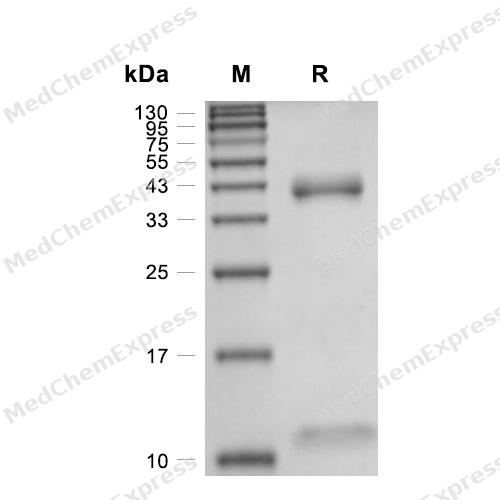
Purity - SDS-PAGE
-
Bioactivity - ELISA
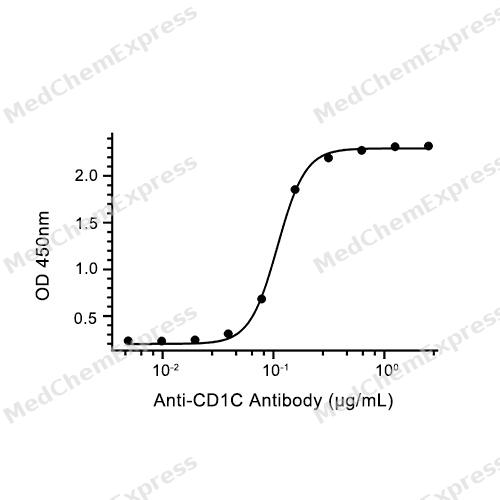
Bioactivity - ELISA


Technical Parameters
-
Species Rhesus Macaque
-
Source HEK293
-
Tag C-6*His
-
Accession
NP_001139005 (Q21-F298)&NP_001040602 (I21-M119)
-
Synonyms
CD1C; CD1c Antigen; Prev. CD1; BDCA1; T-Cell Surface Glycoprotein CD1c; R7; CD1C Antigen, C Polypeptide; CD1c Molecule; Cortical Thymocyte Antigen CD1C; B2M; Beta 2-Microglobulin; Beta-2-Microglobulin; Beta-2-Microglobin; Beta Chain Of MHC Class I Molecul
-
Molecular Weight
Approximately 38 & 12 kDa.
-
Purity
≥ 95%, as determined by reducing SDS-PAGE.


Product Properties
Lyophilized powder.
Lyophilized from a 0.22 μm filtered solution of PBS, pH 7.4.
<1 EU/μg, determined by LAL method.
It is not recommended to reconstitute to a concentration less than 100 μg/mL in ddH2O. For long term storage it is recommended to add a carrier protein (0.1% BSA, 5% HSA, 10% FBS or 5% Trehalose).
Stored at -20°C for 2 years from date of receipt. After reconstitution, it is stable at 4°C for 1 week or -20°C for longer (with carrier protein). It is recommended to freeze aliquots at -20°C or -80°C for extended storage.
Room temperature in continental US; may vary elsewhere.


Documentation
-
Data Sheet (235 KB)
-
SDS (252 KB)
- English - EN (252 KB)
- Français - FR (252 KB)
- Deutsch - DE (252 KB)
- Norwegian - NO (252 KB)
- Español - ES (252 KB)
- Swedish - SV (252 KB)
- Italian - IT (252 KB)
- Korean - KR (252 KB)
- Portuguese - PT (252 KB)
-
Handling Instructions (2659 KB)

Calculators
Concentration (start) × Volume (start) = Concentration (final) × Volume (final)


 Powered by Bioz

