



CD31/PECAM-1 Protein, Mouse (HEK293, His)

Based on 1 Customer Validation
The CD31/PECAM-1 protein is a cell adhesion molecule critical for leukocyte transendothelial migration (TEM) under inflammatory conditions.CD31/PECAM-1 also regulates bradykinin receptor BDKRB2 activation and modulates ERK1/2 activation in endothelial cells.CD31/PECAM-1 Protein, Mouse (HEK293, His) is the recombinant mouse-derived CD31/PECAM-1 protein, expressed by HEK293 , with C-6*His labeled tag.
- Species: Mouse
- Source: HEK293
-
Storage:Stored at -20°C for 2 years from date of receipt. After reconstitution, it is stable at 4°C for 1 week or -20°C for longer (with carrier protein). It is recommended to freeze aliquots at -20°C or -80°C for extended storage.


To place orders, for customer services and technical support, please contact: MedChemExpress USA
Tel: 609-228-6898 E-mail: [email protected] [email protected]


-
 Biological Activity
-
Technical Parameters
-
Product Properties
- Documentation
- Help & FAQs




Biological Activity
Description
The CD31/PECAM-1 protein is a cell adhesion molecule critical for leukocyte transendothelial migration (TEM) under inflammatory conditions.CD31/PECAM-1 also regulates bradykinin receptor BDKRB2 activation and modulates ERK1/2 activation in endothelial cells.CD31/PECAM-1 Protein, Mouse (HEK293, His) is the recombinant mouse-derived CD31/PECAM-1 protein, expressed by HEK293 , with C-6*His labeled tag.
Background
CD31/PECAM-1 protein, a pivotal cell adhesion molecule, is essential for leukocyte transendothelial migration (TEM) in most inflammatory conditions. The critical role of Tyr-679 in TEM is underscored by its requirement for efficient trafficking of PECAM1 to and from the lateral border recycling compartment (LBRC), crucial for targeting the LBRC membrane around migrating leukocytes. The trans-homophilic interaction potentially contributes to endothelial cell-cell adhesion via cell junctions, while heterophilic interaction with CD177 plays a role in the transendothelial migration of neutrophils. Homophilic ligation of PECAM1 serves a dual purpose, preventing macrophage-mediated phagocytosis of neighboring viable leukocytes by transmitting a detachment signal, while promoting the macrophage-mediated phagocytosis of apoptotic leukocytes by tethering them to phagocytic cells. Notably, PECAM1 modulates bradykinin receptor BDKRB2 activation and regulates bradykinin- and hyperosmotic shock-induced ERK1/2 activation in endothelial cells. Its interaction with various partners, including BDKRB2, GNAQ, PTPN11, FER, and CD177, further elucidates the intricate molecular mechanisms governing its diverse cellular functions, while its trans-homodimerization is crucial for effective cell-cell interaction. The interaction nuances, such as Ca(2+)-dependency and directness, add layers of complexity to the regulatory roles of CD31/PECAM-1.
Verified Bioactivity
Measured by its binding ability in a functional ELISA. Recombinant Mouse CD31/PECAM-1 binds to Recombinant Biotinylated Human Integrin alpha 8 beta 1 (HY-P73869) with an ED50 of 0.42 μg/mL.
MCE Validation Data
-
Purity - SDS-PAGE
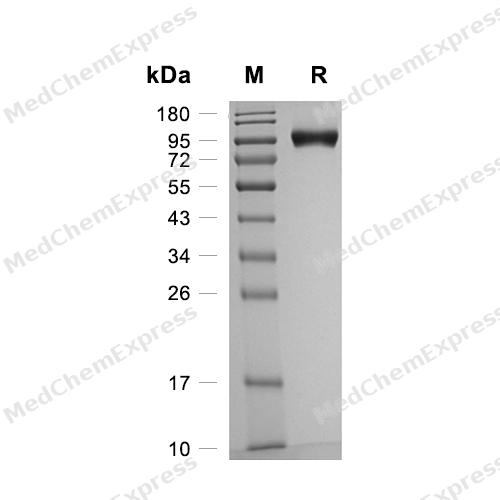
Purity - SDS-PAGE
-
Bioactivity - ELISA
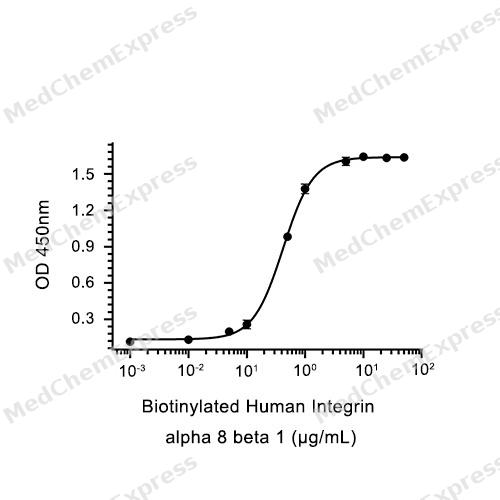
Bioactivity - ELISA


Technical Parameters
-
Species Mouse
-
Source HEK293
-
Tag C-6*His
-
Accession
Q08481 (E18-K590)
-
Molecular Construction
-
N-term
-
CD31 (E18-K590)
Accession # Q08481 -
6*His
-
C-term
-
-
Protein Length
Extracellular Domain
-
Synonyms
PECAM1; PECAM-1; Platelet And Endothelial Cell Adhesion Molecule 1; GPIIA'; Platelet Endothelial Cell Adhesion Molecule; PECA1; CD31 Antigen; Platelet/Endothelial Cell Adhesion Molecule 1; CD31; Platelet Endothelial Cell Adhesion Molecule-1; EndoCAM; CD31
-
AA Sequence
EENSFTINSIHMESLPSWEVMNGQQLTLECLVDISTTSKSRSQHRVLFYKDDAMVYNVTSREHTESYVIPQARVFHSGKYKCTVMLNNKEKTTIEYEVKVHGVSKPKVTLDKKEVTEGGVVTVNCSLQEEKPPIFFKIEKLEVGTKFVKRRIDKTSNENFVLMEFPIEAQDHVLVFRCQAGILSGFKLQESEPIRSEYVTVQESFSTPKFEIKPPGMIIEGDQLHIRCIVQVTHLVQEFTEIIIQKDKAIVATSKQSSEAVYSVMAMVEYSGHYTCKVESNRISKASSIMVNITELFPKPKLEFSSSRLDQGELLDLSCSVSGTPVANFTIQKEETVLSQYQNFSKIAEESDSGEYSCTAGIGKVVKRSGLVPIQVCEMLSKPSIFHDAKSEIIKGHAIGISCQSENGTAPITYHLMKAKSDFQTLEVTSNDPATFTDKPTRDMEYQCRADNCHSHPAVFSEILRVRVIAPVDEVVISILSSNEVQSGSEMVLRCSVKEGTSPITFQFYKEKEDRPFHQAVVNDTQAFWHNKQASKKQEGQYYCTASNRASSMRTSPRSSTLAVRVFLAPWKK
-
Molecular Weight
Approximately 70-110 kDa, based on SDS-PAGE under reducing conditions, due to the glycosylation.
-
Glycosylation
Yes
-
Purity
≥ 95%, as determined by reducing SDS-PAGE.


Product Properties
Lyophilized powder.
Lyophilized from a 0.22 μm filtered solution of PBS, 5 mM EDTA, pH 7.4.
<1 EU/μg, determined by LAL method.
It is not recommended to reconstitute to a concentration less than 100 μg/mL in ddH2O. For long term storage it is recommended to add a carrier protein (0.1% BSA, 5% HSA, 10% FBS or 5% Trehalose).
Stored at -20°C for 2 years from date of receipt. After reconstitution, it is stable at 4°C for 1 week or -20°C for longer (with carrier protein). It is recommended to freeze aliquots at -20°C or -80°C for extended storage.
Room temperature in continental US; may vary elsewhere.


Documentation
-
Data Sheet (239 KB)
-
SDS (251 KB)
- English - EN (251 KB)
- Français - FR (251 KB)
- Deutsch - DE (251 KB)
- Norwegian - NO (251 KB)
- Español - ES (251 KB)
- Swedish - SV (251 KB)
- Italian - IT (251 KB)
- Korean - KR (251 KB)
- Portuguese - PT (251 KB)
-
Handling Instructions (2659 KB)

Calculators
Concentration (start) × Volume (start) = Concentration (final) × Volume (final)


 Powered by Bioz

