



CD81 Protein, Mouse (HEK293, Fc)

Based on 1 Customer Validation
The CD81 protein has important effects on cellular processes and is involved in CD19 receptor trafficking on activated B cells. This facilitates CD19-CR2 and B cell receptor complex assembly, lowering the antigen dose threshold for B cell clonal expansion. CD81 Protein, Mouse (HEK293, Fc) is the recombinant mouse-derived CD81 protein, expressed by HEK293 , with N-mFc labeled tag.
- Species: Mouse
- Source: HEK293
-
Storage:Stored at -80°C for 1 year from date of receipt. It is stable at -20°C for 3 months after opening. It is recommended to freeze aliquots at -80°C for extended storage. Avoid repeated freeze-thaw cycles.


To place orders, for customer services and technical support, please contact: MedChemExpress USA
Tel: 609-228-6898 E-mail: [email protected] [email protected]


-
 Biological Activity
-
Technical Parameters
-
Product Properties
- Documentation
- Help & FAQs




Biological Activity
Description
The CD81 protein has important effects on cellular processes and is involved in CD19 receptor trafficking on activated B cells. This facilitates CD19-CR2 and B cell receptor complex assembly, lowering the antigen dose threshold for B cell clonal expansion. CD81 Protein, Mouse (HEK293, Fc) is the recombinant mouse-derived CD81 protein, expressed by HEK293 , with N-mFc labeled tag.
Background
CD81 is a protein that plays a crucial role in various cellular processes. It is involved in the trafficking and compartmentalization of the CD19 receptor on the surface of activated B cells. This facilitates the assembly of CD19-CR2 and B cell receptor complexes, which lowers the threshold dose of antigen required to trigger B cell clonal expansion and immune response. In T cells, CD81 associates with CD4 or CD8 coreceptors and helps define the maturation state of synapses with B cells. It also facilitates the localization of CD3 in immune synapses, which is necessary for T cell activation and costimulation. CD81 can act as both a positive and negative regulator of cell-cell fusion processes. In myoblasts, it associates with CD9 and PTGFRN to inhibit myotube fusion during muscle regeneration. In macrophages, CD81 prevents fusion into multinucleated giant cells and osteoclasts. It also regulates sperm-egg fusion and may be involved in the acrosome reaction. CD81 is involved in protein trafficking within intracellular compartments and regulates intracellular dNTP levels in T cells. Additionally, it plays a role in integrin-dependent migration of macrophages and is specifically required for the infectivity of Plasmodium yoelii in hepatocytes during malaria infection.
Verified Bioactivity
Immobilized Mouse CD81 at 1 μg/mL (100 μL/well) can bind Anti-CD81 Antibody. The ED50 for this effect is 0.741 μg/mL.
MCE Validation Data
-
Bioactivity - ELISA
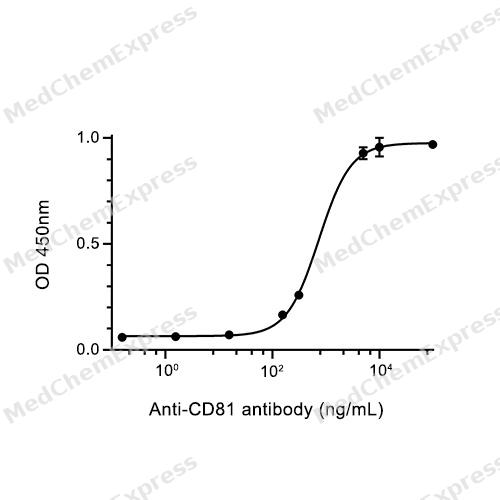
Bioactivity - ELISA


Technical Parameters
-
Species Mouse
-
Source HEK293
-
Tag N-mFc
-
Accession
P35762 (K116-K201)
-
Molecular Construction
-
N-term
-
mFc
-
CD81 (K116-K201)
Accession # P35762 -
C-term
-
-
Protein Length
Extracellular Domain
-
Synonyms
CD81; CD81 Antigen (Target Of Antiproliferative Antibody 1); Prev. TAPA1; Tspan-28; TSPAN28; TAPA-1; Tetraspanin-28; Target Of The Antiproliferative Antibody 1; CD81 Antigen; Tetraspanin; S5.7; CVID6; CD81 Molecule; 26 KDa Cell Surface Protein TAPA-1
-
AA Sequence
KDQIAKDVKQFYDQALQQAVMDDDANNAKAVVKTFHETLNCCGSNALTTLTTTILRNSLCPSGGNILTPLLQQDCHQKIDELFSGK
-
Predicted Molecular Mass
36.1 kDa
-
Purity
≥ 90%, as determined by reducing SDS-PAGE.


Product Properties
Solution
Supplied as a 0.22 μm filtered solution of PBS, pH 7.4.
<1 EU/μg, determined by LAL method.
Stored at -80°C for 1 year from date of receipt. It is stable at -20°C for 3 months after opening. It is recommended to freeze aliquots at -80°C for extended storage. Avoid repeated freeze-thaw cycles.
Shipping with dry ice.


Documentation
-
Data Sheet (235 KB)
-
SDS (252 KB)
- English - EN (252 KB)
- Français - FR (252 KB)
- Deutsch - DE (252 KB)
- Norwegian - NO (252 KB)
- Español - ES (252 KB)
- Swedish - SV (252 KB)
- Italian - IT (252 KB)
- Korean - KR (252 KB)
- Portuguese - PT (252 KB)
-
Handling Instructions (2659 KB)

Calculators
Concentration (start) × Volume (start) = Concentration (final) × Volume (final)


 Powered by Bioz

