



Cerebellin-2 Protein, Human (CHO, HA)

Based on 1 Customer Validation
The protein Cerebellin-2 organizes synapses in specific brain neurons, which is critical for long-term maintenance. It forms homohexamers composed of disulfide-bonded homotrimers connected through the C1q domain. Cerebellin-2 Protein, Human (CHO, HA) is the recombinant human-derived Cerebellin-2 protein, expressed by CHO , with N-HA labeled tag.
- Species: Human
- Source: CHO
-
Storage:Stored at -20°C for 2 years from date of receipt. After reconstitution, it is stable at 4°C for 1 week or -20°C for longer (with carrier protein). It is recommended to freeze aliquots at -20°C or -80°C for extended storage.


To place orders, for customer services and technical support, please contact: MedChemExpress USA
Tel: 609-228-6898 E-mail: [email protected] [email protected]


-
 Biological Activity
-
Technical Parameters
-
Product Properties
- Documentation
- Help & FAQs




Biological Activity
Description
The protein Cerebellin-2 organizes synapses in specific brain neurons, which is critical for long-term maintenance. It forms homohexamers composed of disulfide-bonded homotrimers connected through the C1q domain. Cerebellin-2 Protein, Human (CHO, HA) is the recombinant human-derived Cerebellin-2 protein, expressed by CHO , with N-HA labeled tag.
Background
Cerebellin-2 Protein serves as a synaptic organizer in specific neuronal subsets in the brain, playing an essential role in the long-term maintenance, though not the establishment, of excitatory synapses. It forms homohexamers linked by disulfide-bound homotrimers, assembled through the globular C1q domains, with the trimers associating via N-terminal cysteine residues to create disulfide-linked hexamers. Cerebellin-2 may also form homooligomers or heterooligomers with CBLN1 and CBLN3 before secretion. Once secreted, it no longer interacts with other CBLN family members. Cerebellin-2 engages in interactions with GRID2, and to a lesser extent with GRID1. Additionally, it interacts with NRXN1 and NRXN2 long and short isoforms generated through alternative promoter usage. The protein exhibits weak interaction with NRXN3 short isoform and no interaction with NRXN3 long isoform.
Verified Bioactivity
Measured in a cell proliferation assay using SH-SY5Y cells. The ED50 for this effect is 1.222 μg/mL, corresponding to a specific activity is 818.331 units/mg.
MCE Validation Data
-
Purity - SDS-PAGE
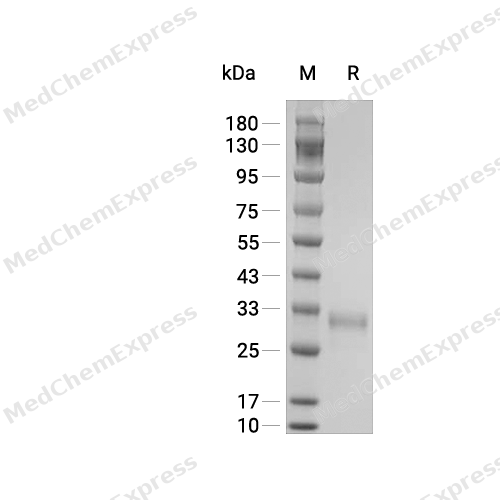
Purity - SDS-PAGE
-
Bioactivity - Cell-Based Assay
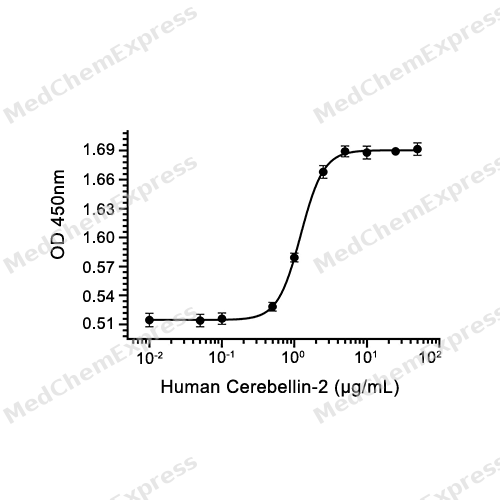
Bioactivity - Cell-Based Assay


Technical Parameters
-
Species Human
-
Source CHO
-
Tag N-HA
-
Accession
Q8IUK8 (R50-L224)
-
Molecular Construction
-
N-term
-
HA
-
Cerebellin-2 (R50-L224)
Accession # Q8IUK8 -
C-term
-
-
Protein Length
Full Length of Mature Protein
-
Synonyms
CBLN2; Cerebellin-2; Cerebellin 2 Precursor
-
AA Sequence
RAQNDTEPIVLEGKCLVVCDSSPSADGAVTSSLGISVRSGSAKVAFSATRSTNHEPSEMSNRTMTIYFDQVLVNIGNHFDLASSIFVAPRKGIYSFSFHVVKVYNRQTIQVSLMQNGYPVISAFAGDQDVTREAASNGVLLLMEREDKVHLKLERGNLMGGWKYSTFSGFLVFPL
-
Predicted Molecular Mass
20.2 kDa
-
Molecular Weight
Approximately 30 kDa, based on SDS-PAGE under reducing conditions, due to the glycosylation.
-
Glycosylation
Yes
-
Purity
≥ 95%, as determined by reducing SDS-PAGE.


Product Properties
Lyophilized powder.
Lyophilized from a 0.22 μm filtered solution of PBS, pH 7.4.
<1 EU/μg, determined by LAL method.
It is not recommended to reconstitute to a concentration less than 200 μg/mL in ddH2O. For long term storage it is recommended to add a carrier protein (0.1% BSA, 5% HSA, 10% FBS or 5% Trehalose).
Stored at -20°C for 2 years from date of receipt. After reconstitution, it is stable at 4°C for 1 week or -20°C for longer (with carrier protein). It is recommended to freeze aliquots at -20°C or -80°C for extended storage.
Room temperature in continental US; may vary elsewhere.


Documentation
-
Data Sheet (236 KB)
-
SDS (251 KB)
- English - EN (251 KB)
- Français - FR (251 KB)
- Deutsch - DE (251 KB)
- Norwegian - NO (251 KB)
- Español - ES (251 KB)
- Swedish - SV (251 KB)
- Italian - IT (251 KB)
- Korean - KR (251 KB)
- Portuguese - PT (251 KB)
-
Handling Instructions (2659 KB)

Calculators
Concentration (start) × Volume (start) = Concentration (final) × Volume (final)


 Powered by Bioz

