



CRBN Protein, Human (HEK293, Flag)

Based on 1 Customer Validation
CRBN Protein, Human (HEK293, Flag) is the recombinant human-derived Cereblon, expressed by HEK293 , with N-3*Flag labeled tag.
- Species: Human
- Source: HEK293
-
Storage:Stored at -80°C for 1 year from date of receipt. It is stable at -20°C for 3 months after opening. It is recommended to freeze aliquots at -80°C for extended storage. Avoid repeated freeze-thaw cycles.


To place orders, for customer services and technical support, please contact: MedChemExpress USA
Tel: 609-228-6898 E-mail: [email protected] [email protected]


-
 Biological Activity
-
Technical Parameters
-
Product Properties
- Documentation
- Help & FAQs




Biological Activity
Description
CRBN Protein, Human (HEK293, Flag) is the recombinant human-derived Cereblon, expressed by HEK293 , with N-3*Flag labeled tag.
Background
CRBN serves as the substrate recognition component of a DCX (DDB1-CUL4-X-box) E3 ubiquitin-protein ligase complex, mediating ubiquitination and subsequent proteasomal degradation of target proteins like MEIS2, ILF2, or GLUL. Its proper degradation of key regulatory proteins is essential for normal limb outgrowth and fibroblast growth factor FGF8 expression. CRBN maintains presynaptic glutamate release and cognitive functions (e.g., memory and learning) by negatively regulating large-conductance calcium-activated potassium (BK) channels in excitatory neurons. It likely functions by modulating BK channel assembly and neuronal surface expression via interaction with KCNT1. By similarity, CRBN may also regulate anxiety-like behaviors through a BK channel-independent mechanism. In TLR4 signaling, CRBN acts as a negative regulator by binding TRAF6 and ECSIT, thereby inhibiting ECSIT ubiquitination—a critical step in the pathway.
Verified Bioactivity
Human CRBN Immobilized on CM5 Chip can bind Lenalidomide (HY-A0003) with an affinity constant of 10.3 μM as determined in SPR assay.
MCE Validation Data
-
Purity - SDS-PAGE
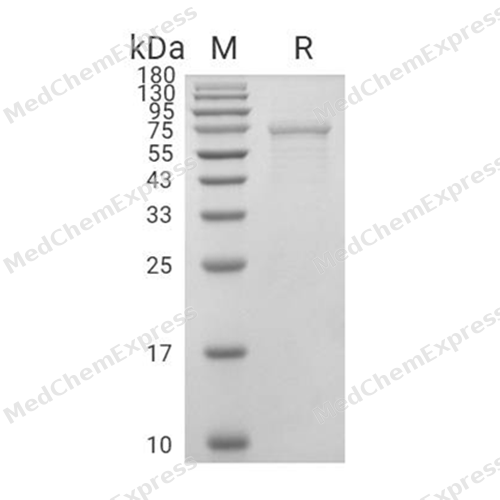
Purity - SDS-PAGE
-
Bioactivity - SPR
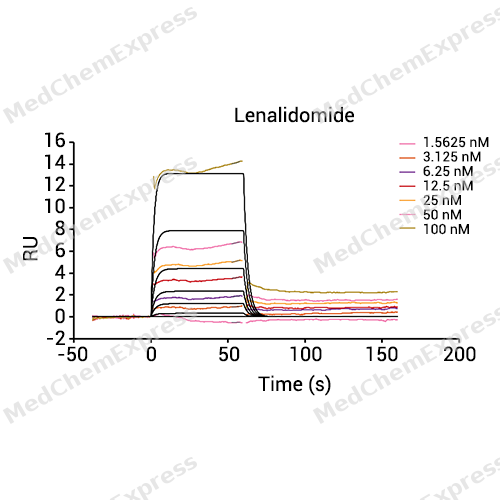
Bioactivity - SPR


Technical Parameters
-
Species Human
-
Source HEK293
-
Tag N-3*Flag
-
Accession
Q96SW2-1 (A2-L442)
-
Gene ID51185
-
Protein Length
Full Length of Isoform 1
-
Synonyms
CRBN; MRT2; Prev. MRT2A; Protein X 0001; Protein Cereblon; Cereblon; Mental Retardation, Non-Syndromic, Autosomal Recessive, 2A
-
AA Sequence
AGEGDQQDAAHNMGNHLPLLPAESEEEDEMEVEDQDSKEAKKPNIINFDTSLPTSHTYLGADMEEFHGRTLHDDDSCQVIPVLPQVMMILIPGQTLPLQLFHPQEVSMVRNLIQKDRTFAVLAYSNVQEREAQFGTTAEIYAYREEQDFGIEIVKVKAIGRQRFKVLELRTQSDGIQQAKVQILPECVLPSTMSAVQLESLNKCQIFPSKPVSREDQCSYKWWQKYQKRKFHCANLTSWPRWLYSLYDAETLMDRIKKQLREWDENLKDDSLPSNPIDFSYRVAACLPIDDVLRIQLLKIGSAIQRLRCELDIMNKCTSLCCKQCQETEITTKNEIFSLSLCGPMAAYVNPHGYVHETLTVYKACNLNLIGRPSTEHSWFPGYAWTVAQCKICASHIGWKFTATKKDMSPQKFWGLTRSALLPTIPDTEDEISPDKVILCL
-
Predicted Molecular Mass
53.4 kDa
-
Molecular Weight
Approximately 60-70 kDa, based on SDS-PAGE under reducing conditions, due to the glycosylation.
-
Glycosylation
Yes
-
Purity
≥ 85%, as determined by reducing SDS-PAGE.


Product Properties
Solution
Supplied as a 0.22 μm filtered solution in 40 mM Tris-HCl, 110 mM NaCl, 2.2 mM KCl, 0.04% Tween-20, pH 8.0, 20% Glycerol.
Note: For SPR assay, please replace the buffer. Primary amine components (e.g., Tris, imidazole) can affect protein-coupled chips.
<1 EU/μg, determined by LAL method.
Stored at -80°C for 1 year from date of receipt. It is stable at -20°C for 3 months after opening. It is recommended to freeze aliquots at -80°C for extended storage. Avoid repeated freeze-thaw cycles.
Shipping with dry ice.


Documentation
-
Data Sheet (238 KB)
-
SDS (252 KB)
- English - EN (252 KB)
- Français - FR (252 KB)
- Deutsch - DE (252 KB)
- Norwegian - NO (252 KB)
- Español - ES (252 KB)
- Swedish - SV (252 KB)
- Italian - IT (252 KB)
- Korean - KR (252 KB)
- Portuguese - PT (252 KB)
-
Handling Instructions (2659 KB)

Calculators
Concentration (start) × Volume (start) = Concentration (final) × Volume (final)


 Powered by Bioz

