



Complement Factor B/CFB Protein, Mouse (His)
Based on 1 publication(s) in Google Scholar
CFB is an important component of the alternative pathway of the complement system and is cleaved by factor D, producing two fragments: Ba and Bb. The Bb fragment is characterized as a serine protease and subsequently forms a complex with complement factor 3b, ultimately producing a C3 or C5 convertase. Complement Factor B/CFB Protein, Mouse (His) is the recombinant mouse-derived CFB protein, expressed by E. coli , with N-6*His labeled tag.
- Species: Mouse
- Source: E. coli
-
Storage:Stored at -20°C for 2 years from date of receipt. After reconstitution, it is stable at 4°C for 1 week or -20°C for longer (with carrier protein). It is recommended to freeze aliquots at -20°C or -80°C for extended storage.


To place orders, for customer services and technical support, please contact: MedChemExpress USA
Tel: 609-228-6898 E-mail: [email protected] [email protected]


-
 Biological Activity
-
Technical Parameters
-
Product Properties
- Documentation
- Help & FAQs




Biological Activity
Description
CFB is an important component of the alternative pathway of the complement system and is cleaved by factor D, producing two fragments: Ba and Bb. The Bb fragment is characterized as a serine protease and subsequently forms a complex with complement factor 3b, ultimately producing a C3 or C5 convertase. Complement Factor B/CFB Protein, Mouse (His) is the recombinant mouse-derived CFB protein, expressed by E. coli , with N-6*His labeled tag.
Background
CFB, or complement factor B, is an integral component of the alternate pathway within the complement system. The protein undergoes cleavage by factor D, resulting in the formation of two distinct fragments: Ba and Bb. Of particular significance, Bb functions as a serine protease and subsequently associates with complement factor 3b. This complex formation gives rise to the C3 or C5 convertase, a pivotal enzyme involved in the activation of the complement cascade. The described molecular events underscore the central role of CFB in the intricate regulatory mechanisms of the complement system, shedding light on its contribution to immune responses.
MCE Validation Data
-
Purity - SDS-PAGE
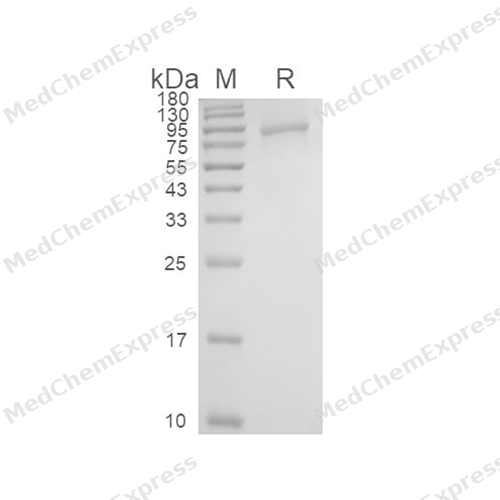
Purity - SDS-PAGE


Publications (1)
-
Journal Impact Factor
-
Most Recent
-
Am J Physiol Cell Physiol
Activation of the alternative complement pathway modulates inflammation in thoracic aortic aneurysm/dissection. [Abstract]2024 Feb 1;326(2):C647-C658. PMID: 38189133


Technical Parameters
-
Species Mouse
-
Source E. coli
-
Tag N-6*His
-
Accession
P04186 (T23-L761)
-
Molecular Construction
-
N-term
-
6*His
-
CFB (T23-L761)
Accession # P04186 -
C-term
-
-
Protein Length
Full Length of Mature Protein
-
Synonyms
CFB; Complement Factor B Preproprotein; Prev. BFD; Glycine-Rich Beta Glycoprotein; Prev. BF; C3 Proaccelerator; Properdin Factor B; C3 Proactivator; C3/C5 Convertase; ARMD14; H2-Bf; AHUS4; B-Factor, Properdin; FBI12; Properdin B; CFAB; PBF2; CFBD; GBG; FB
-
AA Sequence
TPVLEARPQVSCSLEGVEIKGGSFQLLQGGQALEYLCPSGFYPYPVQTRTCRSTGSWSDLQTRDQKIVQKAECRAIRCPRPQDFENGEFWPRSPFYNLSDQISFQCYDGYVLRGSANRTCQENGRWDGQTAICDDGAGYCPNPGIPIGTRKVGSQYRLEDIVTYHCSRGLVLRGSQKRKCQEGGSWSGTEPSCQDSFMYDSPQEVAEAFLSSLTETIEGADAEDGHSPGEQQKRKIVLDPSGSMNIYLVLDGSDSIGSSNFTGAKRCLTNLIEKVASYGVRPRYGLLTYATVPKVLVRVSDERSSDADWVTEKLNQISYEDHKLKSGTNTKRALQAVYSMMSWAGDAPPEGWNRTRHVIIIMTDGLHNMGGNPVTVIQDIRALLDIGRDPKNPREDYLDVYVFGVGPLVDSVNINALASKKDNEHHVFKVKDMEDLENVFYQMIDETKSLSLCGMVWEHKKGNDYHKQPWQAKISVTRPLKGHETCMGAVVSEYFVLTAAHCFMVDDQKHSIKVSVGGQRRDLEIEEVLFHPKYNINGKKAEGIPEFYDYDVALVKLKNKLKYGQTLRPICLPCTEGTTRALRLPQTATCKQHKEQLLPVKDVKALFVSEQGKSLTRKEVYIKNGDKKASCERDATKAQGYEKVKDASEVVTPRFLCTGGVDPYADPNTCKGDSGGPLIVHKRSRFIQVGVISWGVVDVCRDQRRQQLVPSYARDFHINLFQVLPWLKDKLKDEDLGFL
-
Molecular Weight
Approximately 85-87 kDa, based on SDS-PAGE under reducing conditions.
-
Purity
≥ 90%, as determined by reducing SDS-PAGE.


Product Properties
Lyophilized powder
Lyophilized from a 0.22 μm filtered solution of 10 mM Tris-HCl, 1 mM EDTA, 6% trehalose, pH 8.0.
Note: For SPR assay, please replace the buffer. Primary amine components (e.g., Tris, imidazole) can affect protein-coupled chips.
<1 EU/μg, determined by LAL method.
It is not recommended to reconstitute to a concentration less than 100 μg/mL in ddH2O.
Stored at -20°C for 2 years from date of receipt. After reconstitution, it is stable at 4°C for 1 week or -20°C for longer (with carrier protein). It is recommended to freeze aliquots at -20°C or -80°C for extended storage.
Room temperature in continental US; may vary elsewhere.


Documentation
-
Data Sheet (239 KB)
-
SDS (252 KB)
- English - EN (252 KB)
- Français - FR (252 KB)
- Deutsch - DE (252 KB)
- Norwegian - NO (252 KB)
- Español - ES (252 KB)
- Swedish - SV (252 KB)
- Italian - IT (252 KB)
- Korean - KR (252 KB)
- Portuguese - PT (252 KB)
-
Handling Instructions (2659 KB)

Calculators
Concentration (start) × Volume (start) = Concentration (final) × Volume (final)


 Powered by Bioz

