



Coagulation Factor II/F2 Protein, Mouse (HEK293, His)

Based on 1 Customer Validation
Coagulation Factor II/F2, also known as thrombin, functions as a pivotal serine protease. Its enzymatic action involves cleaving bonds after Arg and Lys residues, facilitating the conversion of fibrinogen to fibrin. Thrombin additionally activates key factors like V, VII, VIII, XIII, and, in conjunction with thrombomodulin, protein C. Beyond blood homeostasis, thrombin plays a role in inflammation and the complex dynamics of wound healing. Coagulation Factor II/F2 Protein, Mouse (HEK293, His) is the recombinant mouse-derived Coagulation Factor II/F2 protein, expressed by HEK293 , with C-His labeled tag.
- Species: Mouse
- Source: HEK293
-
Storage:Stored at -20°C for 2 years from date of receipt. After reconstitution, it is stable at 4°C for 1 week or -20°C for longer (with carrier protein). It is recommended to freeze aliquots at -20°C or -80°C for extended storage.


To place orders, for customer services and technical support, please contact: MedChemExpress USA
Tel: 609-228-6898 E-mail: [email protected] [email protected]


-
 Biological Activity
-
Technical Parameters
-
Product Properties
- Documentation
- Help & FAQs




Biological Activity
Description
Coagulation Factor II/F2, also known as thrombin, functions as a pivotal serine protease. Its enzymatic action involves cleaving bonds after Arg and Lys residues, facilitating the conversion of fibrinogen to fibrin. Thrombin additionally activates key factors like V, VII, VIII, XIII, and, in conjunction with thrombomodulin, protein C. Beyond blood homeostasis, thrombin plays a role in inflammation and the complex dynamics of wound healing. Coagulation Factor II/F2 Protein, Mouse (HEK293, His) is the recombinant mouse-derived Coagulation Factor II/F2 protein, expressed by HEK293 , with C-His labeled tag.
Background
The Coagulation Factor II/F2 protein, commonly known as thrombin, plays a pivotal role in various physiological processes. Operating as a serine protease, thrombin cleaves bonds following Arg and Lys residues, leading to the conversion of fibrinogen into fibrin. Moreover, thrombin activates several crucial factors, including V, VII, VIII, XIII, and, when in conjunction with thrombomodulin, protein C. Beyond its fundamental role in blood homeostasis, thrombin also contributes to inflammation and the intricate process of wound healing.
Verified Bioactivity
Measured by its ability to cleave a peptide substrate, BOC-Val-Pro-Arg-AMC. Read at excitation and emission wavelengths of 380 nm and 460 nm (top read). The specific activity is 25888.119 pmoL/min/µg, as measured under the described conditions. (Activation description: The proenzyme needs to be activated by Thermolysin for an activated form.)
MCE Validation Data
-
Purity - SDS-PAGE
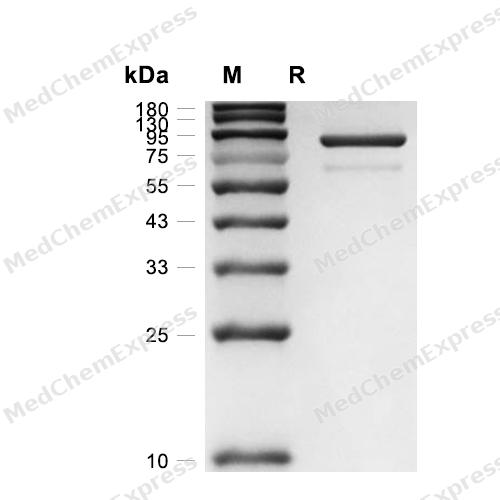
Purity - SDS-PAGE


Technical Parameters
-
Species Mouse
-
Source HEK293
-
Tag C-His
-
Accession
Q3TJ94 (Q25-G618)
-
Molecular Construction
-
N-term
-
F2 (Q25-G618)
Accession # Q3TJ94 -
His
-
C-term
-
-
Protein Length
Full Length of Mature Protein
-
Synonyms
F2; Coagulation Factor II (Thrombin); Coagulation Factor II, Thrombin; Prothrombin B-Chain; Prothrombin; F2 Protein; Prepro-Coagulation Factor II; RPRGL2; Coagulation Factor II; THPH1; Thrombin Factor II; PT
-
AA Sequence
QHVFLAPQQALSLLQRVRRANSGFLEELRKGNLERECVEEQCSYEEAFEALESPQDTDVFWAKYTVCDSVRKPRETFMDCLEGRCAMDLGVNYLGTVNVTHTGIQCQLWRSRYPHKPEINSTTHPGADLKENFCRNPDSSTTGPWCYTTDPTVRREECSVPVCGQEGRTTVVMTPRSGGSKDNLSPPLGQCLTERGRLYQGNLAVTTLGSPCLPWNSLPAKTLSKYQDFDPEVKLVENFCRNPDWDEEGAWCYVAGQPGDFEYCNLNYCEEAVGEENYDVDESIAGRTTDAEFHTFFNEKTFGLGEADCGLRPLFEKKSLKDTTEKELLDSYIDGRIVEGWDAEKGIAPWQVMLFRKSPQELLCGASLISDRWVLTAAHCILYPPWDKNFTENDLLVRIGKHSRTRYERNVEKISMLEKIYVHPRYNWRENLDRDIALLKLKKPVPFSDYIHPVCLPDKQTVTSLLRAGYKGRVTGWGNLRETWTTNINEIQPSVLQVVNLPIVERPVCKASTRIRITDNMFCAGFKVNDTKRGDACEGDSGGPFVMKSPFNNRWYQMGIVSWGEGCDRKGKYGFYTHVFRLKRWIQKVIDQFG
-
Molecular Weight
Approximately 85 kDa, based on SDS-PAGE under reducing conditions.
-
Glycosylation
Yes
-
Purity
≥ 95%, as determined by reducing SDS-PAGE.


Product Properties
Lyophilized powder.
Lyophilized from a 0.22 μm filtered solution of PBS, pH 7.4.
<1 EU/μg, determined by LAL method.
It is not recommended to reconstitute to a concentration less than 100 μg/mL in ddH2O. For long term storage it is recommended to add a carrier protein (0.1% BSA, 5% HSA, 10% FBS or 5% Trehalose).
Stored at -20°C for 2 years from date of receipt. After reconstitution, it is stable at 4°C for 1 week or -20°C for longer (with carrier protein). It is recommended to freeze aliquots at -20°C or -80°C for extended storage.
Room temperature in continental US; may vary elsewhere.


Documentation
-
Data Sheet (239 KB)
-
SDS (251 KB)
- English - EN (251 KB)
- Français - FR (251 KB)
- Deutsch - DE (251 KB)
- Norwegian - NO (251 KB)
- Español - ES (251 KB)
- Swedish - SV (251 KB)
- Italian - IT (251 KB)
- Korean - KR (251 KB)
- Portuguese - PT (251 KB)
-
Handling Instructions (2659 KB)

Calculators
Concentration (start) × Volume (start) = Concentration (final) × Volume (final)


 Powered by Bioz

