



COASY Protein, Human (His)

Based on 1 Customer Validation
COASY protein is a bifunctional enzyme that plays a key role in catalyzing the fourth and fifth steps of the CoA biosynthetic pathway. The coaD domain promotes the phosphopantothenate adenylyltransferase activity of the fourth reaction, and the coaE domain drives the dephosphoCoA kinase activity of the fifth reaction. COASY Protein, Human (His) is the recombinant human-derived COASY protein, expressed by E. coli , with N-His labeled tag.
- Species: Human
- Source: E. coli
-
Storage:Stored at -20°C for 2 years from date of receipt. After reconstitution, it is stable at 4°C for 1 week or -20°C for longer (with carrier protein). It is recommended to freeze aliquots at -20°C or -80°C for extended storage.


To place orders, for customer services and technical support, please contact: MedChemExpress USA
Tel: 609-228-6898 E-mail: [email protected] [email protected]


-
 Biological Activity
-
Technical Parameters
-
Product Properties
- Documentation
- Help & FAQs




Biological Activity
Description
COASY protein is a bifunctional enzyme that plays a key role in catalyzing the fourth and fifth steps of the CoA biosynthetic pathway. The coaD domain promotes the phosphopantothenate adenylyltransferase activity of the fourth reaction, and the coaE domain drives the dephosphoCoA kinase activity of the fifth reaction. COASY Protein, Human (His) is the recombinant human-derived COASY protein, expressed by E. coli , with N-His labeled tag.
Background
The COASY protein functions as a bifunctional enzyme, playing a pivotal role in catalyzing the fourth and fifth sequential steps of the CoA biosynthetic pathway. The phosphopantetheine adenylyltransferase activity, coded by the coaD domain, facilitates the fourth reaction, while the dephospho-CoA kinase activity, coded by the coaE domain, drives the fifth reaction in the pathway. This enzyme is integral to CoA biosynthesis regulation and may serve as a crucial point for controlling the overall process, ensuring the proper and efficient synthesis of CoA, a vital cofactor involved in various cellular metabolic pathways.
Verified Bioactivity
Measured in a cell proliferation assay using MDA-MB-231 cells. The ED50 for this effect is typically 15.42 ng/mL, corresponding to a specific activity is 64850.843 units/mg.
MCE Validation Data
-
Purity - SDS-PAGE
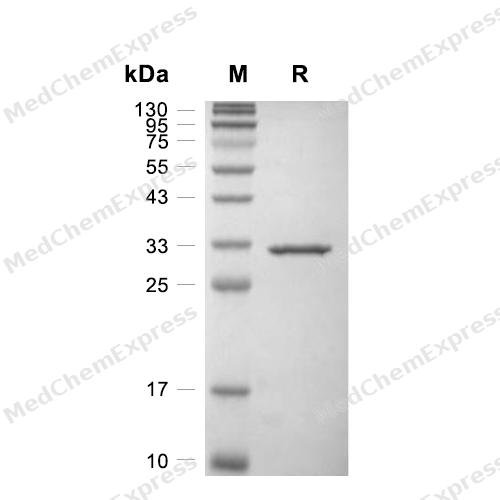
Purity - SDS-PAGE
-
Bioactivity - Cell-Based Assay
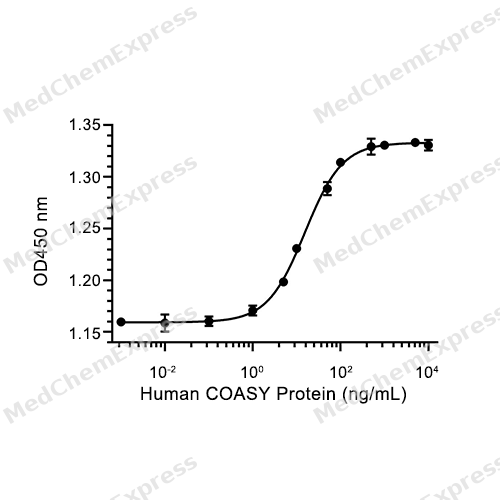
Bioactivity - Cell-Based Assay

Assay Procedure
Materials
Cell Line for assay: ATDC5 cells
Culture medium: DMEM high glucose medium+10% HS+1% P/S (DMEM complete medium)
COASY Protein, Human (His) (HY-P76843)
Penicillin-Streptomycin (100×), Sterile (HY-K1006)
Cell Counting Kit-8 (CCK8 solution, HY-K0301)
Procedure
1. Cells were seeded at a density of 3000 cells per well in a 96-well plate, with a volume of 100 μL per well. (The outer perimeter of the 96-well plate was not seeded with cells; an equal volume of PBS solution was added instead.)
2. Add 100 μL of complete DMEM medium containing different concentrations of Human COASY protein to the 96-well plate, resulting in final Human COASY protein concentrations of 0, 0.001, 0.01, 0.1, 1, 5, 10, 50, 100, 500, 1000, 5000, 10000 ng/mL.
3. Incubate cells at 37°C in a 5% CO2 incubator for 72 hours.
4. Upon reaching the incubation time, add 10 μL of CCK-8 solution to each well under dark conditions. Incubate at 37°C in a 5% CO2 incubator for 2 hours.
5. Measure the optical density (OD) at 450 nm using a microplate reader.
6. Using GraphPad Prism software, plot a curve with OD values on the y-axis and protein concentration on the x-axis to calculate the ED50 value.


Technical Parameters
-
Species Human
-
Source E. coli
-
Tag N-6*His
-
Accession
Q13057-1 (M296-D564)
-
Molecular Construction
-
N-term
-
His
-
COASY (M296-D564)
Accession # Q13057-1 -
C-term
-
-
Protein Length
Partial
-
Synonyms
COASY; POV-2; Coenzyme A Synthase; Bifunctional Phosphopantetheine Adenylyl Transferase/Dephospho CoA Kinase; NBP; Phosphopantetheine Adenylyltransferase / Dephosphocoenzyme A Kinase; Bifunctional Coenzyme A Synthase; Nucleotide Binding Protein; CoA Synth
-
AA Sequence
MAINRFRLENDLEELALYQIQLLKDLRHTENEEDKVSSSSFRQRMLGNLLRPPYERPELPTCLYVIGLTGISGSGKSSIAQRLKGLGAFVIDSDHLGHRAYAPGGPAYQPVVEAFGTDILHKDGIINRKVLGSRVFGNKKQLKILTDIMWPIIAKLAREEMDRAVAEGKRVCVIDAAVLLEAGWQNLVHEVWTAVIPETEAVRRIVERDGLSEAAAQSRLQSQMSGQQLVEQSHVVLSTLWEPHITQRQVEKAWALLQKRIPKTHQALD
-
Molecular Weight
Approximately 33 kDa, based on SDS-PAGE under reducing conditions.
-
Purity
≥ 95%, as determined by reducing SDS-PAGE.


Product Properties
Lyophilized powder.
Lyophilized from a 0.22 μm filtered solution of 20 mM PB, 300 mM NaCl, pH 6.6, 8% trehalose, 8% mannitol and 0.02% Tween 80.
<1 EU/μg, determined by LAL method.
It is not recommended to reconstitute to a concentration less than 100 μg/mL in ddH2O.
Stored at -20°C for 2 years from date of receipt. After reconstitution, it is stable at 4°C for 1 week or -20°C for longer (with carrier protein). It is recommended to freeze aliquots at -20°C or -80°C for extended storage.
Room temperature in continental US; may vary elsewhere.


Documentation
-
Data Sheet (236 KB)
-
SDS (251 KB)
- English - EN (251 KB)
- Français - FR (251 KB)
- Deutsch - DE (251 KB)
- Norwegian - NO (251 KB)
- Español - ES (251 KB)
- Swedish - SV (251 KB)
- Italian - IT (251 KB)
- Korean - KR (251 KB)
- Portuguese - PT (251 KB)
-
Handling Instructions (2659 KB)

Calculators
Concentration (start) × Volume (start) = Concentration (final) × Volume (final)


 Powered by Bioz

