



CSF1R Protein, Human (HEK293)
Based on 1 publication(s) in Google Scholar
CSF1R protein is ubiquitously found in mononuclear phagocytes, especially macrophages and monocytes, and is involved in a variety of biological processes. It induces the release of proinflammatory chemokines in response to IL34 and CSF1, contributing to innate immunity and inflammation. CSF1R Protein, Human (HEK293) is the recombinant human-derived CSF1R protein, expressed by HEK293 , with tag free.
- Species: Human
- Source: HEK293
-
Storage:Stored at -20°C for 2 years from date of receipt. After reconstitution, it is stable at 4°C for 1 week or -20°C for longer (with carrier protein). It is recommended to freeze aliquots at -20°C or -80°C for extended storage.


To place orders, for customer services and technical support, please contact: MedChemExpress USA
Tel: 609-228-6898 E-mail: [email protected] [email protected]


-
 Biological Activity
-
Technical Parameters
-
Product Properties
- Documentation
- Help & FAQs




Biological Activity
Description
CSF1R protein is ubiquitously found in mononuclear phagocytes, especially macrophages and monocytes, and is involved in a variety of biological processes. It induces the release of proinflammatory chemokines in response to IL34 and CSF1, contributing to innate immunity and inflammation. CSF1R Protein, Human (HEK293) is the recombinant human-derived CSF1R protein, expressed by HEK293 , with tag free.
Background
The CSF1R protein, particularly found in mononuclear phagocytes like macrophages and monocytes, is involved in various biological processes. It promotes the release of pro-inflammatory chemokines in response to IL34 and CSF1, contributing to innate immunity and inflammatory processes. Additionally, CSF1R is crucial for regulating osteoclast proliferation and differentiation, bone resorption, normal bone and tooth development. It is also required for normal fertility in both males and females, as well as for the development of milk ducts and acinar structures in the mammary gland during pregnancy.
Verified Bioactivity
1.This product does not contain protein kinase domain.
2.Measured by its ability to inhibit the M-CSF-induced proliferation of M-NFS-60 mouse myelogenous leukemia lymphoblast cells. The ED50 for this effect is 0.01 μg/mL in the presence of 1 ng/mL of human M-CSF, corresponding to a specific activity is 1×10⁵ units/mg.
3.Immobilized Human M-CSF R, No Tag at 0.5 μg/mL (100 μl/well) on the plate. Dose response curve for Anti-M-CSF R Antibody, hFc Tag with the EC50 of 7.1 ng/mL determined by ELISA.
MCE Validation Data
-
Purity - SDS-PAGE
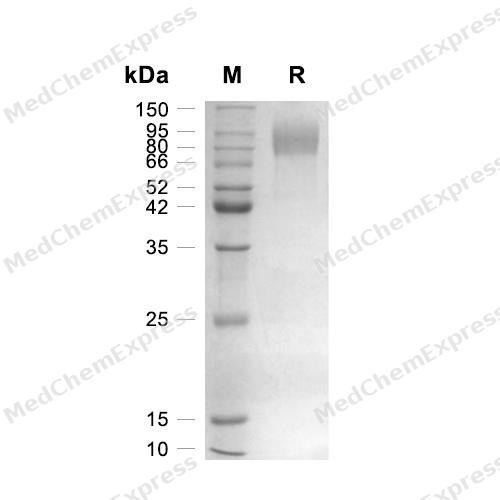
Purity - SDS-PAGE
-
Bioactivity - Cell-Based Assay
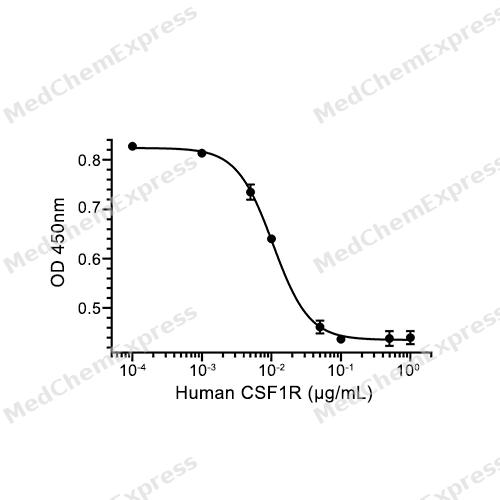
Bioactivity - Cell-Based Assay


Publications (1)
-
Journal Impact Factor
-
Most Recent
-
Int Immunopharmacol
ACTL6A accelerates the progression of NSCLC through hippo/YAP signaling axis and TAMs-mediated immune regulation. [Abstract]2026 Jan 1;168(Pt 1):115828. PMID: 41223612


Technical Parameters
-
Species Human
-
Source HEK293
-
Tag Tag Free
-
Accession
P07333-1/NP_005202.2 (I20-E512)
-
Molecular Construction
-
N-term
-
CSF1R (I20-E512)
Accession # P07333-1/NP_005202.2 -
C-term
-
-
Protein Length
Partial Extracellular Domain
-
Synonyms
CSF1R; CSF-1R; Prev. FMS; Macrophage Colony Stimulating Factor I Receptor; C-FMS; Colony Stimulating Factor Receptor; CD115; Receptor Protein-Tyrosine Kinase; CSFR; FMS Proto-Oncogene; McDonough Feline Sarcoma Viral (V-Fms) Oncogene Homolog; BANDDOS; Macr
-
AA Sequence
IPVIEPSVPELVVKPGATVTLRCVGNGSVEWDGPPSPHWTLYSDGSSSILSTNNATFQNTGTYRCTEPGDPLGGSAAIHLYVKDPARPWNVLAQEVVVFEDQDALLPCLLTDPVLEAGVSLVRVRGRPLMRHTNYSFSPWHGFTIHRAKFIQSQDYQCSALMGGRKVMSISIRLKVQKVIPGPPALTLVPAELVRIRGEAAQIVCSASSVDVNFDVFLQHNNTKLAIPQQSDFHNNRYQKVLTLNLDQVDFQHAGNYSCVASNVQGKHSTSMFFRVVESAYLNLSSEQNLIQEVTVGEGLNLKVMVEAYPGLQGFNWTYLGPFSDHQPEPKLANATTKDTYRHTFTLSLPRLKPSEAGRYSFLARNPGGWRALTFELTLRYPPEVSVIWTFINGSGTLLCAASGYPQPNVTWLQCSGHTDRCDEAQVLQVWDDPYPEVLSQEPFHKVTVQSLLTVETLEHNQTYECRAHNSVGSGSWAFIPISAGAHTHPPDE
-
Molecular Weight
Approximately 70-100 kDa, based on SDS-PAGE under reducing conditions, due to the glycosylation.
-
Glycosylation
Yes
-
Purity
≥ 90%, as determined by reducing SDS-PAGE.


Product Properties
Lyophilized powder.
Lyophilized from a 0.22 μm filtered solution of 50 mM Tris, 150 mM NaCl, pH 7.5.
Note: For SPR assay, please replace the buffer. Primary amine components (e.g., Tris, imidazole) can affect protein-coupled chips.
<1 EU/μg, determined by LAL method.
It is not recommended to reconstitute to a concentration less than 100 μg/mL in ddH2O. For long term storage it is recommended to add a carrier protein (0.1% BSA, 5% HSA, 10% FBS or 5% Trehalose).
Stored at -20°C for 2 years from date of receipt. After reconstitution, it is stable at 4°C for 1 week or -20°C for longer (with carrier protein). It is recommended to freeze aliquots at -20°C or -80°C for extended storage.
Room temperature in continental US; may vary elsewhere.


Documentation
-
Data Sheet (263 KB)
-
SDS (252 KB)
- English - EN (252 KB)
- Français - FR (252 KB)
- Deutsch - DE (252 KB)
- Norwegian - NO (252 KB)
- Español - ES (252 KB)
- Swedish - SV (252 KB)
- Italian - IT (252 KB)
- Korean - KR (252 KB)
- Portuguese - PT (252 KB)
-
Handling Instructions (2659 KB)

Calculators
Concentration (start) × Volume (start) = Concentration (final) × Volume (final)


 Powered by Bioz

