



DLAT Protein, Human (sf9, His)

Based on 1 Customer Validation
DLAT protein is an important component of the pyruvate dehydrogenase complex, which mainly promotes the conversion of pyruvate into acetyl-CoA and CO2. This enzymatic step establishes a critical link between glycolysis and the tricarboxylic acid (TCA) cycle. DLAT Protein, Human (sf9, His) is the recombinant human-derived DLAT protein, expressed by Sf9 insect cells , with N-His labeled tag.
- Species: Human
- Source: Sf9 insect cells
-
Storage:Stored at -20°C for 2 years from date of receipt. After reconstitution, it is stable at 4°C for 1 week or -20°C for longer (with carrier protein). It is recommended to freeze aliquots at -20°C or -80°C for extended storage.


To place orders, for customer services and technical support, please contact: MedChemExpress USA
Tel: 609-228-6898 E-mail: [email protected] [email protected]


-
 Biological Activity
-
Technical Parameters
-
Product Properties
- Documentation
- Help & FAQs




Biological Activity
Description
DLAT protein is an important component of the pyruvate dehydrogenase complex, which mainly promotes the conversion of pyruvate into acetyl-CoA and CO2. This enzymatic step establishes a critical link between glycolysis and the tricarboxylic acid (TCA) cycle. DLAT Protein, Human (sf9, His) is the recombinant human-derived DLAT protein, expressed by Sf9 insect cells , with N-His labeled tag.
Background
DLAT protein, an essential component of the pyruvate dehydrogenase complex, plays a central role in the intricate process of converting pyruvate into acetyl-CoA and CO2. This enzymatic transformation is a critical step that establishes a pivotal connection between the glycolytic pathway and the tricarboxylic acid (TCA) cycle. DLAT's catalytic activity is instrumental in channeling pyruvate-derived metabolites into the TCA cycle, enabling the efficient utilization of carbon compounds for energy production and maintaining cellular metabolic equilibrium.
Verified Bioactivity
The enzyme activity of this recombinant protein is testing in progress, we cannot offer a guarantee yet.
MCE Validation Data
-
Purity - SDS-PAGE
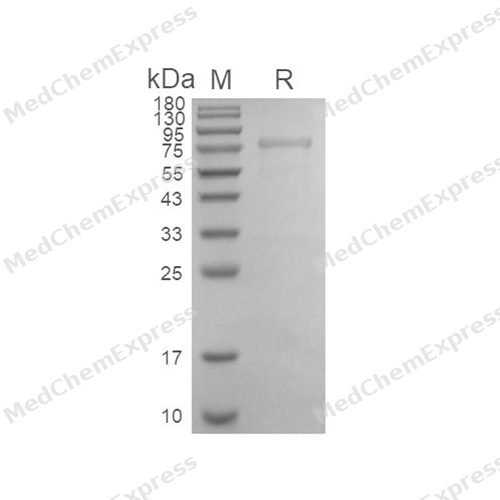
Purity - SDS-PAGE


Technical Parameters
-
Species Human
-
Source Sf9 insect cells
-
Tag N-His
-
Accession
P10515 (S87-L647)
-
Molecular Construction
-
N-term
-
His
-
DLAT (S87-L647)
Accession # P10515 -
C-term
-
-
Protein Length
Full Length of Mature Protein
-
Synonyms
DLAT; E2 Component Of Pyruvate Dehydrogenase Complex; Prev. DLTA; M2 Antigen Complex 70 KDa Subunit; PDC-E2; PDCE2; Dihydrolipoyllysine-Residue Acetyltransferase Component Of Pyruvate Dehydrogenase Complex, Mitochondrial; PBC; Dihydrolipoamide Acetyltrans
-
AA Sequence
SLPPHQKVPLPSLSPTMQAGTIARWEKKEGDKINEGDLIAEVETDKATVGFESLEECYMAKILVAEGTRDVPIGAIICITVGKPEDIEAFKNYTLDSSAAPTPQAAPAPTPAATASPPTPSAQAPGSSYPPHMQVLLPALSPTMTMGTVQRWEKKVGEKLSEGDLLAEIETDKATIGFEVQEEGYLAKILVPEGTRDVPLGTPLCIIVEKEADISAFADYRPTEVTDLKPQVPPPTPPPVAAVPPTPQPLAPTPSAPCPATPAGPKGRVFVSPLAKKLAVEKGIDLTQVKGTGPDGRITKKDIDSFVPSKVAPAPAAVVPPTGPGMAPVPTGVFTDIPISNIRRVIAQRLMQSKQTIPHYYLSIDVNMGEVLLVRKELNKILEGRSKISVNDFIIKASALACLKVPEANSSWMDTVIRQNHVVDVSVAVSTPAGLITPIVFNAHIKGVETIANDVVSLATKAREGKLQPHEFQGGTFTISNLGMFGIKNFSAIINPPQACILAIGASEDKLVPADNEKGFDVASMMSVTLSCDHRVVDGAVGAQWLAEFRKYLEKPITMLL
-
Molecular Weight
Approximately 75-77 kDa, based on SDS-PAGE under reducing conditions, due to the glycosylation.
-
Glycosylation
Yes
-
Purity
≥ 85%, as determined by reducing SDS-PAGE.


Product Properties
Lyophilized powder
Lyophilized from a 0.22 μm filtered solution of PBS, pH 7.4, 0.2 mM PMSF.
<1 EU/μg, determined by LAL method.
It is not recommended to reconstitute to a concentration less than 100 μg/mL in ddH2O. For long term storage it is recommended to add a carrier protein (0.1% BSA, 5% HSA, 10% FBS or 5% Trehalose).
Stored at -20°C for 2 years from date of receipt. After reconstitution, it is stable at 4°C for 1 week or -20°C for longer (with carrier protein). It is recommended to freeze aliquots at -20°C or -80°C for extended storage.
Shipping with dry ice.


Documentation
-
Data Sheet (238 KB)
-
SDS (251 KB)
- English - EN (251 KB)
- Français - FR (251 KB)
- Deutsch - DE (251 KB)
- Norwegian - NO (251 KB)
- Español - ES (251 KB)
- Swedish - SV (251 KB)
- Italian - IT (251 KB)
- Korean - KR (251 KB)
- Portuguese - PT (251 KB)
-
Handling Instructions (2659 KB)

Calculators
Concentration (start) × Volume (start) = Concentration (final) × Volume (final)


 Powered by Bioz

