



DSC2/Desmocollin-2 Protein, Human (HEK293, His, solution)

Based on 1 Customer Validation
DSC2/Desmocollin-2 protein is vital for intercellular desmosome junctions, mediating adhesion by interacting with plaque proteins and intermediate filaments. It also regulates cell positioning and interacts with DSP, PKP2, and JUP, strengthening junction stability. Overall, DSC2/Desmocollin-2 protein maintains tissue organization and functionality. DSC2/Desmocollin-2 Protein, Human (HEK293, His, solution) is the recombinant human-derived DSC2/Desmocollin-2 protein, expressed by HEK293 , with C-His labeled tag.
- Species: Human
- Source: HEK293
-
Storage:Stored at -80°C for 1 year from date of receipt. It is stable at -20°C for 3 months after opening. It is recommended to freeze aliquots at -80°C for extended storage. Avoid repeated freeze-thaw cycles.


To place orders, for customer services and technical support, please contact: MedChemExpress USA
Tel: 609-228-6898 E-mail: [email protected] [email protected]


-
 Biological Activity
-
Technical Parameters
-
Product Properties
- Documentation
- Help & FAQs




Biological Activity
Description
DSC2/Desmocollin-2 protein is vital for intercellular desmosome junctions, mediating adhesion by interacting with plaque proteins and intermediate filaments. It also regulates cell positioning and interacts with DSP, PKP2, and JUP, strengthening junction stability. Overall, DSC2/Desmocollin-2 protein maintains tissue organization and functionality. DSC2/Desmocollin-2 Protein, Human (HEK293, His, solution) is the recombinant human-derived DSC2/Desmocollin-2 protein, expressed by HEK293 , with C-His labeled tag.
Background
DSC2/Desmocollin-2 protein is a critical component of intercellular desmosome junctions, playing a crucial role in facilitating cell-cell adhesion by mediating the interaction between plaque proteins and intermediate filaments. In addition to its adhesive function, DSC2 may also contribute to epidermal cell positioning by regulating the adhesiveness between cells expressing different isoforms. This protein interacts with DSP, PKP2, and JUP, further reinforcing the stability and integrity of these junctions. By participating in these molecular interactions, DSC2/Desmocollin-2 protein ensures the proper organization and functionality of tissues.
Verified Bioactivity
Measured by its ability to inhibit the proliferation of PC-3 cells. The ED50 for this effect is 0.7589 μg/mL, corresponding to a specific activity is 1.317×10^3 units/mg.
MCE Validation Data
-
Bioactivity - Cell-Based Assay
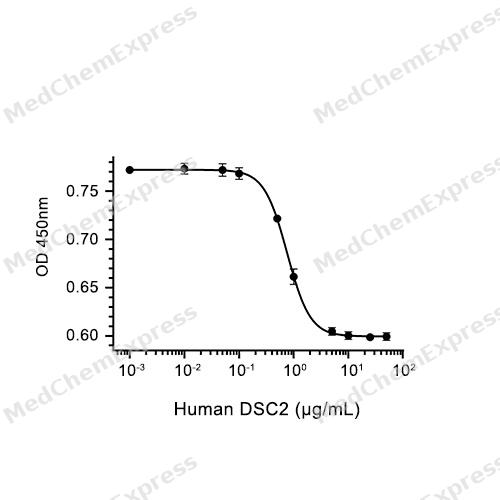
Bioactivity - Cell-Based Assay


Technical Parameters
-
Species Human
-
Source HEK293
-
Tag C-His
-
Accession
Q02487 (A28-R684)
-
Molecular Construction
-
N-term
-
DSC2 (A28-R684)
Accession # Q02487 -
His
-
C-term
-
-
Protein Length
Partial Extracellular Domain (with Propeptide)
-
Synonyms
DSC2; Desmosomal Glycoprotein III; Prev. DSC3; Desmocollin-3; CDHF2; DGII/III; Cadherin Family Member 2; ARVD11; Desmocollin-2; DG2; Desmosomal Glycoprotein II/III; Desmocollin 2; Desmosomal Glycoprotein II
-
AA Sequence
ASDACKNVTLHVPSKLDAEKLVGRVNLKECFTAANLIHSSDPDFQILEDGSVYTTNTILLSSEKRSFTILLSNTENQEKKKIFVFLEHQTKVLKKRHTKEKVLRRAKRRWAPIPCSMLENSLGPFPLFLQQVQSDTAQNYTIYYSIRGPGVDQEPRNLFYVERDTGNLYCTRPVDREQYESFEIIAFATTPDGYTPELPLPLIIKIEDENDNYPIFTEETYTFTIFENCRVGTTVGQVCATDKDEPDTMHTRLKYSIIGQVPPSPTLFSMHPTTGVITTTSSQLDRELIDKYQLKIKVQDMDGQYFGLQTTSTCIINIDDVNDHLPTFTRTSYVTSVEENTVDVEILRVTVEDKDLVNTANWRANYTILKGNENGNFKIVTDAKTNEGVLCVVKPLNYEEKQQMILQIGVVNEAPFSREASPRSAMSTATVTVNVEDQDEGPECNPPIQTVRMKENAEVGTTSNGYKAYDPETRSSSGIRYKKLTDPTGWVTIDENTGSIKVFRSLDREAETIKNGIYNITVLASDQGGRTCTGTLGIILQDVNDNSPFIPKKTVIICKPTMSSAEIVAVDPDEPIHGPPFDFSLESSTSEVQRMWRLKAINDTAARLSYQNDPPFGSYVVPITVRDRLGMSSVTSLDVTLCDCITENDCTHRVDPR
-
Predicted Molecular Mass
75 kDa
-
Molecular Weight
Approximately 85 kDa (mature form) & 100 kDa (pro form), based on SDS-PAGE under reducing conditions, due to the glycosylation.
-
Glycosylation
Yes
-
Purity
≥ 90%, as determined by reducing SDS-PAGE.


Product Properties
Solution
Supplied as a 0.22 μm filtered solution of PBS, pH 7.4.
<1 EU/μg, determined by LAL method.
Stored at -80°C for 1 year from date of receipt. It is stable at -20°C for 3 months after opening. It is recommended to freeze aliquots at -80°C for extended storage. Avoid repeated freeze-thaw cycles.
Shipping with dry ice.


Documentation
-
Data Sheet (239 KB)
-
SDS (252 KB)
- English - EN (252 KB)
- Français - FR (252 KB)
- Deutsch - DE (252 KB)
- Norwegian - NO (252 KB)
- Español - ES (252 KB)
- Swedish - SV (252 KB)
- Italian - IT (252 KB)
- Korean - KR (252 KB)
- Portuguese - PT (252 KB)
-
Handling Instructions (2659 KB)

Calculators
Concentration (start) × Volume (start) = Concentration (final) × Volume (final)


 Powered by Bioz

