



DSC2/Desmocollin-2 Protein, Rat (HEK293, His)

Based on 1 Customer Validation
DSC2 (or Desmocollin-2) is an important component of desmosome connections between cells and plays a key role in the complex interaction network between plaque proteins and intermediate filaments. At these junctions, DSC2 contributes to cell-cell adhesion, promoting tissue cohesion and stability. DSC2/Desmocollin-2 Protein, Rat (HEK293, His) is the recombinant rat-derived DSC2/Desmocollin-2 protein, expressed by HEK293 , with C-His labeled tag.
- Species: Rat
- Source: HEK293
-
Storage:Stored at -20°C for 2 years from date of receipt. After reconstitution, it is stable at 4°C for 1 week or -20°C for longer (with carrier protein). It is recommended to freeze aliquots at -20°C or -80°C for extended storage.


To place orders, for customer services and technical support, please contact: MedChemExpress USA
Tel: 609-228-6898 E-mail: [email protected] [email protected]


-
 Biological Activity
-
Technical Parameters
-
Product Properties
- Documentation
- Help & FAQs




Biological Activity
Description
DSC2 (or Desmocollin-2) is an important component of desmosome connections between cells and plays a key role in the complex interaction network between plaque proteins and intermediate filaments. At these junctions, DSC2 contributes to cell-cell adhesion, promoting tissue cohesion and stability. DSC2/Desmocollin-2 Protein, Rat (HEK293, His) is the recombinant rat-derived DSC2/Desmocollin-2 protein, expressed by HEK293 , with C-His labeled tag.
Background
Desmocollin-2 (DSC2) is a crucial component of intercellular desmosome junctions, playing a pivotal role in cell-cell adhesion. As part of desmosomes, DSC2 contributes to the intricate network that mediates cell-cell interactions. These junctions are essential for the maintenance of tissue integrity and provide structural support through the interaction of plaque proteins and intermediate filaments. DSC2's involvement in this molecular complex underscores its significance in ensuring the cohesion and stability of tissues, particularly those subjected to mechanical stress. The protein's function in promoting cell-cell adhesion highlights its importance in the maintenance of tissue architecture and overall cellular integrity. (
Verified Bioactivity
Measured by the ability of the immobilized protein to support the adhesion of the Caki-2 human clear cell carcinoma epithelial cells. The adhesion rate for this effect is 75.84% in the presence of 10 μg/mL Rat DSC2.
MCE Validation Data
-
Purity - SDS-PAGE
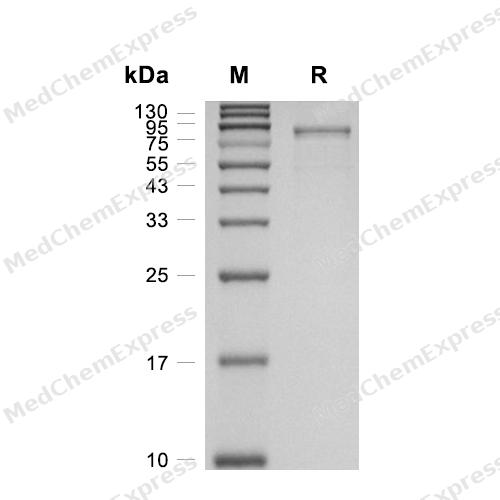
Purity - SDS-PAGE


Technical Parameters
-
Species Rat
-
Source HEK293
-
Tag C-His
-
Accession
Q3T1K6 (C29-P694)
-
Molecular Construction
-
N-term
-
DSC2 (C29-P694)
Accession # Q3T1K6 -
His
-
C-term
-
-
Protein Length
Partial
-
Synonyms
DSC2; Desmosomal Glycoprotein III; Prev. DSC3; Desmocollin-3; CDHF2; DGII/III; Cadherin Family Member 2; ARVD11; Desmocollin-2; DG2; Desmosomal Glycoprotein II/III; Desmocollin 2; Desmosomal Glycoprotein II
-
AA Sequence
CDACKEVVLQVPSELPAGKFVGRVNLMECLKSANVIHLSDPDFQVFEDGSVYTTNSVVLSSGQRSFTIWLFNTDSQEERELSVHLEGPVEVLNQRLHTEKVLRRAKRRWAPIPCSMMENSLGPFPLFLQQIQSDKAQNYTIYYSISGPGVDKEPVGLFRIDRDTGNLYCTDRVDREQYDSFELTALAMTPDGYMVENLLTLLIKVEDENDNYPIFTQKVYSFTVLENSPFGSHVGEVCATDKDEPDTMHTRLKYSILEQSPSPPMLFTMHPRTGVITTTSTQLDRELIDKYQLIIKVQDMDGQYFGLQTTATCVITIGDVNDNLPTFTRTTYVTSVEENTVNVELLRLSVQDKDLVNSPNWRANYTILKGNENGNFKIKTDPQTNEGILCVIMPLDYEERQRVTLEIGVVNEAPYTRQAGSKSSMSTATVTVNVKNQDEGPECIPQTQTVRIRENVPIGTRNDGYKAYDPETKNSIGIRYRKLSDPKGWITVNEDSGSITIFRTLDREAETIRNGIYNITVLALDADGRSCTGTLGILLEDVNDNGPFIPKQTVVICRATMSSAEIVAVDPDEPANGPPFDFSLESSDSEVRRRWKLTRINDTAASLSYQNDPAFDSYVIPVRVTDRFGLSSVTSLNVVVCDCITESDCTYRTGERTGYADVRLGP
-
Molecular Weight
Approximately 76 kDa & 91 kDa, based on SDS-PAGE under reducing conditions, due to the glycosylation.
-
Glycosylation
Yes
-
Purity
≥ 95%, as determined by reducing SDS-PAGE.


Product Properties
Lyophilized powder.
Lyophilized from a 0.22 μm filtered solution of PBS, pH 7.4.
<1 EU/μg, determined by LAL method.
It is not recommended to reconstitute to a concentration less than 100 μg/mL in ddH2O. For long term storage it is recommended to add a carrier protein (0.1% BSA, 5% HSA, 10% FBS or 5% Trehalose).
Stored at -20°C for 2 years from date of receipt. After reconstitution, it is stable at 4°C for 1 week or -20°C for longer (with carrier protein). It is recommended to freeze aliquots at -20°C or -80°C for extended storage.
Room temperature in continental US; may vary elsewhere.


Documentation
-
Data Sheet (239 KB)
-
SDS (251 KB)
- English - EN (251 KB)
- Français - FR (251 KB)
- Deutsch - DE (251 KB)
- Norwegian - NO (251 KB)
- Español - ES (251 KB)
- Swedish - SV (251 KB)
- Italian - IT (251 KB)
- Korean - KR (251 KB)
- Portuguese - PT (251 KB)
-
Handling Instructions (2659 KB)

Calculators
Concentration (start) × Volume (start) = Concentration (final) × Volume (final)


 Powered by Bioz

