



FGFR-4 Protein, Rat (HEK293, hFc)
Based on 1 Customer Validation
The FGFR-4 protein is a tyrosine-protein kinase receptor for fibroblast growth factor that regulates cellular processes, lipid metabolism, bile acid biosynthesis, and more.Its effects include downregulation of CYP7A1 in response to FGF19.FGFR-4 Protein, Rat (HEK293, hFc) is the recombinant rat-derived FGFR-4 protein, expressed by HEK293 , with C-hFc labeled tag.
- Species: Rat
- Source: HEK293
-
Storage:Stored at -20°C for 2 years from date of receipt. After reconstitution, it is stable at 4°C for 1 week or -20°C for longer (with carrier protein). It is recommended to freeze aliquots at -20°C or -80°C for extended storage.


To place orders, for customer services and technical support, please contact: MedChemExpress USA
Tel: 609-228-6898 E-mail: [email protected] [email protected]


-
 Biological Activity
-
Technical Parameters
-
Product Properties
- Documentation
- Help & FAQs




Biological Activity
Description
The FGFR-4 protein is a tyrosine-protein kinase receptor for fibroblast growth factor that regulates cellular processes, lipid metabolism, bile acid biosynthesis, and more.Its effects include downregulation of CYP7A1 in response to FGF19.FGFR-4 Protein, Rat (HEK293, hFc) is the recombinant rat-derived FGFR-4 protein, expressed by HEK293 , with C-hFc labeled tag.
Background
FGFR-4 protein, a tyrosine-protein kinase, functions as a cell-surface receptor for fibroblast growth factors, playing a crucial role in the regulation of cell proliferation, differentiation, and migration. Additionally, it contributes to the control of lipid metabolism, bile acid biosynthesis, glucose uptake, vitamin D metabolism, and phosphate homeostasis. Its significance is highlighted in the normal down-regulation of CYP7A1, the rate-limiting enzyme in bile acid synthesis, in response to FGF19. Upon ligand binding, FGFR-4 activates various signaling cascades, including the phosphorylation of PLCG1 and FRS2. This activation leads to the production of cellular signaling molecules like diacylglycerol and inositol 1,4,5-trisphosphate. Furthermore, FRS2 phosphorylation triggers the recruitment of GRB2, GAB1, PIK3R1, and SOS1, activating RAS, MAPK1/ERK2, MAPK3/ERK1, the MAP kinase signaling pathway, and the AKT1 signaling pathway. Notably, FGFR-4 promotes SRC-dependent phosphorylation of the matrix protease MMP14, facilitating its lysosomal degradation. To regulate FGFR-4 signaling, the receptor undergoes internalization and degradation, a process facilitated by MMP14.
Verified Bioactivity
1.This product does not contain protein kinase domain.
2.Measured by its binding ability in a functional ELISA.
3.Immobilized human FGF18 at 10 μg/mL (100 μl/well) can bind Rat FGFR4 , The EC50 of Rat FGFR4 is <1.17 μg/mL.
4.Measured by its ability to inhibit FGF acidic-dependent proliferation of NIH-3T3 mouse fibroblast cells. The ED50 for this effect is 1.025 ng/mL, corresponding to a specific activity is 9.76×10^5 units/mg.
MCE Validation Data
-
Purity - SDS-PAGE
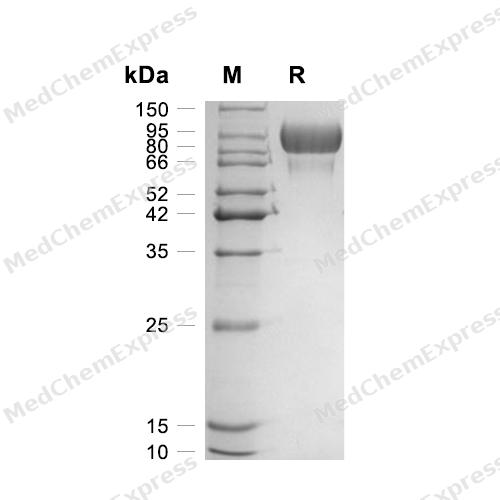
Purity - SDS-PAGE
-
Bioactivity - Cell-Based Assay
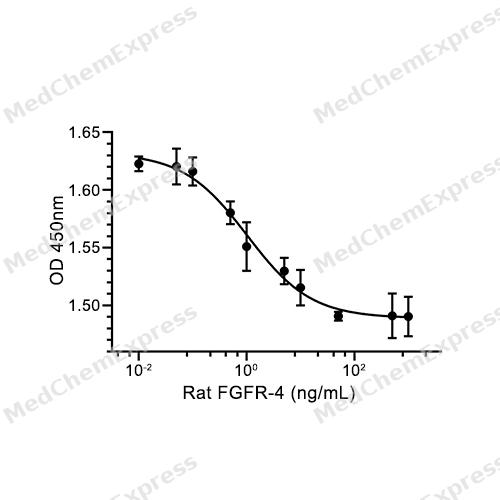
Bioactivity - Cell-Based Assay


Technical Parameters
-
Species Rat
-
Source HEK293
-
Tag C-hFc
-
Accession
Q498D6 (F17-D367)
-
Gene ID25114
-
Molecular Construction
-
N-term
-
FGFR-4 (F17-D367)
Accession # Q498D6 -
hFc
-
C-term
-
-
Protein Length
Extracellular Domain
-
Synonyms
FGFR4; Receptor Protein-Tyrosine Kinase; Fibroblast Growth Factor Receptor 4; Hydroxyaryl-Protein Kinase; JTK2; Protein-Tyrosine Kinase; TKF; Soluble FGFR4 Variant 1; CD334; Tyrosylprotein Kinase; Tyrosine Kinase Related To Fibroblast Growth Factor Recept
-
AA Sequence
FSLEASEEMEQEPCPAPISEQQEQVLTVALGQPVRLCCGRTERGRHWYKEGSRLASAGRVRGWRGRLEIASFLPEDAGRYLCLARGSMTVVHNLTLIMDDSLPSINNEDPKTLSSSSSGHSYLQQAPYWTHPQRMEKKLHAVPAGNTVKFRCPAAGNPMPTIHWLKNGQAFHGENRIGGIRLRHQHWSLVMESVVPSDRGTYTCLVENSLGSIRYSYLLDVLERSPHRPILQAGLPANTTAVVGSNVELLCKVYSDAQPHIQWLKHIVINGSSFGADGFPYVQVLKTTDINSSEVEVLYLRNVSAEDAGEYTCLAGNSIGLSYQSAWLTVLPAEEEDLAWTTATSEARYTD
-
Predicted Molecular Mass
65 kDa
-
Molecular Weight
Approximately 80-115 kDa, based on SDS-PAGE under reducing conditions.
-
Glycosylation
Yes
-
Purity
≥ 90%, as determined by reducing SDS-PAGE.


Product Properties
Lyophilized powder.
Lyophilized from a 0.22 μm filtered solution of 20 mM PB, 150 mM NaCl, pH 7.4.
<1 EU/μg, determined by LAL method.
It is not recommended to reconstitute to a concentration less than 100 μg/mL in ddH2O. For long term storage it is recommended to add a carrier protein (0.1% BSA, 5% HSA, 10% FBS or 5% Trehalose).
Stored at -20°C for 2 years from date of receipt. After reconstitution, it is stable at 4°C for 1 week or -20°C for longer (with carrier protein). It is recommended to freeze aliquots at -20°C or -80°C for extended storage.
Room temperature in continental US; may vary elsewhere.


Documentation
-
Data Sheet (238 KB)
-
SDS (251 KB)
- English - EN (251 KB)
- Français - FR (251 KB)
- Deutsch - DE (251 KB)
- Norwegian - NO (251 KB)
- Español - ES (251 KB)
- Swedish - SV (251 KB)
- Italian - IT (251 KB)
- Korean - KR (251 KB)
- Portuguese - PT (251 KB)
-
Handling Instructions (2659 KB)

Calculators
Concentration (start) × Volume (start) = Concentration (final) × Volume (final)


 Powered by Bioz

