



FGL2 Protein, Mouse (HEK293, His-Avi, Flag)
Based on 2 publication(s) in Google Scholar
FGL2 is a key enzyme in the coagulation cascade and plays a key role in the conversion of prothrombin to thrombin, reflecting its important contribution to hemostasis and coagulation processes. Structurally, FGL2 forms homotetramers characterized by disulfide bonds that contribute to its functional integrity and catalytic activity in the complex process of thrombin generation. FGL2 Protein, Mouse (HEK293, His-Avi, Flag) is the recombinant mouse-derived FGL2 protein, expressed by HEK293 , with C-Avi, N-His, N-Flag labeled tag.
- Species: Mouse
- Source: HEK293
-
Storage:Stored at -20°C for 2 years from date of receipt. After reconstitution, it is stable at 4°C for 1 week or -20°C for longer (with carrier protein). It is recommended to freeze aliquots at -20°C or -80°C for extended storage.


To place orders, for customer services and technical support, please contact: MedChemExpress USA
Tel: 609-228-6898 E-mail: [email protected] [email protected]


-
 Biological Activity
-
Technical Parameters
-
Product Properties
- Documentation
- Help & FAQs




Biological Activity
Description
FGL2 is a key enzyme in the coagulation cascade and plays a key role in the conversion of prothrombin to thrombin, reflecting its important contribution to hemostasis and coagulation processes. Structurally, FGL2 forms homotetramers characterized by disulfide bonds that contribute to its functional integrity and catalytic activity in the complex process of thrombin generation. FGL2 Protein, Mouse (HEK293, His-Avi, Flag) is the recombinant mouse-derived FGL2 protein, expressed by HEK293 , with C-Avi, N-His, N-Flag labeled tag.
Background
FGL2 (Fibrinogen-Like Protein 2) is a crucial enzyme involved in the coagulation pathway, exerting its function by converting prothrombin into thrombin. This conversion is a pivotal step in the blood clotting process, playing a fundamental role in maintaining hemostasis. Structurally, FGL2 forms a homotetramer, indicating the assembly of four identical subunits. The integrity of this tetrameric structure is maintained through disulfide linkages between the subunits. The homotetrameric arrangement suggests a cooperative mechanism, potentially enhancing the efficiency of FGL2 in its prothrombin-to-thrombin conversion activity. Ongoing research may reveal additional insights into the specific regulatory mechanisms and physiological implications of FGL2 in the coagulation cascade.
Verified Bioactivity
Immobilized Mouse FGL2, His Tag at 5μg/mL (100μL/well) can bind anti-FGL2 Antibody, The ED50 for this effect is 5.068 ng/mL.
MCE Validation Data
-
Purity - SDS-PAGE
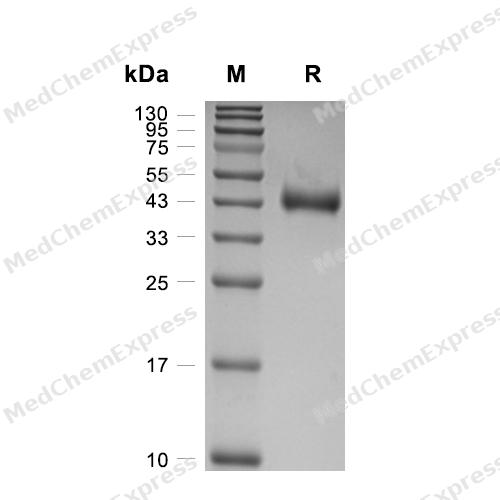
Purity - SDS-PAGE
-
Bioactivity - ELISA
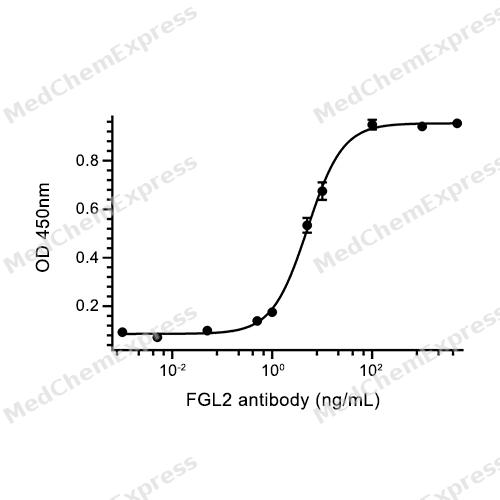
Bioactivity - ELISA


Publications (2)
-
Journal Impact Factor
-
Most Recent
-
Cell Metab
Bone marrow immune cells respond to fluctuating nutritional stress to constrain weight regain. [Abstract]2023 Nov 7;35(11):1915-1930.e8. PMID: 37703873 -
Cell Commun Signal
Single-cell profiling reveals periosteal signatures of impaired periosteal cells proliferation in a drill-hole model of type 2 diabetes. [Abstract]2025 Aug 12;23(1):371. PMID: 40796869


Technical Parameters
-
Species Mouse
-
Source HEK293
-
Tag C-Avi;N-His;N-Flag
-
Accession
P12804 (P197-P432)
-
Protein Length
Full Length of Fibrinogen C-terminal Domain
-
Synonyms
FGL2; Fibrinogen-Like Protein 2; Fibrinogen Like 2; T49; Fibroleukin; Fibrinogen-Like 2; PT49
-
AA Sequence
PVQHLIYKDCSDHYVLGRRSSGAYRVTPDHRNSSFEVYCDMETMGGGWTVLQARLDGSTNFTREWKDYKAGFGNLEREFWLGNDKIHLLTKSKEMILRIDLEDFNGLTLYALYDQFYVANEFLKYRLHIGNYNGTAGDALRFSRHYNHDLRFFTTPDRDNDRYPSGNCGLYYSSGWWFDSCLSANLNGKYYHQKYKGVRNGIFWGTWPGINQAQPGGYKSSFKQAKMMIRPKNFKP
-
Molecular Weight
Approximately 40-50 kDa, based on SDS-PAGE under reducing conditions, due to the glycosylation.
-
Glycosylation
Yes
-
Purity
≥ 95%, as determined by Bis-Tris PAGE.


Product Properties
Lyophilized powder.
1.Lyophilized from a 0.22 μm filtered solution of PBS, 8% trehalose, pH 7.4.
2.Lyophilized from a 0.22 μm filtered solution of PBS, pH 6.8, 8% trehalose.
Please refer to the lot-specific COA for specific buffer information.
<1 EU/μg, determined by LAL method.
It is not recommended to reconstitute to a concentration less than 100 μg/mL in ddH2O. For long term storage it is recommended to add a carrier protein (0.1% BSA, 5% HSA, 10% FBS or 5% Trehalose).
Stored at -20°C for 2 years from date of receipt. After reconstitution, it is stable at 4°C for 1 week or -20°C for longer (with carrier protein). It is recommended to freeze aliquots at -20°C or -80°C for extended storage.
Room temperature in continental US; may vary elsewhere.


Documentation
-
Data Sheet (237 KB)
-
SDS (252 KB)
- English - EN (252 KB)
- Français - FR (252 KB)
- Deutsch - DE (252 KB)
- Norwegian - NO (252 KB)
- Español - ES (252 KB)
- Swedish - SV (252 KB)
- Italian - IT (252 KB)
- Korean - KR (252 KB)
- Portuguese - PT (252 KB)
-
Handling Instructions (2659 KB)

Calculators
Concentration (start) × Volume (start) = Concentration (final) × Volume (final)


 Powered by Bioz

