



Fractalkine/CX3CL1 Protein, Human (315a.a, HEK293, His)

Based on 1 Customer Validation
Fractalkine/CX3CL1 protein, a chemokine, binds CX3CR1 and integrins ITGAV:ITGB3 and ITGA4:ITGB1. It regulates immune response, inflammation, adhesion, chemotaxis, and leukocyte migration. It activates integrins via CX3CR1-dependent and -independent pathways, binding to site 1 with CX3CR1 and site 2 without CX3CR1. Soluble Fractalkine/CX3CL1 attracts T-cells and monocytes, not neutrophils. Fractalkine/CX3CL1 Protein, Human (315a.a, HEK293, His) is the recombinant human-derived Fractalkine/CX3CL1 protein, expressed by HEK293 , with C-His labeled tag.
- Species: Human
- Source: HEK293
-
Storage:Stored at -20°C for 2 years from date of receipt. After reconstitution, it is stable at 4°C for 1 week or -20°C for longer (with carrier protein). It is recommended to freeze aliquots at -20°C or -80°C for extended storage.


To place orders, for customer services and technical support, please contact: MedChemExpress USA
Tel: 609-228-6898 E-mail: [email protected] [email protected]


-
 Biological Activity
-
Technical Parameters
-
Product Properties
- Documentation
- Help & FAQs




Biological Activity
Description
Fractalkine/CX3CL1 protein, a chemokine, binds CX3CR1 and integrins ITGAV:ITGB3 and ITGA4:ITGB1. It regulates immune response, inflammation, adhesion, chemotaxis, and leukocyte migration. It activates integrins via CX3CR1-dependent and -independent pathways, binding to site 1 with CX3CR1 and site 2 without CX3CR1. Soluble Fractalkine/CX3CL1 attracts T-cells and monocytes, not neutrophils. Fractalkine/CX3CL1 Protein, Human (315a.a, HEK293, His) is the recombinant human-derived Fractalkine/CX3CL1 protein, expressed by HEK293 , with C-His labeled tag.
Background
Fractalkine/CX3CL1 is a chemokine that serves as a ligand for both CX3CR1 and integrins ITGAV:ITGB3 and ITGA4:ITGB1. Its signaling through the CX3CR1-CX3CL1 pathway plays various roles in different tissue compartments, including immune response, inflammation, cell adhesion, and chemotaxis. It regulates leukocyte adhesion and migration at the endothelium and can activate integrins in both a CX3CR1-dependent and CX3CR1-independent manner. In the presence of CX3CR1, it activates integrins by binding to the classical ligand-binding site (site 1), while in the absence of CX3CR1, it binds to a second site (site 2) in integrins that is distinct from site 1 and enhances the binding of other integrin ligands to site 1. The soluble form of Fractalkine/CX3CL1 acts as a chemotactic factor for T-cells and monocytes but not neutrophils.
Verified Bioactivity
Measured by its binding ability in a functional ELISA.
MCE Validation Data
-
Purity - SDS-PAGE
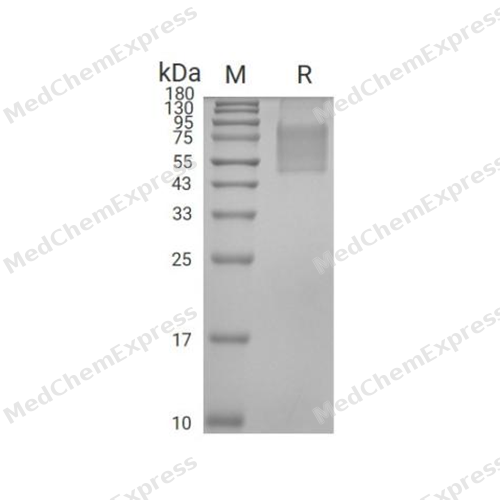
Purity - SDS-PAGE


Technical Parameters
-
Species Human
-
Source HEK293
-
Tag C-His
-
Accession
P78423 (Q25-R339)
-
Molecular Construction
-
N-term
-
Fractalkine (Q25-R339)
Accession # P78423 -
His
-
C-term
-
-
Protein Length
Extracellular Domain
-
Synonyms
CX3CL1; NTN; Prev. SCYD1; CX3C Membrane-Anchored Chemokine; Chemokine (C-X3-C Motif) Ligand 1; Small-Inducible Cytokine D1; Fractalkine; C-X3-C Motif Chemokine 1; Neurotactin; NTT; C3Xkine; Small Inducible Cytokine Subfamily D (Cys-X3-Cys), Member-1; ABCD
-
AA Sequence
QHHGVTKCNITCSKMTSKIPVALLIHYQQNQASCGKRAIILETRQHRLFCADPKEQWVKDAMQHLDRQAAALTRNGGTFEKQIGEVKPRTTPAAGGMDESVVLEPEATGESSSLEPTPSSQEAQRALGTSPELPTGVTGSSGTRLPPTPKAQDGGPVGTELFRVPPVSTAATWQSSAPHQPGPSLWAEAKTSEAPSTQDPSTQASTASSPAPEENAPSEGQRVWGQGQSPRPENSLEREEMGPVPAHTDAFQDWGPGSMAHVSVVPVSSEGTPSREPVASGSWTPKAEEPIHATMDPQRLGVLITPVPDAQAATR
-
Predicted Molecular Mass
34.4 kDa
-
Molecular Weight
Approximately 50-90 kDa, based on SDS-PAGE under reducing conditions, due to the glycosylation.
-
Glycosylation
Yes
-
Purity
≥ 95%, as determined by reducing SDS-PAGE.


Product Properties
Lyophilized powder.
1.Lyophilized from a 0.22 μm filtered solution of 20 mM PB, 150 mM NaCl, pH 7.2.
2.Lyophilized from a 0.22 μm filtered solution of PBS, 5% trehalose, 5% mannitol, 0.01% Tween-80, pH 7.4.
Please refer to the lot-specific COA for specific buffer information.
<1 EU/μg, determined by LAL method.
It is not recommended to reconstitute to a concentration less than 100 μg/mL in ddH2O. For long term storage it is recommended to add a carrier protein (0.1% BSA, 5% HSA, 10% FBS or 5% Trehalose).
Stored at -20°C for 2 years from date of receipt. After reconstitution, it is stable at 4°C for 1 week or -20°C for longer (with carrier protein). It is recommended to freeze aliquots at -20°C or -80°C for extended storage.
Room temperature in continental US; may vary elsewhere.


Documentation
-
Data Sheet (237 KB)
-
SDS (251 KB)
- English - EN (251 KB)
- Français - FR (251 KB)
- Deutsch - DE (251 KB)
- Norwegian - NO (251 KB)
- Español - ES (251 KB)
- Swedish - SV (251 KB)
- Italian - IT (251 KB)
- Korean - KR (251 KB)
- Portuguese - PT (251 KB)
-
Handling Instructions (2659 KB)

Calculators
Concentration (start) × Volume (start) = Concentration (final) × Volume (final)


 Powered by Bioz

