



G-CSF Protein, Mouse (HEK293, His)
Based on 2 publication(s) in Google Scholar
The G-CSF Protein, a monomeric cytokine in the granulocyte/macrophage colony-stimulating factor family, crucially regulates hematopoiesis by orchestrating the production, differentiation, and function of granulocytes and monocytes-macrophages. Its production emphasizes its significance in maintaining immune system balance and functionality. G-CSF Protein, Mouse (HEK293, His) is the recombinant mouse-derived G-CSF protein, expressed by HEK293 , with C-6*His labeled tag.
- Species: Mouse
- Source: HEK293
-
Storage:Stored at -20°C for 2 years from date of receipt. After reconstitution, it is stable at 4°C for 1 week or -20°C for longer (with carrier protein). It is recommended to freeze aliquots at -20°C or -80°C for extended storage.


To place orders, for customer services and technical support, please contact: MedChemExpress USA
Tel: 609-228-6898 E-mail: [email protected] [email protected]


-
 Biological Activity
-
Technical Parameters
-
Product Properties
- Documentation
- Help & FAQs


-
HY-B0215
Acetylcysteine -
HY-12305
Q-VD-OPh -
HY-14622A
Necrostatin 2 racemate -

HY-P7361
GM-CSF Protein, Mouse -
HY-148439
Daraxonrasib -
HY-B0988
Deferoxamine mesylate -
HY-P7063
IL-6 Protein, Mouse -
HY-K0202
Protein A/G Magnetic Beads -
HY-P70422
G-CSF Protein, Human -
HY-P7090
TNF-alpha/TNFSF2 Protein, Mouse (156a.a) -
HY-P71824
HSP70/DnaK Protein, E. coli (P.pastoris, His)


Biological Activity
Description
The G-CSF Protein, a monomeric cytokine in the granulocyte/macrophage colony-stimulating factor family, crucially regulates hematopoiesis by orchestrating the production, differentiation, and function of granulocytes and monocytes-macrophages. Its production emphasizes its significance in maintaining immune system balance and functionality. G-CSF Protein, Mouse (HEK293, His) is the recombinant mouse-derived G-CSF protein, expressed by HEK293 , with C-6*His labeled tag.
Background
The G-CSF Protein, a member of the granulocyte/macrophage colony-stimulating factors, plays a crucial role in hematopoiesis by regulating the production, differentiation, and function of two closely related white cell populations in the blood: granulocytes and monocytes-macrophages. Specifically, this cytokine induces the generation of granulocytes, contributing to the intricate orchestration of hematopoietic processes.
Verified Bioactivity
Measured in a cell proliferation assay using NFS 60 mouse myelogenous leukemia lymphoblast cells. The ED50 for this effect is ≤103.9 pg/mL, corresponding to a specific activity is ≥6.9624×10⁶ units/mg.
MCE Validation Data
-
Purity - SDS-PAGE
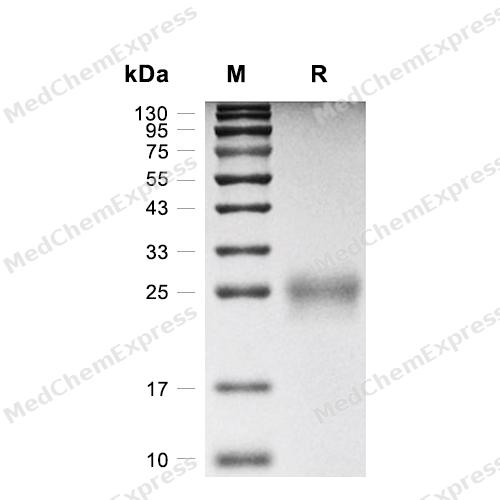
Purity - SDS-PAGE
-
Bioactivity - Cell-Based Assay
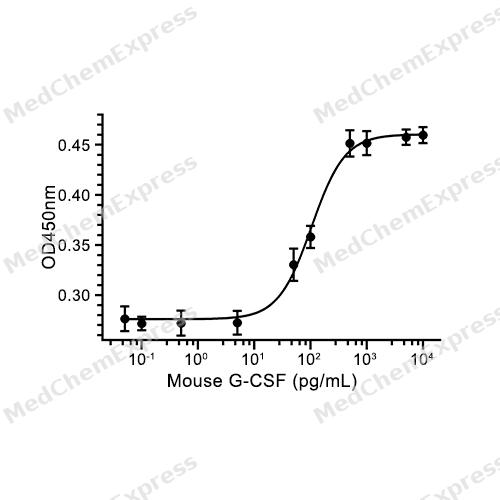
Bioactivity - Cell-Based Assay


Publications (2)
-
Journal Impact Factor
-
Most Recent
-
Nat Biomed Eng
Activatable near-infrared probes for the detection of specific populations of tumour-infiltrating leukocytes in vivo and in urine. [Abstract]2023 Mar;7(3):281-297. PMID: 36941352 -


Technical Parameters
-
Species Mouse
-
Source HEK293
-
Tag C-6*His
-
Accession
P09920 (V31-A208)
-
Molecular Construction
-
N-term
-
G-CSF (V31-A208)
Accession # P09920 -
6*His
-
C-term
-
-
Protein Length
Full Length of Mature Protein
-
Synonyms
CSF3; Filgrastim; Prev. C17orf33; MGC45931; Prev. GCSF; Colony Stimulating Factor 3 Nirs Variant 1; Prev. G-CSF; Granulocyte Colony Stimulating Factor; Granulocyte Colony-Stimulating Factor; Granulocyte-Colony Stimulating Factor; Pluripoietin; Chromosome
-
AA Sequence
VPLVTVSALPPSLPLPRSFLLKSLEQVRKIQASGSVLLEQLCATYKLCHPEELVLLGHSLGIPKASLSGCSSQALQQTQCLSQLHSGLCLYQGLLQALSGISPALAPTLDLLQLDVANFATTIWQQMENLGVAPTVQPTQSAMPAFTSAFQRRAGGVLAISYLQGFLETARLALHHLA
-
Predicted Molecular Mass
19.8 kDa
-
Molecular Weight
Approximately 25 kDa, based on SDS-PAGE under reducing conditions.
-
Glycosylation
Yes
-
Purity
≥ 95%, as determined by reducing SDS-PAGE.


Product Properties
Lyophilized powder
1.Lyophilized from a 0.22 μm filtered solution of 10 mM sodium citrate, 0.1% Tween 20, pH 3.5.
2.Lyophilized from a 0.22 μm filtered solution of 20 mM PB, 150 mM NaCl, pH 7.4.
3.Lyophilized from a 0.22 μm filtered solution of PBS, pH 7.0, 8% trehalose.
Please refer to the lot-specific COA for specific buffer information.
<1 EU/μg, determined by LAL method.
It is not recommended to reconstitute to a concentration less than 100 μg/mL in ddH2O.
Stored at -20°C for 2 years from date of receipt. After reconstitution, it is stable at 4°C for 1 week or -20°C for longer (with carrier protein). It is recommended to freeze aliquots at -20°C or -80°C for extended storage.
Room temperature in continental US; may vary elsewhere.


Documentation
-
Data Sheet (236 KB)
-
SDS (252 KB)
- English - EN (252 KB)
- Français - FR (252 KB)
- Deutsch - DE (252 KB)
- Norwegian - NO (252 KB)
- Español - ES (252 KB)
- Swedish - SV (252 KB)
- Italian - IT (252 KB)
- Korean - KR (252 KB)
- Portuguese - PT (252 KB)
-
Handling Instructions (2659 KB)

Calculators
Concentration (start) × Volume (start) = Concentration (final) × Volume (final)


 Powered by Bioz

