



Glial fibrillary acidic Protein, Human (His)

Based on 1 Customer Validation
Glial fibrillary acidic protein (GFAP) belongs to the class III intermediate filament family and serves as a cell-specific marker that is critical for distinguishing astrocytes from other glial cells during the development of the central nervous system. GFAP plays a key role in differentiating the identity of astrocytes, contributing to their unique characteristics. Glial fibrillary acidic Protein, Human (His) is the recombinant human-derived Glial fibrillary acidic protein, expressed by E. coli , with N-6*His labeled tag.
- Species: Human
- Source: E. coli
-
Storage:Stored at -20°C for 2 years from date of receipt. After reconstitution, it is stable at 4°C for 1 week or -20°C for longer (with carrier protein). It is recommended to freeze aliquots at -20°C or -80°C for extended storage.


To place orders, for customer services and technical support, please contact: MedChemExpress USA
Tel: 609-228-6898 E-mail: [email protected] [email protected]


-
 Biological Activity
-
Technical Parameters
-
Product Properties
- Documentation
- Help & FAQs




Biological Activity
Description
Glial fibrillary acidic protein (GFAP) belongs to the class III intermediate filament family and serves as a cell-specific marker that is critical for distinguishing astrocytes from other glial cells during the development of the central nervous system. GFAP plays a key role in differentiating the identity of astrocytes, contributing to their unique characteristics. Glial fibrillary acidic Protein, Human (His) is the recombinant human-derived Glial fibrillary acidic protein, expressed by E. coli , with N-6*His labeled tag.
Background
Glial Fibrillary Acidic Protein (GFAP), classified as a class-III intermediate filament, serves as a cell-specific marker crucial for distinguishing astrocytes from other glial cells, particularly during the central nervous system's developmental stages. As a key structural component of astrocytes, GFAP contributes to the formation and maintenance of the cytoskeleton, providing structural support and stability. Additionally, GFAP is recognized as a reliable marker for identifying and characterizing astroglial cells in various physiological and pathological contexts. It has been reported to interact with SYNM, indicating potential functional connections between GFAP and other proteins involved in cytoskeletal dynamics or cellular signaling within the astrocyte. Ongoing research may provide further insights into the multifaceted roles of GFAP in astrocyte biology and central nervous system development.
MCE Validation Data
-
Purity - SDS-PAGE
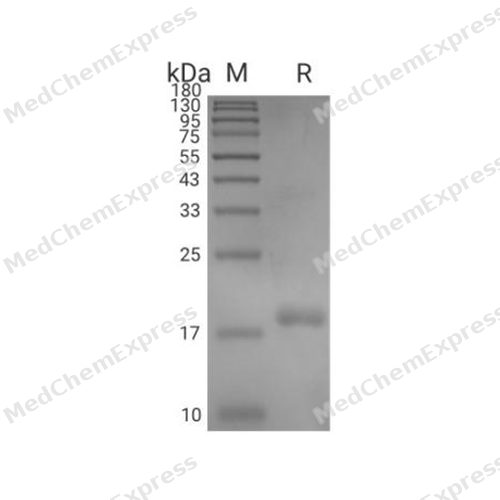
Purity - SDS-PAGE


Technical Parameters
-
Species Human
-
Source E. coli
-
Tag N-6*His
-
Accession
P14136-1 (L292-M432)
-
Molecular Construction
-
N-term
-
6*His
-
GFAP (L292-M432)
Accession # P14136-1 -
C-term
-
-
Protein Length
Partial
-
Synonyms
GFAP; Intermediate Filament Protein; Glial Fibrillary Acidic Protein; ALXDRD; FLJ45472
-
AA Sequence
LTCDLESLRGTNESLERQMREQEERHVREAASYQEALARLEEEGQSLKDEMARHLQEYQDLLNVKLALDIEIATYRKLLEGEENRITIPVQTFSNLQIRETSLDTKSVSEGHLKRNIVVKTVEMRDGEVIKESKQEHKDVM
-
Predicted Molecular Mass
18.7 kDa
-
Molecular Weight
Approximately 17 kDa, based on SDS-PAGE under reducing conditions.
-
Purity
≥ 95%, as determined by reducing SDS-PAGE.


Product Properties
Lyophilized powder.
Lyophilized from a 0.2 μm filtered solution of PBS, pH 7.4.
<1 EU/μg, determined by LAL method.
It is not recommended to reconstitute to a concentration less than 100 μg/mL in ddH2O. For long term storage it is recommended to add a carrier protein (0.1% BSA, 5% HSA, 10% FBS or 5% Trehalose).
Stored at -20°C for 2 years from date of receipt. After reconstitution, it is stable at 4°C for 1 week or -20°C for longer (with carrier protein). It is recommended to freeze aliquots at -20°C or -80°C for extended storage.
Room temperature in continental US; may vary elsewhere.


Documentation
-
Data Sheet (235 KB)
-
SDS (251 KB)
- English - EN (251 KB)
- Français - FR (251 KB)
- Deutsch - DE (251 KB)
- Norwegian - NO (251 KB)
- Español - ES (251 KB)
- Swedish - SV (251 KB)
- Italian - IT (251 KB)
- Korean - KR (251 KB)
- Portuguese - PT (251 KB)
-
Handling Instructions (2659 KB)

Calculators
Concentration (start) × Volume (start) = Concentration (final) × Volume (final)


 Powered by Bioz

