



GM-CSF Protein, Human (CHO)
Based on 1 Customer Validation
GM-CSF Protein is a hematopoietic growth factor and immunomodulator. By binding to specific receptors on the surface of target cells, GM-CSF Protein activates intracellular signaling pathways to regulate cell proliferation, differentiation, maturation, and function. GM-CSF Protein plays an important role in the hematopoietic process and the immune system. GM-CSF Protein, Human (CHO) is a recombinant GM-CSF Protein expressed by CHO without a tag.
- Species: Human
- Source: CHO
-
Storage:Stored at -20°C for 2 years from date of receipt. After reconstitution, it is stable at 4°C for 1 week or -20°C for longer (with carrier protein). It is recommended to freeze aliquots at -20°C or -80°C for extended storage.


To place orders, for customer services and technical support, please contact: MedChemExpress USA
Tel: 609-228-6898 E-mail: [email protected] [email protected]


-
 Biological Activity
-
Technical Parameters
-
Product Properties
- Documentation
- References
- Help & FAQs


-

HY-P7050A
M-CSF Protein, Human (CHO) -
HY-P7042
IL-4 Protein, Human (CHO) -
HY-P78868
GM-CSF Protein, Human (HEK293) -
HY-90006
5-Fluorouracil -
HY-P7069
GM-CSF Protein, Mouse (CHO) -
HY-P70543
TGF beta 1/TGFB1 Protein, Human (HEK293) -
HY-P7030A
IL-10 Protein, Human (CHO) -
HY-10583
Y-27632 dihydrochloride -
HY-P70445
IL-4 Protein, Human -
HY-15531
Venetoclax -

HY-K0301
Cell Counting Kit-8 -
HY-P7085A
M-CSF Protein, Mouse (CHO)


Biological Activity
Description
GM-CSF Protein is a hematopoietic growth factor and immunomodulator. By binding to specific receptors on the surface of target cells, GM-CSF Protein activates intracellular signaling pathways to regulate cell proliferation, differentiation, maturation, and function. GM-CSF Protein plays an important role in the hematopoietic process and the immune system. GM-CSF Protein, Human (CHO) is a recombinant GM-CSF Protein expressed by CHO without a tag[1][2][3][4].
Background
GM-CSF is a cytokine secreted by various cells (such as T cells, monocytes, endothelial cells, etc.), playing an important role in the immune system and hematopoietic process. GM-CSF can stimulate the proliferation and differentiation of precursor cells of granulocytes (such as neutrophils and eosinophils) and macrophages in the bone marrow, promoting the production of mature blood cells. GM-CSF can also activate mature granulocytes and macrophages, enhancing their phagocytic ability, bactericidal activity, and antigen-presenting function, and participating in innate and adaptive immune responses. In addition, GM-CSF also has pro-inflammatory activity[1][2][3][4].
In Vitro
GM-CSF Protein (Human; 1% v/v; 7-10 days) can promote the proliferation of acute myeloid leukemia colony-forming cells (AML-CFU)[5].
In Vivo
GM-CSF Protein (Human; 50 U/min/kg; continuous intravenous/subcutaneous infusion; 7-28 days) significantly increases white blood cell counts and bone marrow cellularity in healthy cynomolgous macaques and pancytopenic immunodeficient rhesus macaques, with indices returning to normal after drug withdrawal[6].
Verified Bioactivity
The ED50 is <0.2 ng/mL as measured iby TF-1 cells, corresponding to a specific activity of >5 × 10⁶ units/mg.
MCE Validation Data
-
Purity - SDS-PAGE
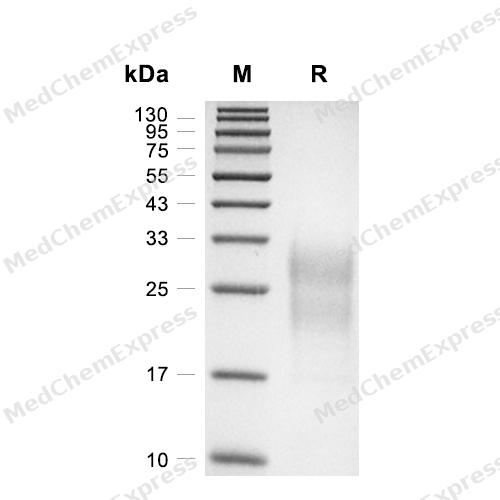
Purity - SDS-PAGE
-
Bioactivity - Cell-Based Assay
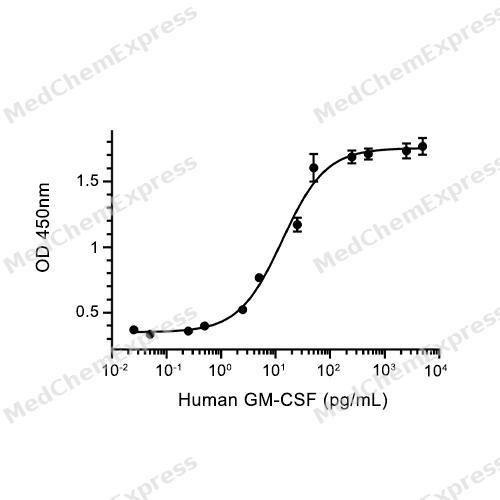
Bioactivity - Cell-Based Assay


Technical Parameters
-
Species Human
-
Source CHO
-
Tag Tag Free
-
Accession
P04141 (A18-E144)
-
Molecular Construction
-
N-term
-
GM-CSF (A18-E144)
Accession # P04141 -
C-term
-
-
Protein Length
Full Length of Mature Protein
-
Synonyms
CSF2; Molgramostim; Colony Stimulating Factor 2; Molgramostin; GMCSF; CSF; Sargramostim; Granulocyte-Macrophage Colony Stimulating Factor; GM-CSF; Granulocyte Macrophage-Colony Stimulating Factor; Colony Stimulating Factor 2 (Granulocyte-Macrophage); Colo
-
AA Sequence
APARSPSPSTQPWEHVNAIQEARRLLNLSRDTAAEMNETVEVISEMFDLQEPTCLQTRLELYKQGLRGSLTKLKGPLTMMASHYKQHCPPTPETSCATQIITFESFKENLKDFLLVIPFDCWEPVQE
-
Predicted Molecular Mass
14.5 kDa
-
Molecular Weight
Approximately 22-28 kDa, based on SDS-PAGE under non reducing (N) conditions.
-
Glycosylation
Yes
-
Purity
≥ 95%, as determined by reducing SDS-PAGE.


Product Properties
Lyophilized powder
1.Lyophilized from a 0.22 μm filtered solution of PBS.
2.Lyophilized from a 0.22 μm filtered solution of PBS, pH 7.4, 8% trehalose.
Please refer to the lot-specific COA for specific buffer information.
<0.2 EU/μg, determined by LAL method.
It is not recommended to reconstitute to a concentration less than 100 μg/mL in ddH2O. For long term storage it is recommended to add a carrier protein (0.1% BSA, 5% HSA, 10% FBS or 5% Trehalose).
Stored at -20°C for 2 years from date of receipt. After reconstitution, it is stable at 4°C for 1 week or -20°C for longer (with carrier protein). It is recommended to freeze aliquots at -20°C or -80°C for extended storage.
Room temperature in continental US; may vary elsewhere.


Documentation
-
SDS (252 KB)
- English - EN (252 KB)
- Français - FR (252 KB)
- Deutsch - DE (252 KB)
- Norwegian - NO (252 KB)
- Español - ES (252 KB)
- Swedish - SV (252 KB)
- Italian - IT (252 KB)
- Korean - KR (252 KB)
- Portuguese - PT (252 KB)
-
Handling Instructions (2659 KB)


References
[1]. Shi Y, et al. Granulocyte-macrophage colony-stimulating factor (GM-CSF) and T-cell responses: what we do and don't know. Cell Res. 2006 Feb;16(2):126-33. [Content Brief]
[2]. Gasson JC, et al. Human granulocyte-macrophage colony-stimulating factor (GM-CSF): regulation of expression. Prog Clin Biol Res. 1990;338:27-41. [Content Brief]
[3]. Gomez-Cambronero J, et al. Granulocyte-macrophage colony-stimulating factor is a chemoattractant cytokine for human neutrophils: involvement of the ribosomal p70 S6 kinase signaling pathway. J Immunol. 2003 Dec 15;171(12):6846-55. [Content Brief]
[4]. Shiomi A, et al. GM-CSF as a therapeutic target in autoimmune diseases. Inflamm Regen. 2016 Jul 5;36:8. [Content Brief]
[5]. Griffin JD, et al. Effects of recombinant human GM-CSF on proliferation of clonogenic cells in acute myeloblastic leukemia. Blood. 1986 May;67(5):1448-53. [Content Brief]
[6]. Donahue RE, et al. Stimulation of haematopoiesis in primates by continuous infusion of recombinant human GM-CSF. Nature. 1986 Jun 26-Jul 2;321(6073):872-5. [Content Brief]

Calculators
Concentration (start) × Volume (start) = Concentration (final) × Volume (final)


 Powered by Bioz

