



M-CSF Protein, Mouse (CHO)
Based on 10 publication(s) in Google Scholar
M-CSF Protein, Mouse (CHO) is a pro-inflammatory cytokine, binds to its receptor CSF1R, and is involved in the development and proliferation of cells of the monocyte/macrophage lineage and participates in the induction of osteoclasts which are important in the destruction of bone and cartilage and in the periarticular osteoporotic changes.
- Species: Mouse
- Source: CHO
-
Storage:Stored at -20°C for 2 years from date of receipt. After reconstitution, it is stable at 4°C for 1 week or -20°C for longer (with carrier protein). It is recommended to freeze aliquots at -20°C or -80°C for extended storage.


To place orders, for customer services and technical support, please contact: MedChemExpress USA
Tel: 609-228-6898 E-mail: [email protected] [email protected]


-
 Biological Activity
-
Technical Parameters
-
Product Properties
- Documentation
- References
- Help & FAQs


-

HY-P73388
RANKL/TNFSF11 Protein, Mouse (HEK293, Fc) -
HY-P7080
IL-4 Protein, Mouse (CHO) -
HY-P70460
IL-13 Protein, Mouse -
HY-P7361
GM-CSF Protein, Mouse -
HY-P7050A
M-CSF Protein, Human (CHO) -
HY-P7069
GM-CSF Protein, Mouse (CHO) -
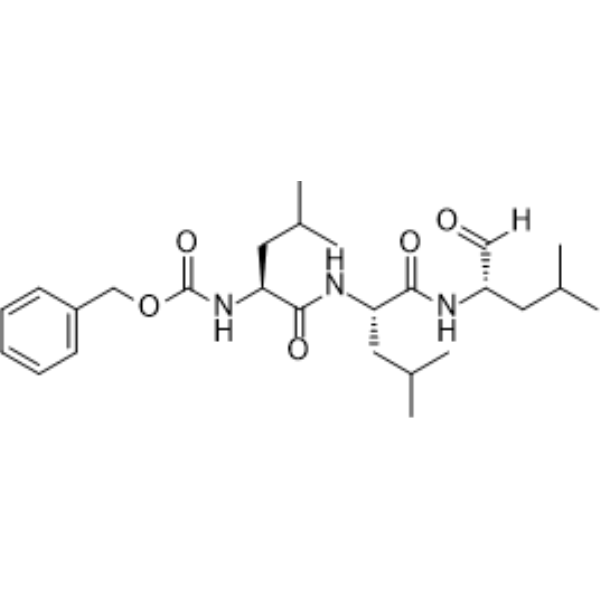
HY-13259
MG-132Proteasome Inhibitor -
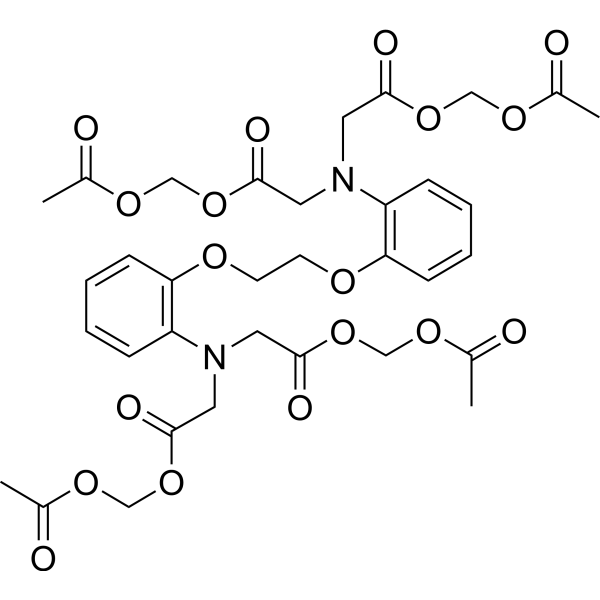
HY-100545
BAPTA-AMCa2+ Chelator -
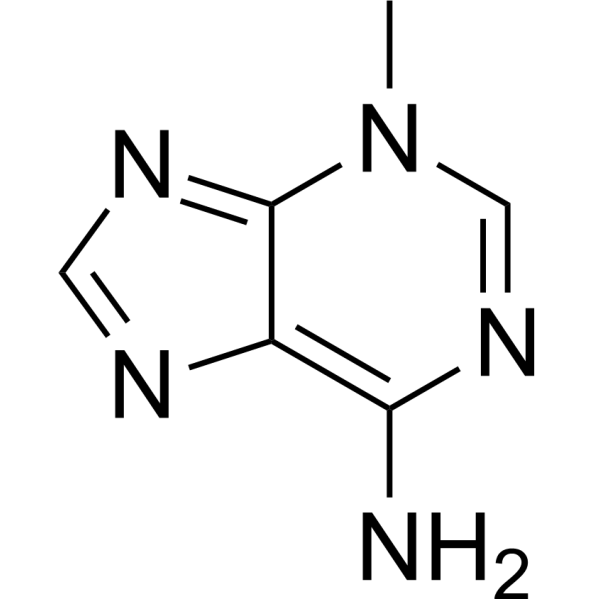
HY-19312
3-MethyladenineAutophagy/PI3K Inhibitor -
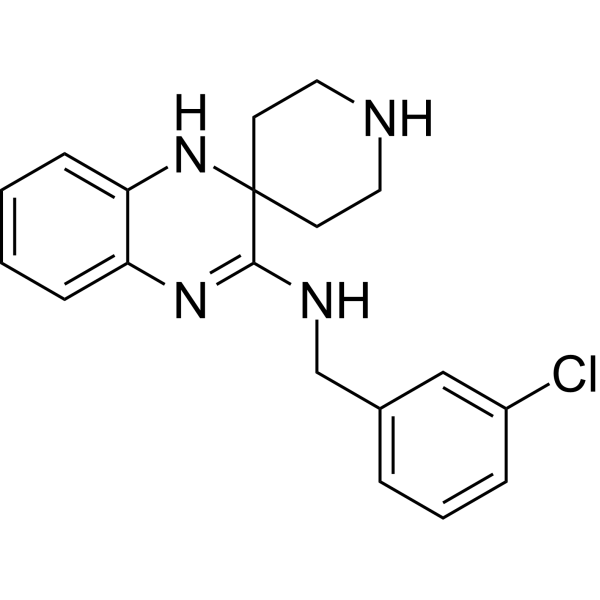
HY-12726
Liproxstatin-1Ferroptosis Inhibitor -
HY-B2176
ATPEndogenous Metabolite -

HY-W250978
OvalbuminsAllergen


Biological Activity
Description
M-CSF Protein, Mouse (CHO) is a pro-inflammatory cytokine, binds to its receptor CSF1R, and is involved in the development and proliferation of cells of the monocyte/macrophage lineage and participates in the induction of osteoclasts which are important in the destruction of bone and cartilage and in the periarticular osteoporotic changes.
Background
Macrophage Colony Stimulating Factor (M-CSF) is a pro-inflammatory cytokine, constitutively produced by several cell types, such as fibroblasts, endothelial cells, stromal cells, macrophages, smooth muscle cells and osteoblasts, binds to its receptor CSF1R, and exists in several isoforms- as a secreted glycoprotein, a cell-surface protein and a proteoglycan[1]. M-CSF is involved in the development and proliferation of cells of the monocyte/macrophage lineage and participates in the induction of osteoclasts, which are important in the destruction of bone and cartilage and in the periarticular osteoporotic changes seen in patients with rheumatoid arthritis[2].
Verified Bioactivity
The ED50 is <3 ng/mL as measured by murine M-NFS-60 cells, corresponding to a specific activity of >3.3 × 10⁵ units/mg.
MCE Validation Data
-
Purity - SDS-PAGE
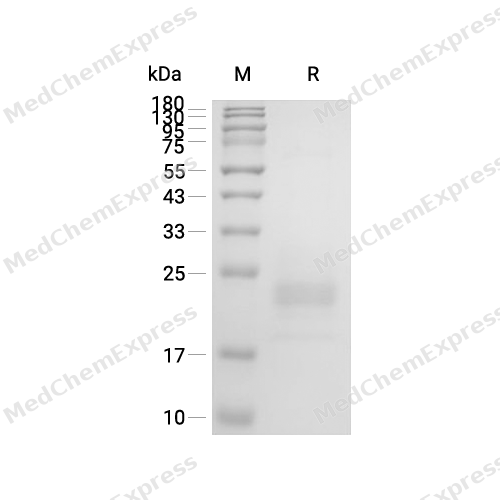
Purity - SDS-PAGE
-
Bioactivity - Cell-Based Assay
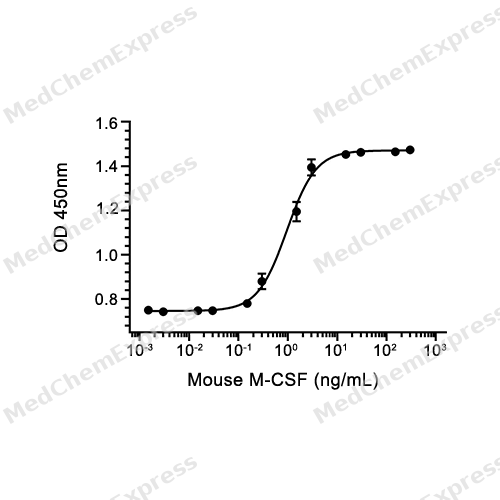
Bioactivity - Cell-Based Assay


Publications (10)
-
Journal Impact Factor
-
Most Recent
-
Nat Commun
ITGB6 modulates resistance to anti-CD276 therapy in head and neck cancer by promoting PF4+ macrophage infiltration. [Abstract]2024 Aug 16;15(1):7077. PMID: 39152118 -
Oncogene
IL-17RA/CTSK axis mediates H. pylori-induced castration-resistant prostate cancer growth. [Abstract]2024 Nov;43(49):3598-3616. PMID: 39424989 -
Commun Biol
Zingerone treats postmenopausal osteoporosis via increased ferroptosis sensitivity by p53-mediated regulation of SAT1 and GPX4 expression. [Abstract]2025 Sep 26;8(1):1367. PMID: 41006700 -
Int Immunopharmacol
TREM2 Insufficiency Protects against Pulmonary Fibrosis by Inhibiting M2 Macrophage Polarization. [Abstract]2023 May:118:110070. PMID: 37003186 -
Mol Med Rep
Exosomal miR‑3681‑3p from M2‑polarized macrophages confers cisplatin resistance to gastric cancer cells by targeting MLH1. [Abstract]2025 Apr;31(4):94. PMID: 39981936 -
Biochim Biophys Acta Mol Basis Dis
Inhibition of macrophage-derived foam cells by Adipsin attenuates progression of atherosclerosis. [Abstract]2022 Sep 5;1868(12):166533. PMID: 36064133 -
Immunol Lett
Heparanase inhibition mitigates bleomycin-induced pulmonary fibrosis in mice by reducing M2 macrophage polarization. [Abstract]2025 Aug:274:107006. PMID: 40180131 -
Exp Ther Med
LPS inhibits TRIM65 expression in macrophages and C57BL/6J mouse by activating the ERK1/2 signaling pathway. [Abstract]2023 Mar 14;25(4):188. PMID: 37021067 -
Kidney Blood Press Res
Nobiletin from Xiaoyu Xiezhuo Decoction: Restoring Mitochondrial Dynamics and Alleviating Renal Ischemia-Reperfusion Injury via M1 Macrophage Modulation. [Abstract]2026 Mar 17:1-18. PMID: 41843713 -


Technical Parameters
-
Species Mouse
-
Source CHO
-
Tag Tag Free
-
Accession
P07141-1 (K33-P187)
-
Molecular Construction
-
N-term
-
M-CSF (K33-P187)
Accession # P07141-1 -
C-term
-
-
Protein Length
Partial Extracellular Domain
-
Synonyms
CSF1; Macrophage Colony Stimulating Factor 1; Colony Stimulating Factor 1; Lanimostim; MCSF; MGC31930; Proteoglycan Macrophage Colony-Stimulating Factor; PG-M-CSF; Macrophage Colony-Stimulating Factor 1; CSF-1; M-CSF; CSF1-HERV-LTR71B Fusion Protein; Colo
-
AA Sequence
KEVSEHCSHMIGNGHLKVLQQLIDSQMETSCQIAFEFVDQEQLDDPVCYLKKAFFLVQDIIDETMRFKDNTPNANATERLQELSNNLNSCFTKDYEEQNKACVRTFHETPLQLLEKIKNFFNETKNLLEKDWNIFTKNCNNSFAKCSSRDVVTKP
-
Molecular Weight
Approximately 18-30 kDa under reduced (R) conditions, 35-44 kDa under non reducing (N) conditions, based on SDS-PAGE, due to the glycosylation.
-
Glycosylation
Yes
-
Structure/Form
Disulfide-linked homodimer
-
Purity
≥ 95%, as determined by reducing SDS-PAGE.


Product Properties
Lyophilized powder
1.Lyophilized from a 0.22 μm filtered solution of PBS, pH 7.4.
2.Lyophilized from a 0.22 μm filtered solution of PBS, pH 7.4, 8% trehalose.
Please refer to the lot-specific COA for specific buffer information.
<0.2 EU/μg, determined by LAL method.
It is not recommended to reconstitute to a concentration less than 100 μg/mL in ddH2O. For long term storage it is recommended to add a carrier protein (0.1% BSA, 5% HSA, 10% FBS or 5% Trehalose).
Stored at -20°C for 2 years from date of receipt. After reconstitution, it is stable at 4°C for 1 week or -20°C for longer (with carrier protein). It is recommended to freeze aliquots at -20°C or -80°C for extended storage.
Room temperature in continental US; may vary elsewhere.


Documentation
-
Data Sheet (262 KB)
-
SDS (252 KB)
- English - EN (252 KB)
- Français - FR (252 KB)
- Deutsch - DE (252 KB)
- Norwegian - NO (252 KB)
- Español - ES (252 KB)
- Swedish - SV (252 KB)
- Italian - IT (252 KB)
- Korean - KR (252 KB)
- Portuguese - PT (252 KB)
-
Handling Instructions (2659 KB)


References
[1]. Hamilton JA. Colony-stimulating factors in inflammation and autoimmunity. Nat Rev Immunol. 2008 Jul;8(7):533-44. [Content Brief]
[2]. Rioja I, et al. Potential novel biomarkers of disease activity in rheumatoid arthritis patients: CXCL13, CCL23, transforming growth factor alpha, tumor necrosis factor receptor superfamily member 9, and macrophage colony-stimulating factor. Arthritis Rheum. 2008 Aug;58(8):2257-67. [Content Brief]

Calculators
Concentration (start) × Volume (start) = Concentration (final) × Volume (final)


 Powered by Bioz

